
[stock_market_widget type=”card” template=”basic2″ assets=”AVGO” realtime=”true” api=”yahoo-finance”]
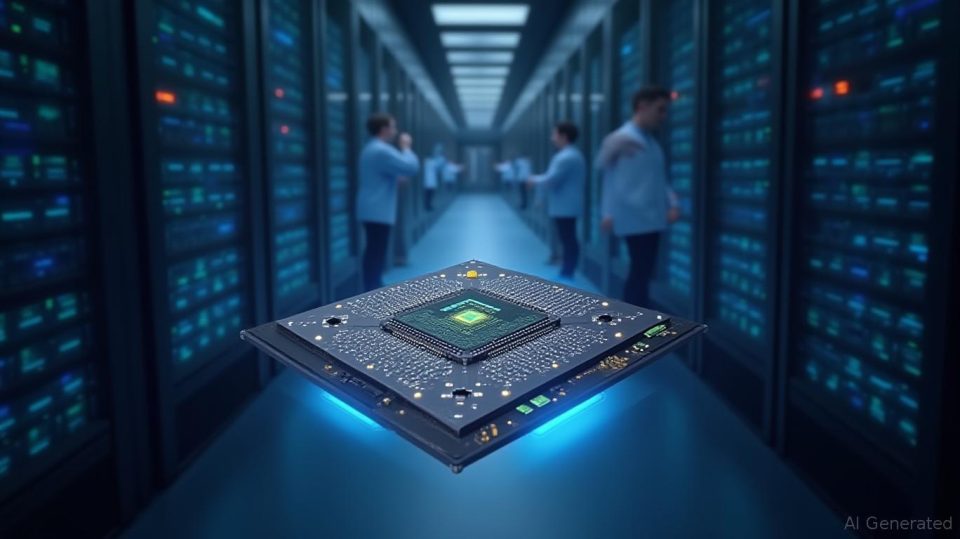
This week, Broadcom Inc. (NASDAQ: AVGO) unveiled its newest weapon in the fast-evolving artificial intelligence hardware contest. The new networking processor, called the Tomahawk Ultra, is designed to accelerate the pace at which AI can crunch data by linking together vast numbers of chips as part of a single system. The stakes here are high. Everyone in tech knows that AI juggernaut Nvidia (NASDAQ: NVDA) is the yardstick when it comes to building clusters of high-performance chips for data centers. For the first time in quite a while, Broadcom has delivered a chip that’s designed to go head-to-head with Nvidia’s proprietary interconnect technology, and try to loosen its grip.
What makes this news ripple through the industry isn’t just that Broadcom has released another networking chip. Rather, it is the way Tomahawk Ultra shifts the conversation about how the next generation of AI hardware gets built. Most AI models today rely on architectures where hundreds or even thousands of processors pass information to one another, often within a single server rack. This makes ultra-fast communication between chips vital. Even with mind-bending advances in chip design, you’re only as fast as your weakest bandwidth bottleneck. Broadcom’s new chip aims to tackle exactly that point.
The Tomahawk Ultra is fundamentally a traffic manager for AI data, sitting at the crossroads and ensuring the thousands of chips in a modern data center don’t get bogged down. Where Nvidia’s NVLink Switch is the dominant player in this slice of the market, Tomahawk Ultra brings two changes to the table. First, it claims it can connect four times as many chips as Nvidia’s competing solution. Second, it does this over an enhanced version of Ethernet, rather than a proprietary transfer protocol. In theory, this could give tech companies that value industry standards and flexibility far more options when constructing their AI clusters.
One reason people have grown wary of Nvidia’s overwhelming popularity is exactly this point, everyone is locked onto one vendor, relying on Nvidia to set the rules for programming and scaling up the compute clusters that run large-scale AI. Nvidia’s CUDA platform and InfiniBand interconnect are excellent but restrictive. By contrast, Broadcom’s approach leverages Ethernet, which has been the networking backbone in data centers for decades. If the Tomahawk Ultra works as advertised, any company capable of building server racks with standard Ethernet wiring could string together more chips at lower expense and without having to rewrite their entire software stack.
What about performance? The Tomahawk Ultra is manufactured by Taiwan Semiconductor Manufacturing using advanced five-nanometer process technology, which puts it on the cutting edge in terms of raw fabrication. While Nvidia is synonymous with graphics processors (GPUs) and has an unmatched grip on the market for training and running AI models, Broadcom’s move targets a crucial flank, how those GPUs talk to one another. If you can speed up data movement, you provide the infrastructure for faster and more capable AI systems across industries.
Broadcom’s role doesn’t end with its own branded gear. The company has been a key partner for Alphabet’s Google (NASDAQ: GOOGL), helping the search giant develop custom AI chips for Google Cloud. Developers and tech pros increasingly recognize Google’s chips as the only serious challenger to Nvidia’s hardware, and Broadcom sits at the heart of that collaboration. It is worth nothing that Broadcom’s client list also includes other tech titans exploring their own solutions, signaling that demand is far from confined to a single product or partnership.
Industry watchers expect that Tomahawk Ultra and the broader Tomahawk 6 series mark Broadcom’s most significant push yet into AI infrastructure. The new chip can support connections for large numbers of GPUs or other compute accelerators within a small physical space, which could change how hyperscale data centers are built in the years ahead. Critics will point out that Nvidia retains key advantages, especially in software and end-to-end control of its ecosystem. But Broadcom’s commitment to open standards and interoperability with existing hardware make their play in the AI networking space all the more interesting.
As AI continues to drive unprecedented demand for computing power and data movement, it is no longer just about the fastest chip in isolation, but about how these chips come together to learn, reason, and generate. With Tomahawk Ultra, Broadcom is shifting the conversation to networked AI systems and challenging the market to rethink where innovation can come from next.
