
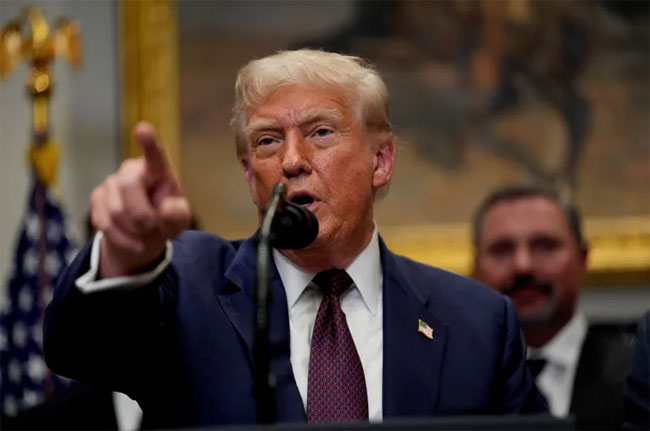
President Donald Trump just triggered a major reset in international trade policy, upending patterns that many businesses and governments had spent years, if not decades, trying to navigate. On Thursday, the White House revealed a sweeping overhaul of so-called “reciprocal” tariffs that will hit dozens of America’s trading partners, with new levies ranging from 10% all the way up to 41% in some cases. For countries struggling to strike a new trade deal with Washington, time has effectively run out, most of these duties are set to start going into effect within the next week.
The numbers in the executive order are eye-popping by any standard. Canada, longtime trading partner and next-door neighbor, now faces a 35% tariff on a broad array of exports to the U.S., up from a previous mark of 25%. India lands at 25%, Taiwan at 20%, and South Africa at 30%, just to name a few. Countries left out of the White House’s executive order get off with a 10% baseline, which is still high compared to what’s been typical in recent decades. But that’s not all. In an uncommon move aimed at closing what the administration sees as loopholes, Trump’s order threatens a 40% penalty tariff on goods the U.S. determines have been “transshipped” through other countries, a particularly pointed warning to those trying to sidestep tariffs by rerouting their exports.
While the economic rationale behind the moves is framed around reducing trade deficits and compelling fairer treatment for American industry, the rollout has been dizzying. Trump told NBC News he’d still consider “compelling offers” from foreign capitals but insisted for most, especially those who “acted too late,” the window has closed. Many major trade partners remain unsure if these rates are locked in or just another step in an ongoing negotiation saga. That’s led to a mood of whiplash both inside financial markets and among policymakers.
The immediate reactions from overseas have ranged from confusion to alarm. Asian leaders, for example, are still parsing what it all means. Cambodia, which saw its levy rate cut to 19% from a prior 49%, struck a celebratory tone, though the broader region sounded much more cautious. Thailand, facing a 19% tariff, publicly thanked Washington for maintaining trade ties but also stressed the difficulty these changes bring to planning and investment.
Europe, which faced the initial “Liberation Day” tariffs in the spring, voiced disappointment at what it sees as an abrupt and unilateral step. Switzerland is hit at 39%, one of the stiffest penalties on the board. Even countries who have managed to secure the minimum 10% are hardly breathing easy, worried about the precedent such a dramatic shift sets for future U.S. policy.
Back home, the response from analysts and investors has been starkly negative. Stocks in the U.S., Europe and Asia fell as traders scrambled to assess which companies stand to benefit and which are left exposed. “There are no true victors in this situation,” a Westpac economist told Reuters, calling the moves “just the start of new and unpredictable global trade framework.” Defensive companies focused on domestic markets may avoid the carnage, but the broader impact is likely to be higher prices for consumers and disruptions running across industries.
For businesses who depend on international supply chains, the reality is a scramble. Many are bracing for higher input costs, delayed shipments and a surge in compliance headaches as governments rush to work out how these sweeping new tariffs will be enforced in practice. For allies, the hope is that the turbulence dies down and meaningful negotiations resume. But the U.S. trade stance looks much less predictable than before, and most are simply along for the ride.
The next week will bring the first evidence of whether Washington’s new approach succeeds in shifting trade balances, or whether it simply ushers in another round of global economic uncertainty.
