
[stock_market_widget type=”card” template=”basic2″ assets=”AC.TO” realtime=”true” api=”yahoo-finance”]
Air Canada (TSX: AC, OTCQX: ACDVF) and the union representing its flight attendants have reached a tentative agreement to end a strike that started on Saturday and lasted several days, causing hundreds of flight cancellations and affecting around 500,000 passengers. With the new deal in place, the airline is set to gradually resume flights, though full-service recovery is expected to take up to 10 days as aircraft and crews realign.
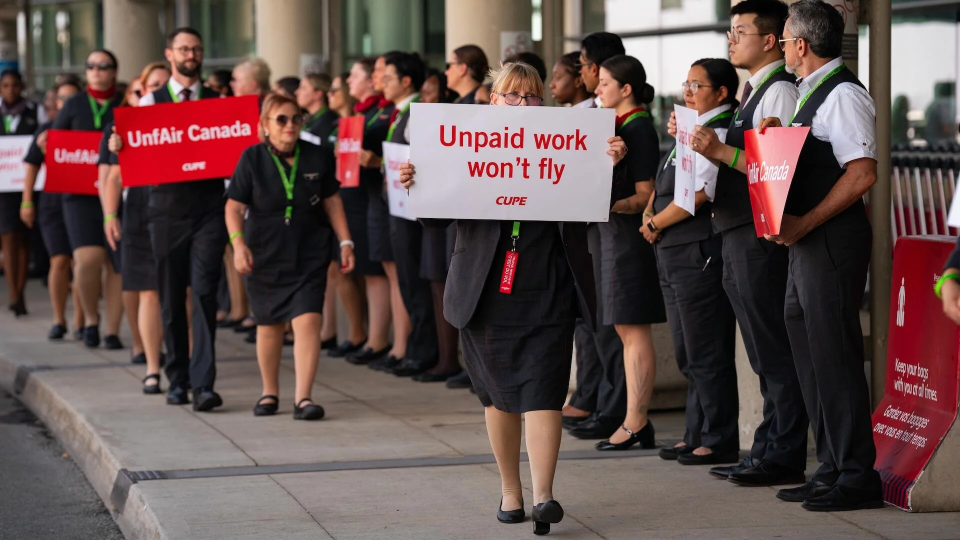
The strike, the first by Air Canada’s flight attendants in 40 years, involved roughly 10,000 cabin crew members represented by the Canadian Union of Public Employees (CUPE). They walked out over pay disputes and compensation for duties performed while on the ground before flights, such as boarding, which traditionally are unpaid. The union has long pushed for better recognition and pay for these activities, which are common sources of frustration among flight attendants industry wide.
Negotiations resumed late Monday night following intervention by a federal mediator, after the Canada Industrial Relations Board had declared the strike illegal and issued orders for the attendants to return to work. CUPE defied those orders in a show of determination, with union leaders vowing to continue until a fair contract was secured. Early Tuesday, the union announced a preliminary deal had been reached and urged members to cooperate fully with the resumption of airline services.
Air Canada’s offer included a pay increase package averaging 38% over four years, with 25% of that increase applied in the first year. This was an improvement from earlier offers but was initially rejected by the union as insufficient, partly because it did not cover all ground-based work hours. The new agreement notably addresses this issue, putting an end to what CUPE describes as “unpaid work,” which they consider a historic win not just for Air Canada attendants but for the industry as a whole.
Michael Rousseau, Air Canada’s President and Chief Executive Officer, acknowledged the disruption caused by the strike. He extended apologies to customers for the widespread travel interruptions and said the airline’s top priority now is to get passengers moving again as quickly as possible. He cautioned travelers to only go to airports if their flights are confirmed to be operating, as some cancellations and delays will persist during the phased restart.
The strike resulted in over 700 flight cancellations daily at its peak, grounding flights at Air Canada and its low-cost subsidiary, Air Canada Rouge, which typically carry about 130,000 passengers per day. The airline said it would provide full refunds or credits to those affected by cancellations and is also offering to rebook travelers on alternate carriers where capacity exists, though options remain limited due to the busy summer travel season.
CUPE’s air component secretary and treasurer praised the agreement as transformative, citing it as a turning point for Canadian flight attendants who fought against longstanding industry norms. The union highlighted that their members’ right to vote on the new contract terms was secured, preserving democratic participation despite the high stakes of the labor dispute.
The tentative deal must now be ratified by the union members before it takes full effect. Should the vote fail, the strike could resume. For the moment, however, both sides appear committed to moving forward, and the labor stalemate that disrupted travel plans nationwide seems to have reached its conclusion.
This agreement marks a rare breakthrough in airline labor relations amid a time when the travel industry is trying to recover from the pandemic’s impact while managing rising costs and inflation pressures. Air Canada’s experience reflects broader challenges faced by carriers worldwide in balancing financial sustainability and workforce demands.
The airline’s phased restart plan is expected to take up to ten days before schedules stabilize and regular service capacity returns, as equipment and crews are gradually brought back into place. Passengers with valid bookings that are confirmed to be operating should monitor airline communications carefully before heading to the airport.
