
[stock_market_widget type=”card” template=”basic” color=”#5679FF” assets=”ORSTED.CO” realtime=”true” api=”yahoo-finance”]
Danish energy company Orsted (Copenhagen: ORSTED.CO) has launched a significant legal challenge against the Trump administration after a stop-work order abruptly halted its Revolution Wind offshore project near Rhode Island. The decision, made in late August, paused construction on a project that was already 80% complete with substantial investments and infrastructure in place. The company’s shares plunged about 30% the day the order was announced, reaching record lows and rattling investor confidence. This move reignites debates about U.S. energy policy, renewable investment stability, and the political environment surrounding offshore wind development.
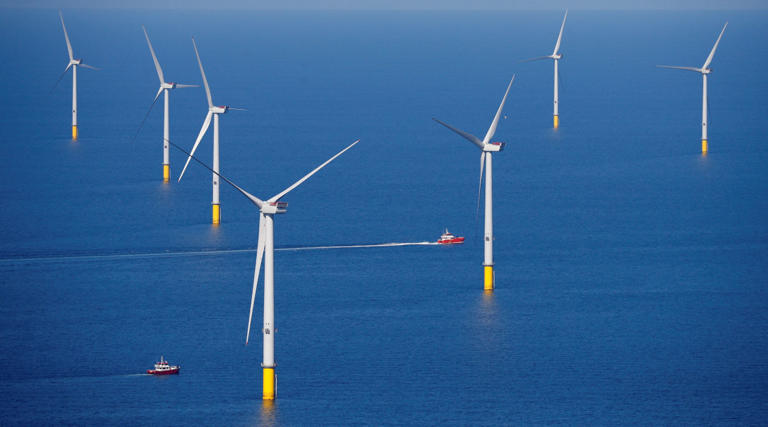
The Revolution Wind project, a joint venture between Orsted and Skyborn Renewables, has seen some $5 billion invested and was poised to deliver 704 megawatts of clean energy to approximately 350,000 homes in New England. With foundations already installed and 45 out of 65 wind turbines erected, the sudden stop caused both financial strain and operational uncertainty. Orsted and Skyborn claimed the stop-work order lacked legal authority, was arbitrary, and challenged the procedural validity, prompting their lawsuit in U.S. District Court in Washington, D.C.
The Trump administration’s Bureau of Ocean Energy Management cited national security concerns, particularly fears around offshore operations potentially being used to mask undersea drone activities. However, state officials, labor unions, and clean energy advocates have criticized this reasoning as vague and baseless, warning about the chilling effect on investments and job losses, including the potential impact on roughly 1,000 union jobs tied to the project. The states of Rhode Island and Connecticut have also joined the lawsuit, highlighting concerns over the disruption to energy supplies and the broader implications for the offshore wind industry in the United States.
For Orsted, Revolution Wind was more than just a project. It represented a critical step in scaling up offshore wind in what is considered one of the largest emerging markets for renewable energy. Its abrupt halt comes against a backdrop of increasing political resistance in the U.S., with previous actions under the Trump administration that curtailed leasing and permitting, rolled back tax credits, and scrutinized imported turbine components with potential tariffs. These moves have introduced a volatile regulatory environment that threatens to undermine confidence in clean energy investments across the board.
Financially, the stop-work order comes at a challenging moment for Orsted. The company recently held an emergency shareholder meeting to approve an approximately $9.4 billion (60 billion Danish kroner) rights issue aimed at stabilizing its finances amid falling share prices and mounting costs associated with regulatory hurdles and project delays. The stopped Revolution Wind project alone is expected to face at least an additional $1 billion in costs should the stoppage persist. Furthermore, other U.S. projects under Orsted’s portfolio and its partners’ stakes face increased uncertainty due to expanding governmental scrutiny and permit reviews.
Orsted’s legal battle centers on claims that the stop-work order violates the Administrative Procedure Act and the Fifth Amendment’s Due Process Clause. The company argues the government overstepped its authority by halting a fully permitted project with extensive state and federal approvals gained over nearly a decade of regulatory processes. This case is closely watched as a potential precedent for how far federal agencies can intervene in large renewable energy projects, impacting the willingness of international investors to commit to what was once considered a promising frontier in green energy.
The controversy also casts a spotlight on the shifting dynamics of U.S. energy policy. On one side, the Trump administration has emphasized protecting traditional industry interests and questioned the reliability and environmental impact of offshore wind. On the other, energy grid operators and state governments assert that projects like Revolution Wind are vital to meeting future demand, ensuring grid stability, and reducing carbon emissions. In New England, the regional grid operator has cautioned that delays increase risks to energy reliability, underscoring the strategic importance of offshore wind in supplementing regional energy needs.
Amid these tensions, global offshore wind capacity continues to grow, driven by policies in Europe and Asia, with the U.S. market at a crossroads. If Orsted prevails in court, it could restore momentum for offshore wind development and reaffirm the feasibility of massive clean infrastructure projects in the U.S. Conversely, a continued halt could deter investment and slow progress on climate goals tied to renewable energy expansion.
Orsted has expressed commitment to resolving the dispute quickly and continuing its work toward the project’s completion targeting commercial operation in late 2026. The outcome of this challenge will likely resonate beyond one project, influencing regulatory scrutiny and investor confidence in the U.S. renewable energy sector for years to come.
