
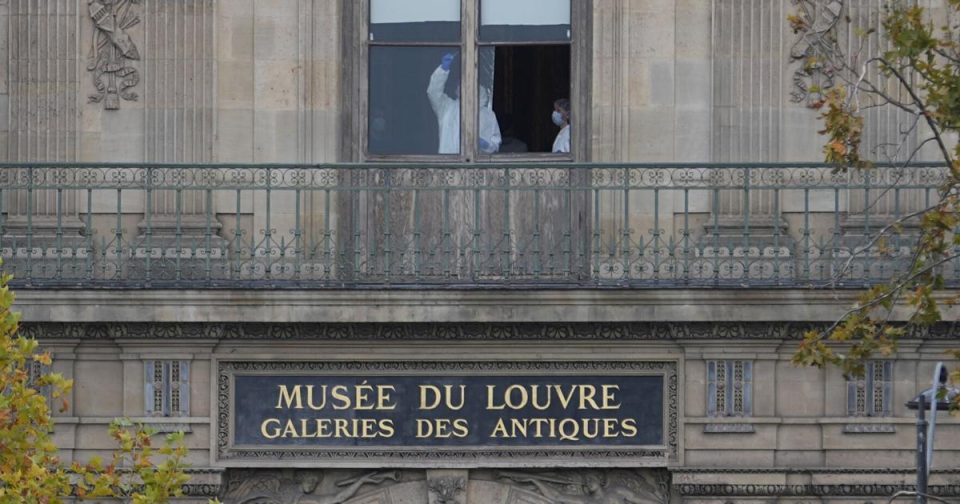
On a quiet Sunday morning in Paris, the Louvre Museum saw one of the most audacious daylight robberies in its history. Just as the museum was opening, four highly skilled thieves executed a plan so swift and precise it has stunned the world. They used a mobile freight elevator fitted with a metal ladder to access an upper-level balcony on the Seine-facing facade. From there, they forced open a window to reach the Apollo Gallery, where France’s historic Napoleonic jewels were displayed. Over the course of only seven minutes, the thieves broke the glass on two state-of-the-art display cases using angle grinders, grabbed nine priceless jewels, and sped away on scooters, leaving chaos behind.
Among the stolen treasures were three of the most valuable and emblematic items tied to France’s imperial past. The first is an emerald necklace, an intricate piece adorned with over 1,000 diamonds, gifted by Napoleon to his second wife, Empress Marie-Louise. This necklace symbolized imperial power and history, embodying more than just its precious stones. Next was the diamond tiara of Empress Eugénie, wife of Napoleon III, a crown jewel set in gold and diamonds that had adorned French royalty. Alongside it was a sapphire and pearl brooch, another exquisite relic from the same era. While the crown of Empress Eugénie was initially stolen, it was later discovered damaged near the museum, underscoring the violence and haste with which the thieves made their escape.
In total, authorities estimate the stolen jewels to be worth around $60 million. This value is not just based on the precious metals and stones but on their historical and cultural significance. According to experts, the recognizable nature of these jewels means the thieves are unlikely to sell them intact, as their provenance is well documented worldwide. Instead, they will likely break down the jewels, melting and separating the gems in hopes of laundering their worth through less traceable means, a race against time for investigators.
The robbery has sent shockwaves through France’s cultural institutions and the global art world. It’s been described as a national tragedy and a direct assault on French heritage. President Emmanuel Macron condemned the theft as an insult to the nation’s history and vowed that the government would pursue every possible lead to recover the treasures and bring the perpetrators to justice. The Louvre itself remained closed for a day following the incident, as security chiefs began an emergency reassessment of protections around these priceless artifacts.
The morning’s events highlighted glaring vulnerabilities in museum security, despite recent upgrades. The thieves’ use of construction-style equipment and a fast getaway on scooters suggested detailed planning and insider knowledge. Law enforcement agencies have launched a nationwide manhunt, combing CCTV footage and tracking the suspects’ escape routes. Items left behind, including angle grinders and a yellow vest, offer clues but no guarantees yet of a quick resolution.
This theft is more than a material loss; it is a cultural blow that ripples through history lovers, investors in heritage assets, and national pride. While the jewels themselves are irreplaceable, the incident serves as a stark reminder of the risks facing institutions that house our collective history. The coming weeks will be crucial as those responsible rush to break apart the stolen treasures, while authorities race to catch them and preserve what they can for future generations.
The Louvre’s Napoleonic jewels were never merely decoration, they are tangible connections to France’s imperial legacy. Their loss in such a brazen daylight robbery challenges museum security standards worldwide and compels a renewed vigilance to protect history from disappearing, piece by piece, in the shadows.
