
[stock_market_widget type=”card” template=”basic2″ assets=”AMZN” realtime=”true” api=”yahoo-finance”]
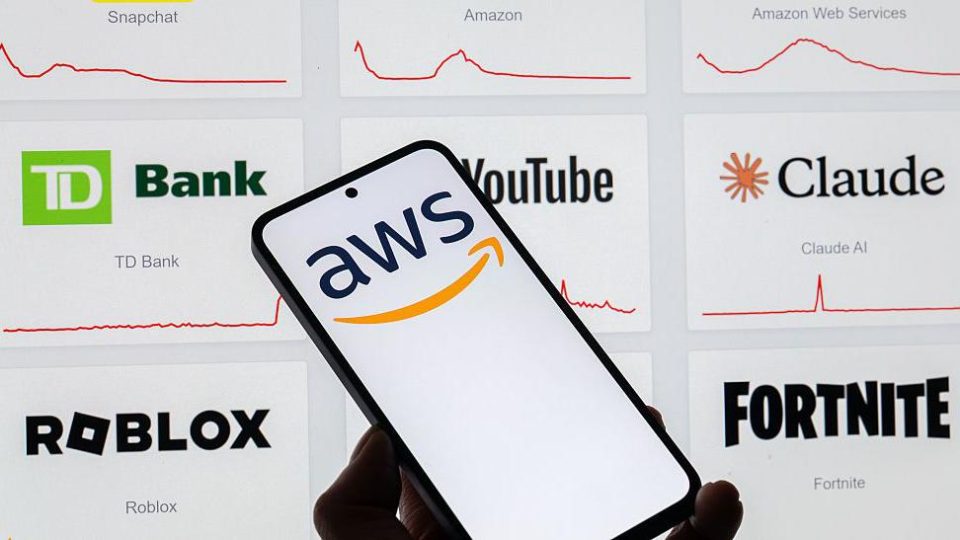
A massive outage at Amazon Web Services (AWS) (NASDAQ: AMZN) earlier this week, briefly disconnected millions from familiar digital platforms, but its deeper impact was a stark reminder of how deeply embedded a single provider has become in daily life. What began as a technical fault in AWS’s US-EAST-1 data center in Northern Virginia quickly rippled across continents, disrupting services from banking and payments to gaming and smart home devices. While major platforms like Snapchat, Reddit, and Fortnite were restored within hours, some financial services including Lloyds Bank and Venmo reported issues lasting into the afternoon, affecting transaction capabilities and customer trust.
The root cause, as later explained by Amazon, stemmed from a flaw in automated systems managing the Domain Name System (DNS) within its largest cloud region. When internal processes fell out of sync, the digital “address book” that directs traffic to the correct servers failed, leaving applications unable to connect. This single point of failure exposed the fragility of systems relying exclusively on one cloud provider, even for critical functions. As Dr. Junade Ali, a software engineer, noted, “faulty automation” broke essential internal systems, rendering even robust applications inoperable if they lacked redundancy.
Beyond the corporate and financial toll, the outage revealed unexpected consumer-level disruptions. Eight Sleep, a maker of internet-connected mattresses, acknowledged that some of its devices overheated or became stuck in an elevated position due to the loss of cloud connectivity. This unusual consequence illustrated how deeply the internet of things has integrated into personal environments, where even a bed relies on continuous cloud access for basic functionality. Similarly, users of Amazon’s own Ring doorbells and Alexa devices reported malfunctions, underscoring that even the provider’s ecosystem is not immune to its own infrastructure failures.
The economic cost of such outages is difficult to quantify precisely but is undoubtedly substantial. While AWS did not disclose financial losses, experts estimate that enterprise downtime can cost thousands of dollars per minute, with broader impacts on productivity, e-commerce, and digital advertising compounding the total. Financial platforms like Coinbase and Robinhood faced trading halts, directly impacting user portfolios and market liquidity during critical hours. The incident prompted renewed discussion in financial and regulatory circles about the risks of concentrated cloud infrastructure, particularly when Wall Street and global banking operations depend on the stability of a handful of technology firms.
The recovery was gradual, with AWS confirming full restoration by 6 p.m. ET, though some backend services continued processing backlogs. The event did not just highlight technical vulnerabilities but also consumer expectations: end users hold brands accountable regardless of where the failure originated. Companies without multi-cloud strategies or failover mechanisms were left exposed, unable to redirect traffic when their primary infrastructure failed. This outage served less as a surprise and more as a confirmation of long-standing concerns about systemic risk in a cloud-dominated world. As reliance on digital infrastructure grows, so does the need for resilience, not just in code, but in architecture and planning.
