
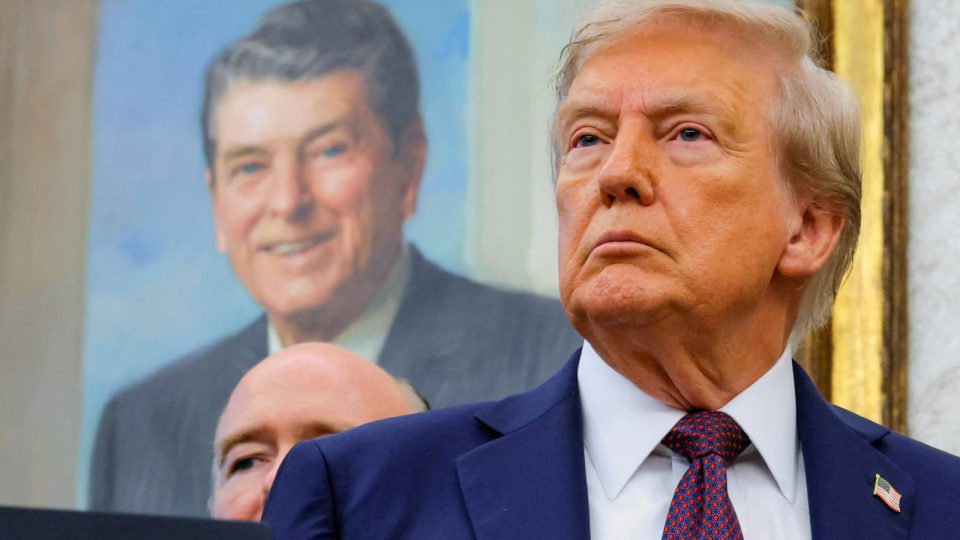
President Donald Trump canceled all trade negotiations with Canada after Ontario aired a television advertisement featuring former President Ronald Reagan criticizing tariffs. The ad, broadcast in Ontario, used excerpts from a 1987 Reagan radio address that warned tariffs might provide short-term gains but ultimately harm workers and consumers in the long run. This move has halted discussions just as the two countries were attempting to resolve ongoing trade tensions stemming from tariffs imposed by the U.S. on Canadian imports.
Trump announced the termination of trade talks on his Truth Social platform, condemning the advertisement as a fraudulent attack designed to interfere with U.S. judicial decisions. He accused the Ontario government of airing what he described as a “fake” ad that misuses Reagan’s words for political purposes. Trump emphasized tariffs as critical to the “national security and economy” of the U.S., noting that due to these actions, all trade negotiations with Canada have been terminated immediately.
The background to these developments lies in a complex history of Canada-U.S. trade relations. Canada is one of the United States’ most important trading partners, with bilateral trade in goods and services totaling more than $900 billion in 2024. Many American industries, especially automotive, rely on Canadian supply chains. However, since Donald Trump took office earlier this year, the U.S. has increased tariffs on Canadian steel, aluminum, and other products, contributing to tension in trade talks.
Before the cancellation, Canadian Prime Minister Mark Carney had recently visited the White House in an effort to negotiate tariff reductions and widen Canada’s export markets. Just two weeks prior, Canada had signaled willingness to repeal a digital services tax that had prompted U.S. complaints. Yet, the Ontario ad proved a particularly sensitive issue for President Trump, who interpreted it as an affront to his tariff policies and an interference in the U.S. Supreme Court’s pending consideration of the tariffs’ legality.
The advertisement itself features Reagan’s voice describing tariffs as initially seeming patriotic but ultimately harmful. Reagan warned that markets would shrink, collapse, and lead to job losses, concluding that tariffs hurt Americans broadly. The Ronald Reagan Foundation and Institute, however, has publicly expressed outrage over the unauthorized use of Reagan’s address. The foundation stated that the Ontario government did not seek or receive permission to use or edit the remarks and is exploring legal options to challenge the advertisement.
The decision to halt trade talks could have significant repercussions. U.S. tariffs have already hit Canadian steel and aluminum industries hard, affecting Canadian economic sectors and market access. The impasse risks escalating trade friction between two countries with deeply intertwined economies and shared security interests. Experts note that the current atmosphere of frustration and mistrust is unusual given the traditionally cooperative relationship between the neighbors.
From President Trump’s perspective, tariffs are an essential tool for protecting American jobs and industries, and any criticism of them is seen as undermining national economic interests. Meanwhile, the Canadian government is navigating a difficult balance, responding to U.S. tariffs with measured countermeasures while attempting to preserve a positive trade relationship. Ontario Premier Doug Ford, whose administration produced the controversial ad, defended its content as reflecting Reagan’s stance on tariffs, underscoring the province’s frustration with U.S. policies.
The timing of the ad’s release is notable given the U.S. Supreme Court’s impending ruling on Trump’s tariffs, which could impact the administration’s legal ability to maintain them. If the court rules against the tariffs, the U.S. government might have to reimburse businesses that have paid the levies since their imposition. The ad’s critical message and Trump’s sharp reaction illustrate how domestic politics, trade policy, and judicial processes are now highly intertwined in U.S.-Canada economic relations.
This episode highlights the challenges of managing international trade amid heightened political sensitivities and diverging economic priorities. It also signals that future negotiations may be fraught with political overtones and that resolving longstanding tariff issues will require renewed diplomacy and mutual understanding. For businesses and markets on both sides of the border, the suspension of talks injects uncertainty at a time when stable cross-border trade is vital to economic health.
President Trump’s decision to end talks underscores the tension between tariff policies and political messaging. As Canada considers responses and legal options concerning the advertisement, both nations face an increasingly complex environment for their trade relationship, shaped by political dynamics as much as economic ones.
