
[stock_market_widget type=”card” template=”basic2″ assets=”AMZN” realtime=”true” api=”yahoo-finance”]
Amazon’s Zoox, a subsidiary of the retail giant Amazon (NASDAQ: AMZN), is making a noticeable move in the autonomous vehicle space by expanding its free robotaxi rides in San Francisco. The company, which has been testing driverless, steering-wheel-free robotaxis in select city neighborhoods like SoMa, the Mission, and the Design District, is now inviting friends and family of employees to experience these rides without charge. This expansion represents Zoox’s latest step in carving out a market presence against early competitors like Waymo and Tesla’s robotaxi services.
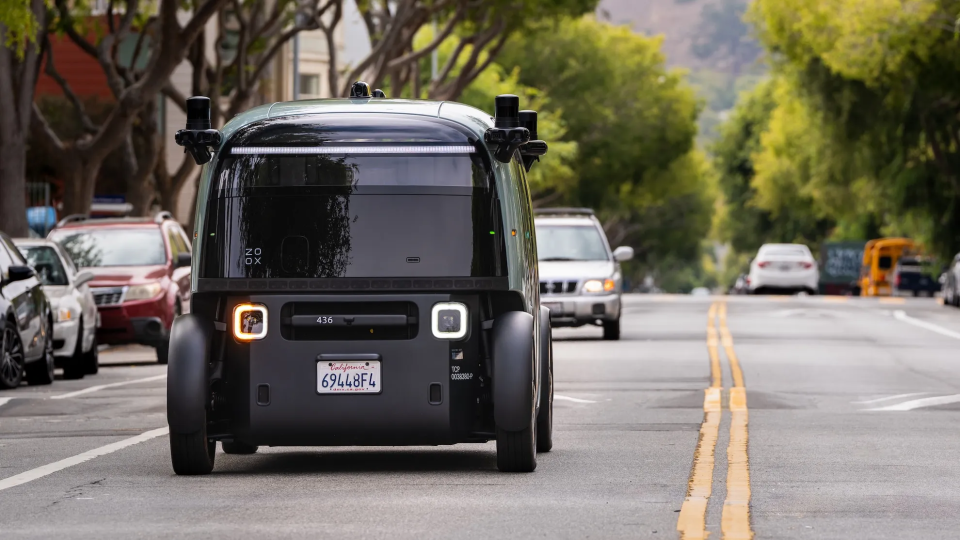
Zoox’s vehicles stand out because they are purpose-built for autonomous ride-hailing rather than retrofitted from existing car models. Unlike rivals such as Waymo, which adapts conventional vehicles with autonomous technology, Zoox’s fleet resembles “gondola-like,” four-passenger vehicles without traditional driver controls like steering wheels or pedals. This unique design aims to create a more communal and tailored passenger experience, featuring amenities such as wireless phone chargers, individual climate controls, and personal screens that allow each rider to adjust their environment. The company’s technical focus shows how far it is from just replicating a ride-share experience rather than reimagining what urban transportation can be.
From a technology standpoint, Zoox is advancing a direction in autonomous vehicles that emphasizes bidirectional driving capabilities and safety without safety drivers, a significant milestone in the sector. This puts it in direct competition with Waymo, which already runs fully driverless rides in several cities, and Tesla, which still requires a safety driver on board. Zoox’s approach is backed by a growing production capacity, highlighted by its state-of-the-art manufacturing facility in Hayward, California, capable of producing up to 10,000 robotaxi units per year once fully scaled. This manufacturing scale-out aligns with their plan to increase the availability of their unique vehicles for both testing and eventual commercial rides.
The regulatory environment in San Francisco adds an extra layer of challenge and opportunity for Zoox. The city has embraced autonomous vehicle testing more openly than many U.S. urban centers, which has allowed companies like Zoox, Waymo, and previously Cruise, to accumulate valuable real-world data and iterate rapidly. However, regulatory scrutiny remains stringent, especially regarding safety standards and data transparency. Zoox’s careful rollout to friends and family before a full public launch aims to gather feedback and maintain compliance with evolving city and state regulations, an approach that exemplifies a measured path to eventual commercial deployment.
Zoox’s expansion also reshapes the competitive dynamics in a market once dominated by Waymo. Although Waymo remains a major force and delivers hundreds of thousands of rides weekly across several cities, Zoox is gaining attention for its radical vehicle design and aggressive plans for expansion. This includes pilot service in Las Vegas since late 2025 and ambitions to grow into other cities like Austin and Miami after San Francisco. Tesla’s robotaxi efforts serve as another competitor in this growing market but operate with human safety drivers for now, which may create a window for Zoox to capture customers who prefer a fully autonomous service.
From the user experience side, early riders have noted the uniqueness of Zoox’s robotaxis, describing the rides as smooth with a shuttle-like ambiance more akin to an amusement park ride than a car trip. However, some feedback has revealed the backward-facing seats can cause motion sickness for some passengers, a factor Zoox is addressing by recommending forward-facing seating for those sensitive to motion. These small details illustrate Zoox’s customer-centric design focus, seeking to foster confidence in autonomous travel and build ridership by making the experience both enjoyable and practical.
Amazon’s backing gives Zoox a stable financial foundation to develop this novel transport mode while challenging the slower-moving incumbents. The company’s $1.3 billion acquisition in 2020 has fueled significant investments into research, production, and service expansion, underscoring Amazon’s commitment to redefine urban mobility over the coming years. Zoox’s progress may ripple across the autonomous vehicle sector, pressuring competitors to innovate faster while raising the overall standard for driverless ride quality and safety.
With public interest in autonomous vehicles growing, highlighted by surveys that show strong support among San Francisco residents, Zoox’s ongoing expansion represents a timely and important development. As it moves toward a full public launch anticipated in 2026, it will be interesting to watch how this battle among robotaxi providers unfolds, what regulatory hurdles they overcome, and how consumers adapt to a driverless future.
The next year could be pivotal as Zoox transitions from testing to commercial service, potentially reshaping how people think about urban transport. The company’s free ride offerings provide a crucial window for passengers to experience this technology firsthand, laying the groundwork for broader acceptance and, hopefully, safer streets through autonomous innovation.
