
[stock_market_widget type=”card” template=”basic2″ assets=”CME” realtime=”true” api=”yahoo-finance”]
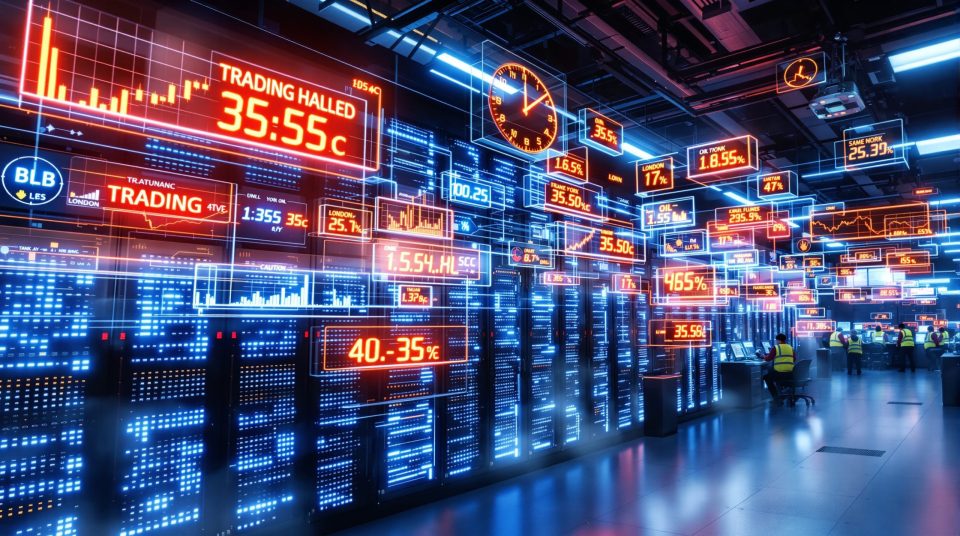
Imagine starting your trading day in Asia, ready to position for month-end expiries, only to find the screens frozen. That is exactly what happened earlier today when CME Group (NASDAQ: CME) experienced an hours-long outage on its Globex platform. The problem stemmed from a chiller plant failure at a CyrusOne data center near Chicago, where multiple cooling units failed, putting the entire server operation at risk.
Data centers like this one house thousands of servers running at full capacity, generating massive heat from constant computations. Cooling systems, often massive chiller plants with refrigerant loops and backup redundancies, keep temperatures stable to avoid thermal shutdowns. When those chillers malfunction, servers throttle down or halt to prevent damage, cascading into full platform outages as happened here. Engineers rushed in temporary cooling units, and markets reopened gradually through the morning, with all futures and options back online by U.S. premarket hours.
The outage hit a broad swath of contracts during low-volume Asian hours on the Friday after U.S. Thanksgiving. Futures tied to the S&P 500, Nasdaq 100, and Dow Jones Industrial Average stopped updating, alongside U.S. Treasuries, crude oil, gold, silver, and even palm oil on Bursa Malaysia. The EBS foreign-exchange platform also froze, leaving traders without price discovery in key pairs. Gold saw erratic swings from thin liquidity once trading resumed, while Bitcoin futures dipped below $91,000 amid options expiry pressures.
Traders voiced real frustration over the disruption. One anonymous participant called it a “nightmare,” highlighting how stuck positions amplified risks on a volatile month-end. Market analyst Tony Sycamore from IG noted, “It’s been a very slow day here in Asia after the Thanksgiving holiday and this hasn’t helped at all, more so given there is interest to transact at the end of what has been a volatile month.” Charu Chanana at Saxo Markets added, “Liquidity is already limited, so even a short suspension can disrupt price discovery in Treasuries, FX, and commodities. The primary concern is a potential surge in catch-up volatility.”
This event underscores vulnerabilities in centralized trading infrastructure. CME Group processes millions of contracts daily as one of the world’s biggest derivatives hubs, yet a single cooling failure exposed single points of failure. Financial ecosystems now demand distributed data centers, AI-driven predictive maintenance, and real-time failover systems to handle such risks. Regulators and exchanges will likely push for enhanced redundancies, as past outages like the 2014 agricultural contracts halt showed these issues persist without action.
