
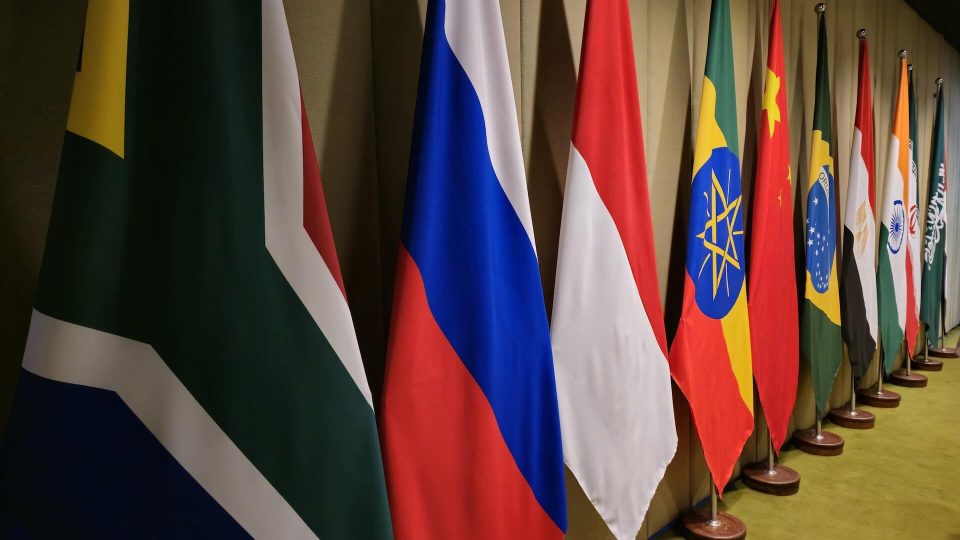
For years, the U.S. dollar has been the default anchor of the global financial system, standing behind everything from trade invoices to central-bank balance sheets. Yet today a quiet shift is unfolding in the reserve books of some of the world’s largest emerging economies, and the metal they are choosing is gold. The BRICS group, which includes Brazil, the Russia, India, the People’s Republic of China and the Republic of South Africa, along with newer members Egypt, Ethiopia, the Islamic Republic of Iran, the United Arab Emirates and the Republic of Indonesia, has moved gold from a background asset to a core pillar of its reserve strategy.
Combined BRICS+ gold reserves now exceed 6,000 tonnes, with Russia leading at about 2,336 tonnes, China at 2,298 tonnes, and India at 880 tonnes. Between 2020 and 2024, BRICS+ central banks accounted for more than half of all gold purchased by central banks worldwide, and their share of global gold reserves has climbed from 11.2% in 2019 to 17.4% in early 2026. That’s not a short-term trade, it is a deliberate, multi-year repositioning of national wealth.
One of the main reasons behind the surge is a push to move away from a system that places the U.S. dollar at the center of global finance. The dollar’s share of global foreign-exchange reserves has fallen from about 71% in 1999 to roughly 57% today, its lowest level since the mid-1990s. BRICS policymakers are not simply rotating into other fiat currencies such as the euro or the renminbi, they are adding gold, an asset with no issuer, no counterparty, and no single government in control. For a group representing about 40% of global GDP on a purchasing-power-parity basis and roughly half of the world’s population, that choice carries structural weight.
A second driver is the memory of what happens when reserves are held in foreign banks and can be frozen. In 2022, after Russia’s invasion of Ukraine, Western governments restricted access to roughly $300 billion of Russia’s foreign reserves, which were held in foreign financial institutions. At the same time, gold Russia kept within its own territory remained under its control. Finance ministers across the emerging-market world watched closely and drew the same lesson: reserves you cannot access are not truly usable reserves. The episode accelerated a broader trend in which central banks began buying gold at a record pace, with official purchases averaging more than 1,000 tonnes per year from 2022 to 2024, the longest sustained buying streak in modern history.
A third influence is concern about the long-run value of the U.S. currency itself. The U.S. federal debt crossed $39 trillion in March 2026, and the Congressional Budget Office projects an annual deficit of about $1.9 trillion for fiscal year 2026. In emerging-market capitals, those figures are watched as indicators of how much future inflation and potential currency-value erosion might be baked into dollar-denominated assets. Gold, which governments cannot print and which cannot be diluted by budget-financing decisions, becomes an attractive hedge for central-bank portfolios that must preserve long-term purchasing power.
A fourth element is the idea of building an alternative financial architecture, where gold plays a foundational role even if the system is still evolving. In late 2025, researchers at the International Research Institute for Advanced Systems launched a pilot for a gold-anchored settlement unit, a digital trade instrument intended to be backed by a mix of gold and BRICS currencies. This is not official BRICS policy, it is an experimental concept, yet it signals the direction some policymakers are exploring. The goal is not to declare a new global currency tomorrow, but to test how trade and finance could function in a world where the dollar’s dominance is no longer taken as a given.
For individual investors, the forces behind BRICS gold buying are familiar, even if scaled up to the sovereign level. Loose fiscal policy, high debt, and sharply rising geopolitical tensions all tend to erode purchasing power over time, and central banks respond by diversifying into assets that cannot be frozen or printed. The same logic shows up in the decisions of savers who hold gold or other hard assets as a form of insurance, even if they never manage a national balance sheet.
What the data underlines is that the shift is already happening. BRICS+ now holds more than 17% of the world’s official gold reserves, up from under 12% in 2019, and central-bank purchases have remained above 1,000 tonnes in several consecutive years. The U.S. dollar has not collapsed, it remains the dominant reserve currency, but its share is gradually declining while the role of gold in central-bank portfolios is rising. The story is less about a sudden break with the dollar and more about a steady, deliberate re-engineering of how some of the world’s largest economies think about what it means to “own” their reserves.
