
[stock_market_widget type=”card” template=”basic2″ assets=”AMZN” realtime=”true” api=”yahoo-finance”]
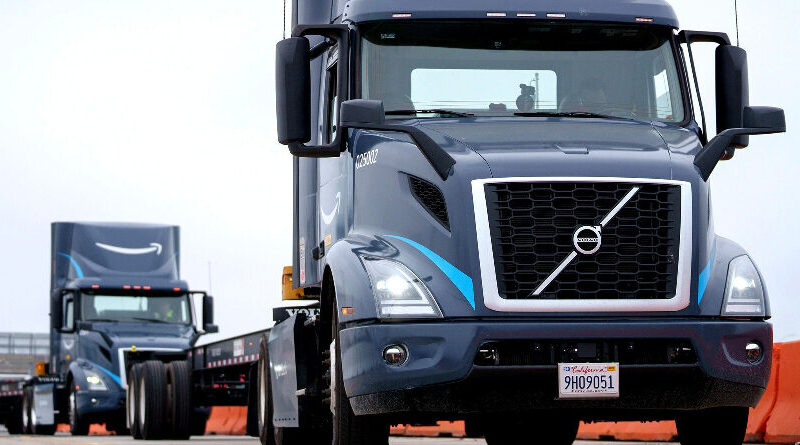
Amazon’s logistics network has quietly added a new player to its no-emissions fleet: Swedish electric-truck operator Einride. In a move that ties together the U.S. freight market, European tech, and the global push toward electrified transport, Amazon is deploying 75 manually operated electric heavy-duty trucks from Einride AB into its Amazon Relay freight network. These trucks are designed to travel up to 3 million electric miles each year, weaving middle-mile freight lanes into Amazon’s broader effort to shrink its carbon footprint across long-haul and regional routes.
Middle-mile transport is the stretch where goods move from warehouses or sorting hubs to local delivery centers, rather than the final leg to a customer’s doorstep. For Amazon Relay, that means a network of drivers who pick up loads using the company’s app and then move them between regional nodes. Adding 75 electric big rigs into this setup signals a shift beyond last-mile delivery vans; it brings zero-emission trucks into the kind of longer-distance, heavier-duty work that has historically been the hardest to electrified.
The trucks themselves are Class 8 electric heavy-duty units, capable of hauling substantial freight over meaningful distances. Although Einride is best known for its autonomous freight pods, these Amazon-bound vehicles are being driven by human operators, not by remote or fully autonomous systems. That pragmatic choice reflects where the industry sits today: manufacturers and fleets are comfortable scaling electric drivetrains, but fully driverless long-haul operations remain a future prospect rather than a near-term reality.
In the United States, that comfort level is still evolving. The U.S. electric-truck market is projected to grow quickly, with estimates of the overall electric-truck segment reaching around $39 billion in 2025 and climbing toward roughly $193 billion by 2033 at a compound annual growth rate north of 20%. For the U.S. specifically, different studies place the market value in the low hundreds of millions of dollars in 2025, depending on how “electric truck” is defined, with forecasts doubling or even multiplying that figure by the mid-2030s. Even so, heavy-duty electric trucks themselves still represent a small slice of the long-haul trucking market, surrounded by millions of diesel-powered rigs.
Europe and China tell a different, but not identical, story. Across the European Union, electric-truck registrations are climbing, especially in the medium-duty segment where shorter-range routes and denser urban networks make batteries more practical. In Germany, the region’s largest truck market, electrically chargeable trucks still account for only a small fraction of new heavy-duty registrations, even as uptake in lighter and medium-duty classes accelerates. The regulatory backdrop in Europe is tight, but the pace of change in the heaviest truck categories remains uneven, shaped by charging infrastructure, battery-range limitations, and the simple economics of long-haul operations.
In China, the curve bends more sharply. Electric heavy-duty trucks have surged in 2025, with new-energy heavy-duty models accounting for roughly 29% of total heavy-duty registrations over the year, and in some months actually outselling conventional diesel trucks. Annual sales of electric heavy-duty units in China have climbed into the hundreds of thousands of vehicles, driven by a mix of local policy, subsidies, and companies such as BYD and CATL that control large portions of the battery and vehicle supply chain. That rapid penetration contrasts with the more cautious, infrastructure-driven rollout the U.S. is experiencing today.
Amazon’s partnership with Einride fits into this broader picture as a test case rather than a finale. By embedding 75 electric big rigs into Amazon Relay, the company is effectively running a pilot of how electric trucks behave in everyday middle-mile operations: route patterns, charging window behavior, maintenance cycles, and driver experience. The move also aligns with earlier electrification efforts, including thousands of electric delivery vans from Rivian and commitments to electrify elements of its freight network in Europe. For investors and business-channel viewers, the key takeaway is not that electric trucks are about to replace the entire U.S. fleet, but that leading logistics players are now treating them as a core part of their medium-term planning.
Looking ahead, most analysts expect the global electric-truck market to keep expanding at a double-digit annual pace into the 2030s, with Asia-Pacific and North America leading in absolute growth and Western Europe in policy-driven adoption. That expansion will depend on battery cost curves, charging infrastructure at truck stops, and whether the economics of electric trucks close the gap with diesel over the full lifecycle of a vehicle. In the U.S., the Amazon-Einride deployment is one small but visible sign that fleets are moving beyond experimentation and into steady, incremental integration of electric heavy-duty units.
The take-away is more about direction than certainty. The U.S. commercial electric-truck market is still young, especially in the heavy-duty segment, and it lags behind some of the more aggressive adoption seen in parts of Europe and whole-scale rollouts in China. Yet deals like Amazon’s with Einride suggest that the basic technology is ready enough to start stacking up miles, data, and real-world experience. The timeline for truly widespread electrification of long-haul trucking remains open, but the road map is now populated with concrete projects, not just hypotheticals.
