
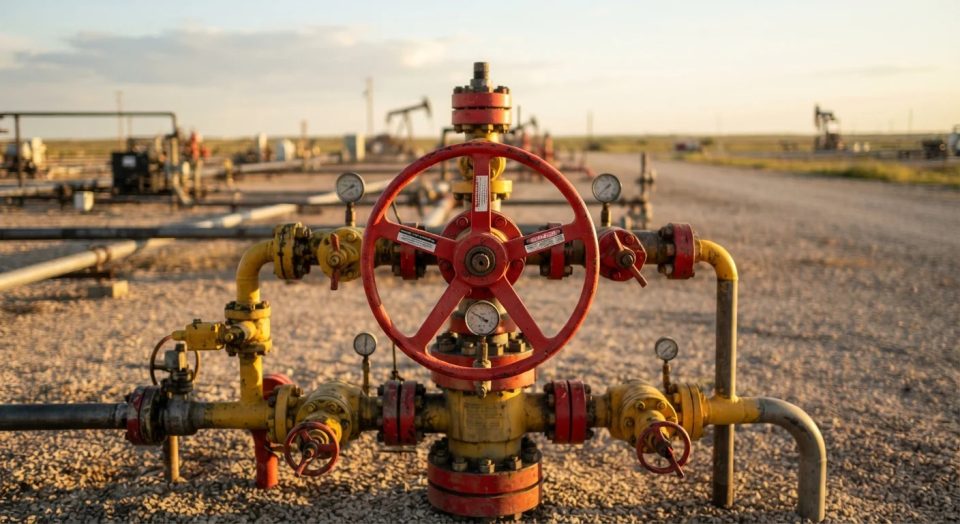
Most oil wells do not flow on their own for long. When a well is first drilled, natural pressure in the reservoir is often strong enough to push oil and gas to the surface. That pressure fades as the well produces, and at some point the operator has to add energy to keep fluids moving. The equipment that does this job is called artificial lift, and it is among the most widely used tools in the oil business. Industry estimates have long held that more than 90% of the world’s wells depend on some form of it.
There is no single way to lift a well. Gas lift injects pressurized gas down the well to lighten the column of fluid. Plunger lift uses a free-moving piston that rides the well’s own gas pressure. Rod lift, the familiar nodding pump jack, uses a long string of steel rods to drive a pump at the bottom of the well. The right choice depends on depth, volume, how thick the oil is, and how much sand comes up with it. Wells also change as they age, so a producer may switch methods more than once.
Two less familiar technologies matter for this story. A progressing cavity pump uses a helix-shaped rotor turning inside a rubber-lined housing, which lets it move thick, sandy fluid that other pumps handle poorly. The design was patented in 1930 by French inventor René Moineau, and Canadian companies took it up in the 1970s to produce cold, sandy heavy crude around Lloydminster. Continuous rod addresses a different weak point. Conventional rod strings are joined by couplings every 25 feet, and those couplings rub against the tubing. Continuous rod needs couplings only at the top and bottom of the string, which spreads the contact and reduces wear, particularly in wells that bend.
That background helps explain a deal announced today. Flowco Holdings Inc. (NYSE: FLOC), a Houston company that supplies production equipment to oil and gas producers, said it has closed its purchase of Lifting Solutions Energy Services Inc. Lifting Solutions was founded in 2014 and is based in Edmonton, Alberta. It makes continuous rod and progressing cavity pumps, develops its own rod coatings and pump technology, and serves wells in Canada, the U.S., the Middle East and other markets.
The fit is fairly easy to see. Flowco’s existing business is built around high-pressure gas lift, conventional gas lift and plunger lift, along with vapor recovery equipment, mostly in the U.S. Lifting Solutions brings rod and pump products that sit outside that lineup, plus a Canadian operating base. Management says the combination should let each side sell to the other’s customers and take part in more later-life well work.
Flowco paid about $113 million in cash, and subject to adjustment under the purchase agreement. The sellers can earn up to about $7.0 million (CAD $10 million) more, depending on how Lifting Solutions performs financially in 2027, with any payment due in early 2028. Flowco funded the purchase by borrowing under its ABL facility, an asset-based credit line of the kind typically secured by receivables and inventory. For a sense of scale, Flowco reported revenue of $235.9 million in the second quarter of 2026.
Flowco expects the deal to be accretive to earnings and free cash flow per share, meaning each share should end up with a little more of both than it had before. That claim is hard to check from the announcement alone. The release does not disclose Lifting Solutions’ revenue or profit, the price paid relative to its earnings, or the interest cost of the new borrowing. Because the purchase was funded with debt, the acquired earnings have to exceed that interest expense for the math to work.
Those answers should come with time. Flowco scheduled a conference call this morning to discuss the acquisition, and its next quarterly reports should show how much debt was added and what the Canadian business contributes. Until then, the clearest takeaway is the direction: a U.S. gas lift specialist now owns a Canadian maker of rods and pumps and has a base outside its home market.
