
Copper is easy to overlook because most of it sits out of sight, inside walls, power lines, motors and the servers that run the internet. Yet the metal has become important enough that the federal government added it to its official list of critical minerals on November 7, 2025. When it comes to where America’s mined copper comes from, one state carries most of the load.
Arizona remained the country’s leading copper producer in 2025, supplying roughly 70% of U.S. mine output, according to the U.S. Geological Survey’s annual Mineral Commodity Summaries, released in February. Smaller amounts came from Alaska, Michigan, Missouri, Montana, Nevada, New Mexico and Utah. The agency estimates national production at 1.0 million tons, down 5% from the year before. Higher copper prices still lifted its value 10% to about $11 billion. Copper was recovered at 26 mines across the country, and just 17 of them accounted for more than 99% of the total.
Geology explains much of this. The state sits on a copper belt that stretches into northern Mexico and is filled with porphyry deposits, huge bodies of modest grade rock that can be mined at scale for decades. Dry weather allows mining all year. The largest operation, an open pit in Greenlee County running since 1939, produces about half of the state’s copper on its own.
The industry’s reach goes beyond the mine gates. The Arizona Mining Association estimated that copper generated more than $21 billion in total economic impact in the state in 2024 and supported around 60,000 jobs. New capacity is coming too, with a large open pit project near Tucson approved for construction in October.
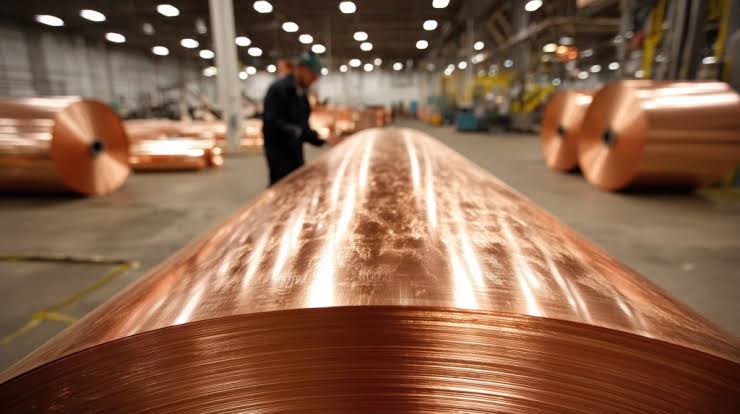
Digging copper out is only part of the challenge. Most ore must be smelted and refined before it becomes usable metal, and the U.S. has only two active copper smelters. Some Arizona mines skip that bottleneck with solvent extraction and electrowinning. Acid dissolves copper from crushed ore, and an electric current plates the metal onto sheets of nearly pure copper, called cathode, right at the site.
That on-site approach is the model at Gunnison Copper Corp. (NYSE American: GUNN, TSX: GCU.TO), a Phoenix producer that operates the Johnson Camp mine in Cochise County. Its American Depositary Receipts, each representing 30 common shares, began trading on the NYSE American on October 26th. Today the company released third quarter results, its first report since that debut.
Johnson Camp produced about 3.42 million pounds of cathode in the quarter, up 71% from the second quarter, and reached commercial production in September. Revenue rose 53% from the prior quarter to $36.1 million, and net income came in at $12.7 million, or $0.03 per share.
For the first nine months, revenue reached $79.9 million and net income was $27.5 million, or $0.06 per share, compared with $3.5 million in revenue and a $46.8 million loss a year earlier. It helps to know what sits behind those profits. Only $21.3 million of the quarter’s revenue came from selling cathode at an average of $6.41 per pound. Another $14.7 million was deferred demonstration service revenue tied to the mine’s funding partner, a venture of a global mining group that paid to restart the operation. Net income also includes non-cash fair value adjustments on a copper stream derivative and on amounts owed to that partner.
The balance sheet is cleaner than a year ago. Gunnison converted its last convertible debenture on September 30th, leaving it debt-free with $23.5 million in cash. In its own materials, the company says its copper serves U.S. defense supply chains and the data centers of a major cloud provider.
The market has been cautious. The receipts closed at $7.79 yesterday, a market value of roughly $134 million, near the bottom of the $7.09 to $11.42 range traded since the debut.
Management is aiming for Johnson Camp’s nameplate rate of 25 million pounds a year, by year end, and nearly double the third quarter pace. Beyond that sits the much larger Gunnison Copper Project, with a final technical report targeted for the second half of 2028. For a small producer in America’s leading copper state, the coming quarters will show how much profit comes from selling metal rather than from accounting gains.
