
For six months, one of the year’s most closely watched real estate listings was essentially a pile of cash waiting for a home. That changed today. Blackstone Digital Infrastructure Trust Inc. (NYSE: BXDC) signed a definitive agreement to acquire a 75% majority interest in two joint ventures with Amazon Web Services, the cloud computing arm of Amazon.com, Inc. (NASDAQ: AMZN). The transaction values the portfolio at about $5 billion, and it is the trust’s first investment.
The trust is a real estate investment trust, or REIT, which is a company that owns income-producing property and passes most of its taxable income to shareholders. It is managed by Blackstone Inc. (NYSE: BX), and its plan has always been narrow: buy finished data centers that are already leased to the biggest cloud providers on long contracts. It raised $1.75 billion when it began trading on the New York Stock Exchange on May 14th, yet it owned no buildings at the time.
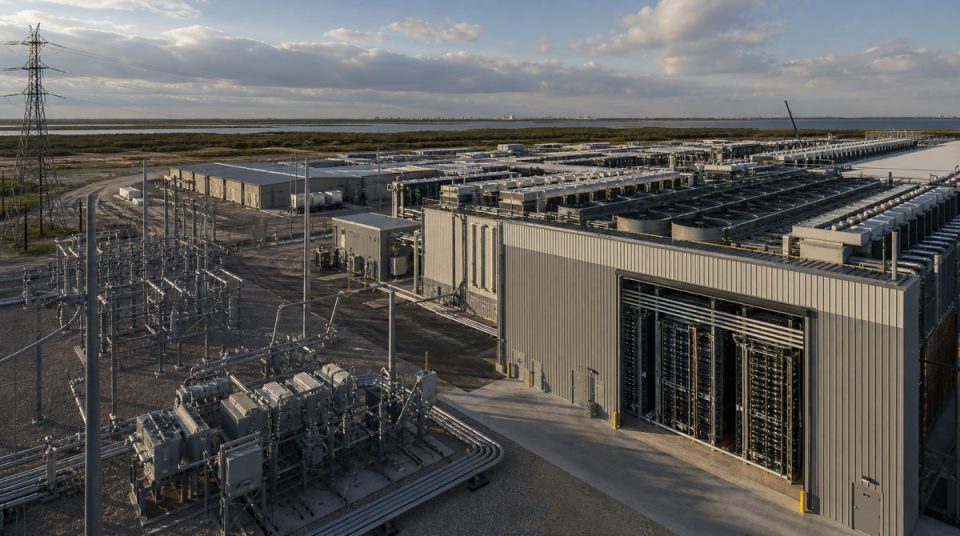
The two joint ventures will own 13 newly built powered shells across two AWS data center campuses, which Bloomberg reported are in northern Indiana and Mississippi. A powered shell is the building, the land and the electrical hookup, while the tenant brings in the servers and equipment. AWS keeps the other 25% and will lease back the entire portfolio on a triple-net basis, meaning Amazon covers property taxes, insurance and upkeep. The initial lease runs 12 years and can be extended to 32 years.
The structure is a sale-leaseback, where the builder sells most of a property to an investor and then rents it back. For a cloud provider spending enormous sums on new capacity, that frees up money for the next project without giving up use of the buildings. Prasad Kalyanaraman, vice president of infrastructure at AWS, said the partnership lets the company “continue expanding responsibly.” For the trust, the source of the deal matters. Until now, the usual sellers of stabilized data centers were developers. Nick Pell, the trust’s chief executive, said the deal shows that the range of assets the trust can invest in is widening. That suggests the hyperscalers themselves could become a regular source of deals.
The price is expressed as an initial capitalization rate of 7.0%. A cap rate is the first year’s net rental income divided by the purchase price. Before its IPO, the trust told regulators it expected returns between 5.75% and 7% or higher, which puts this first deal at the upper end of that range.
The trust will use proceeds from its IPO, and the rest is expected to come from about $2.5 billion of new non-recourse mortgage loans taken on by subsidiaries of the joint ventures and secured by the properties. Non-recourse means lenders can claim the buildings if the loans go unpaid, but cannot go after the trust’s other assets. Lenders have provided commitment letters, and closing is expected in the fourth quarter.
There are two clear risks. The first is leverage: debt covering roughly half the portfolio’s value magnifies both gains and losses, and the interest cost will eat into the rent. The second is concentration, since every building has the same tenant. Amazon is a strong renter, but the trust’s fortunes are now tied to one company’s plans. Investors seemed comfortable anyway, as shares rose more than 6% in premarket trading.
The trust also reported third quarter results. Net income came to $15.6 million, or $0.15 per share, and adjusted funds from operations (AFFO) were $0.17 per share. With no properties during the quarter, those figures mostly reflect a company holding the cash from its offering. Funds from operations of $0.15 per share beat the $0.13 average estimate from analysts surveyed by Zacks Investment Research.
The real test begins once the deal closes and rent starts arriving. At that point, the number to watch is AFFO (Adjusted Funds From Operations), the measure REITs commonly use to show how much cash is available for dividends. That figure will reveal whether a single tenant, a 7.0% starting yield and a sizable mortgage add up to a reliable income stream.
