
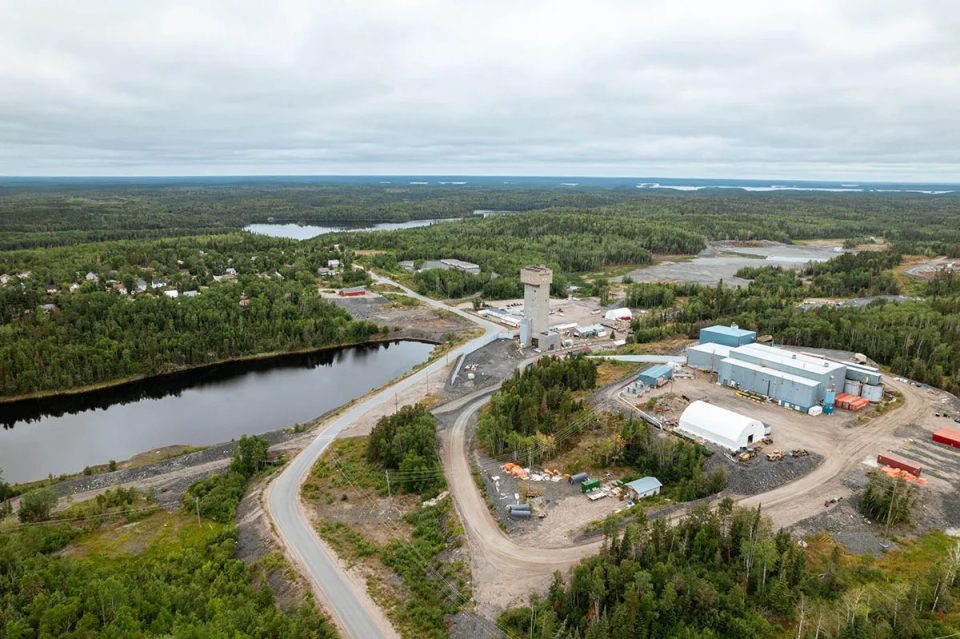
In the summer of 1925, prospector Lorne Howey found gold under the roots of a toppled tree near Red Lake in northwestern Ontario, Canada. Word spread, and by early the next year a full gold rush was underway. The district has been mining ever since.
What sets Red Lake apart is grade, meaning how much gold sits in each tonne of rock. Some deposits here have yielded about two ounces per tonne, which is extraordinary by global standards. By one widely cited count, 28 mines have produced roughly 28 million ounces since 1925, most of it from Red Lake, Campbell, Madsen and Cochenour.
The largest operation today belongs to Evolution Mining Limited (ASX: EVN), an Australian producer that bought the Red Lake complex in 2020. It produced 127,158 ounces in its 2026 fiscal year and plans to keep mining until 2040.
The biggest change is coming from Kinross Gold Corporation (NYSE: KGC), which is developing its Great Bear project about 24 kilometres southeast of town. An early study pointed to average output of 518,000 ounces a year over its first eight years. Ontario has put Great Bear on a faster permitting track, with major construction expected in 2027 and first gold targeted for 2029. The total investment is estimated at about $3.6 billion (C$5 billion).
All of this is reshaping the community. Red Lake’s mayor has said the town is preparing for a large influx of new residents and is seeking government support to handle it.
Against that backdrop, West Red Lake Gold Mines Ltd. (OTCQX: WRLGF, TSXV: WRLG) released a pre-feasibility study today that folds its Madsen Mine and its Rowan deposit into one operating plan. Madsen declared commercial production in the first quarter of this year and has its own mill. Rowan, a past-producing mine about 80 kilometres away by road, would truck its ore to that mill starting in 2029.
The study puts the after-tax net present value of the operation at $547 million (C$764 million). Net present value estimates what all future cash flows are worth in today’s money, discounted here at 5% a year. It assumes a long-term gold price of US$3,568 per ounce and $143 million (C$200 million) in growth capital to build Rowan and expand the mill.
That figure is the heart of the story. The shares closed yesterday at $0.38 (C$0.53), before the study came out, giving the company a market value of about $156 million (C$220 million), less than a third of the study’s estimate.
Gaps like this are common in mining. A study values the mine plan, not the company, so it ignores corporate debt. Investors also discount for risk. Rowan still needs final permits, expected by 2029, and the plan assumes gold at US$4,597 in 2027 before easing to the long-term price. If gold averaged 20% less than assumed, the value would fall to $195 million (C$272 million). At 10% more, it would rise to $719 million (C$1.0 billion).
Over its 10-year life, the plan calls for about 884,000 ounces of gold, or roughly 88,000 ounces a year. The busiest stretch comes between 2029 and 2034, when both mines are running and output averages 108,000 ounces a year. The study puts the full cost of producing each ounce, including the capital needed to keep the mines going, at an average of US$2,457.
Funding is taking shape. Earlier this week the company signed a binding term sheet for a credit facility of up to US$95 million with Gunvor USA LLC, part of Centalion. It would replace existing secured debt, support Madsen and could help fund Rowan, with Gunvor buying all of the gold produced. Final agreements are still pending. Timing also helped, as gold rose more than 2.5% today on the U.S. election results.
Whether the distance between study value and share price narrows will come down to execution. Madsen needs to run consistently, Rowan needs its permits on time, and gold needs to hold near the plan’s prices. The study gives investors a clear yardstick as the company tries to grow from one mine into two.
