
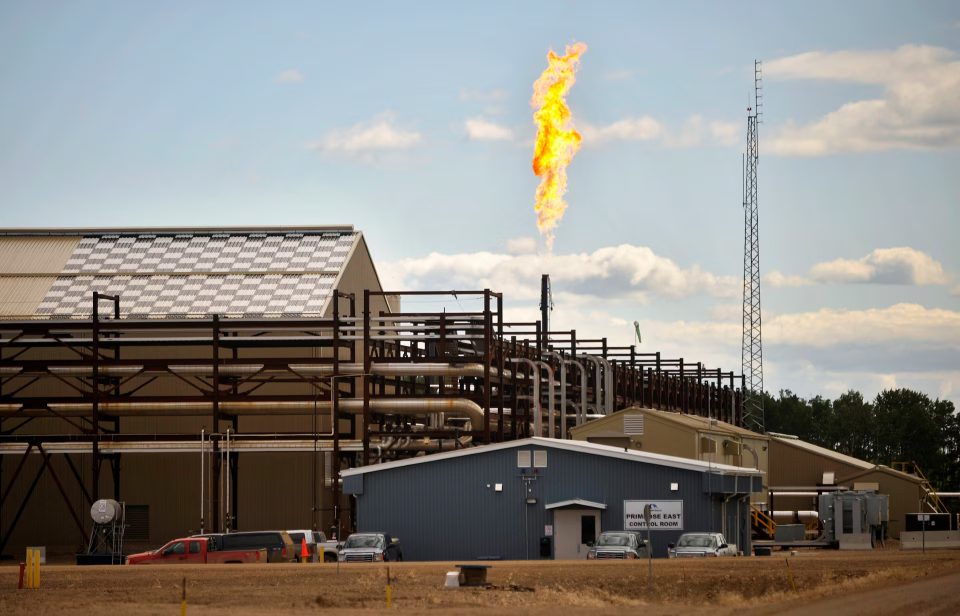
Alberta has been Canada’s natural gas engine for decades, and it still carries most of the load. The province averaged about 11.3 billion cubic feet per day of gas production in 2025, roughly 60% of a national total that hit a record 19.0 billion cubic feet per day. Alberta’s regulator expects provincial output to keep climbing over the next decade.
Much of that growth comes from one rock formation. The Montney stretches across northwestern Alberta and northeastern British Columbia and produces about 10 billion cubic feet per day, around half of Canada’s total. Drilling in 2025 was concentrated there and in the nearby Duvernay.
Gas is only part of the story. Raw gas from the Montney often carries heavier hydrocarbons known as natural gas liquids, including ethane, propane, butane and condensate. Condensate is especially prized because oil sands producers blend it with heavy crude so the oil can flow through pipelines. Liquids prices also tend to track oil rather than gas, which is why many producers drill for liquids even when gas is cheap. Alberta alone produces about 66% of Canada’s propane.
That matters because Alberta gas has endured rough pricing. The main provincial trading hub, known as AECO, has seen stretches of negative prices, when producers effectively paid buyers to take their gas. A long-term outlet arrived in June 2025, when LNG Canada in Kitimat, British Columbia began exporting liquefied natural gas, giving Montney supply a direct path to Asia.
Then the global picture shifted. A Middle East conflict that began in late February choked off roughly 20% of the world’s oil and LNG supply and pushed crude about 70% higher by spring. International buyers started treating Canada as a steadier source of energy. By late September, the Canadian oil patch was on track for its biggest merger wave in about a decade, driven by strong prices rather than distressed sellers.
The latest deal arrived today. Canadian Natural Resources Limited (NYSE: CNQ, TSX: CNQ) agreed to buy Advantage Energy Ltd. (TSX: AAV, OTC: AAVVF), a Calgary producer focused on the Montney and Charlie Lake plays, for $9.62 (CAD $13.55) per share in cash. That is a 25% premium to Advantage’s closing price on November 13th and to its 30-day volume-weighted average, and it tops any price the stock has reached in 18 years.
The offer values Advantage’s equity at about $1.6 billion (CAD $2.255 billion), and the total transaction value, including net debt and convertible debentures, is roughly $1.8 billion (CAD $2.53 billion). Canadian Natural will pay from cash on hand and existing credit facilities. It gets about 79,000 barrels of oil equivalent per day of production, more than 2,200 drilling locations and owned processing plants, all sitting beside its own operations near Grande Prairie.
The agreement is a reversal for Advantage’s board, which concluded in February that no proposal reflected the company’s intrinsic value. Since then, Advantage sold its Wembley assets for $231 million (CAD $325.4 million), cutting net debt by 58% to about $165 million (CAD $233.0 million). A special committee then reviewed its options and unanimously backed this sale, and every director and executive officer has agreed to vote in favor.
Shareholders are expected to vote in January 2027. The deal also needs court approval and clearance under Canada’s Competition Act, with closing targeted for the first quarter of 2027. Advantage also holds carbon capture technology interests through its subsidiary, Entropy, though the announcement did not spell out how those will be handled. Investors reacted quickly, lifting Advantage shares about 23% to roughly $9.51 (CAD $13.39).
That small gap below the offer, about 1.2%, is the merger arbitrage spread, the discount traders accept for waiting until closing and carrying the risk that the deal falls apart. The bigger signal is the price itself. A well-financed buyer has put a firm cash value on Alberta gas and liquids production, and other mid-sized producers with Montney land and owned infrastructure will likely be measured against it. Companies that pair Montney acreage with their own processing plants and modest debt fit the same profile that made Advantage attractive.
