
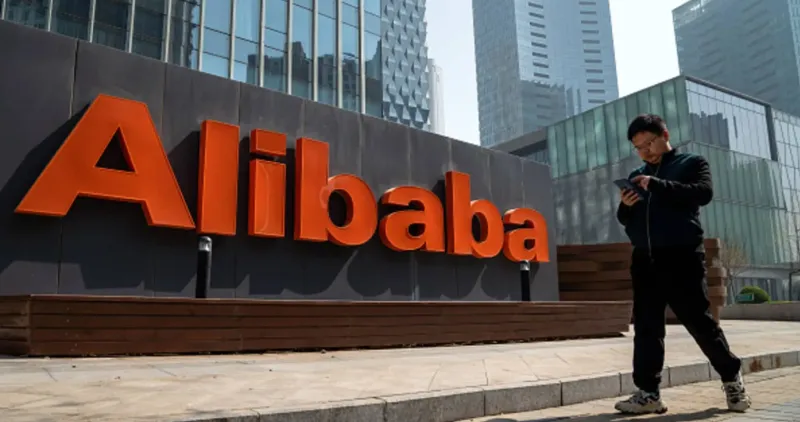
Chinese tech giant Alibaba (NYSE: BABA) is making a significant push into the artificial intelligence (AI) chip market with a newly developed AI processor aimed at tackling the challenges posed by current U.S. trade restrictions on Nvidia chips. The chip, which is currently undergoing testing, represents a key move in China’s broader push for tech self-reliance amid geopolitical tensions that have complicated the supply of advanced semiconductor technology into the country.
Unlike Alibaba’s earlier AI chips, which were produced by Taiwan Semiconductor Manufacturing Company (TSMC), this latest processor is fully manufactured within China. This shift is noteworthy because it reduces Alibaba’s dependence on foreign fabrication facilities, a critical factor given ongoing export controls and regulatory hurdles surrounding Nvidia’s AI chips in the Chinese market. The new chip is designed for a wide range of AI inference tasks, meaning it applies trained models to real-world applications such as customer service, content moderation, and logistics more efficiently. While it handles inference well, the chip is not intended to match the training power of Nvidia’s top models like the H100 or the more advanced Blackwell series, which remain inaccessible to China due to export restrictions. Instead, it is a versatile processor meant to fill gaps created by limited access to Nvidia’s more powerful hardware.
This development comes at a time when Nvidia’s H20 chip, the strongest AI processor allowed for sale legally in China, was effectively blocked for several months by the Trump administration and only recently allowed back into the market under strict conditions. Following the U.S. re-approval, Beijing issued warnings about potential security issues such as “information leaks” and backdoors, pressuring major companies like Alibaba, Tencent, and ByteDance to pause their acquisition of the chip. This created an urgent need for domestic alternatives capable of meeting increasing demand for AI computing power in China’s fast-growing tech landscape.
Alibaba’s chip is built to be compatible with Nvidia’s software ecosystem, a strategic feature that enables the company’s cloud clients to use common AI tools while potentially bypassing direct reliance on Nvidia hardware. This advantage could smooth the transition for users shifting from Nvidia to Alibaba’s homegrown solutions and could accelerate AI adoption in the company’s cloud and e-commerce platforms. However, the chip’s computational power still falls short of Nvidia’s high-end GPUs, particularly in training large-scale AI models that require enormous processing strength.
The bigger question is whether Alibaba’s chip can realistically compete in the global AI semiconductor arena dominated by Nvidia. Currently, Chinese semiconductor factories face technological limitations. They use older manufacturing equipment, and U.S. export controls bar access to the most advanced chipmaking tools, which means Chinese AI chips are generally behind the global cutting edge. This technological gap means Alibaba’s chip is mainly suited for inference rather than training, a less computationally demanding stage of AI operations. Still, the chip’s development signals China’s determination to build a more self-sufficient tech ecosystem that can weather geopolitical disruptions.
Despite these challenges, Alibaba’s commitment to AI and cloud computing is clear and robust. The company recently reported a 26% increase in revenue in its cloud computing segment for the April-June quarter, reaching $4.66 billion. This growth was largely fueled by investments in AI products and infrastructure, including a $53 billion investment plan for AI and cloud technology over the next three years. Alibaba’s cloud division dominates the Chinese market domestically with a market share around 36-37%, even while it holds just 4% of the global cloud market behind industry giants like Amazon and Microsoft. This strong domestic presence coupled with scalable AI capabilities gives Alibaba a solid foundation to expand its chip efforts.
Nonetheless, monetizing AI innovation remains a hurdle in China. While demand for AI-enhanced services is high, Chinese consumers have shown resistance to paid subscription models, and competition in cloud AI services is intensifying. Globally, Alibaba still faces significant challenges competing against established AI chipmakers with years of lead time on advanced semiconductor technology. Yet, by focusing on the domestic market and reducing reliance on U.S. suppliers, Alibaba’s AI chip initiative is an important strategic move in a technology race shaped by trade tensions and national security concerns.
Alibaba’s new AI chip underscores the broader efforts by Chinese tech companies to build indigenous capabilities amid restricted access to U.S. technology. Although the chip currently can’t match Nvidia’s highest-performing GPUs, it is a meaningful step for China’s AI industry in lessening dependence on foreign suppliers. Alibaba’s chip may not revolutionize the global AI chip market right away, but it heightens competition in the domestic market and advances China’s long-term goal of tech self-reliance.
