
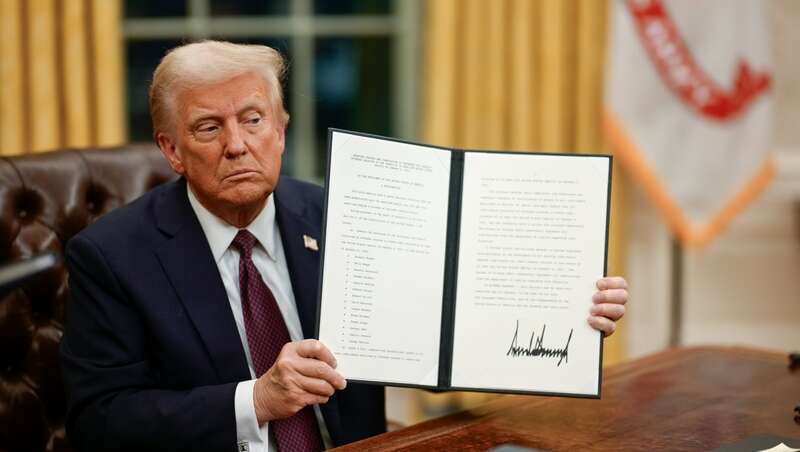
President Trump signed an executive order yesterday establishing a single federal framework for artificial intelligence (AI) regulation across the United States. The ceremony at the White House brought together a handful of familiar Silicon Valley figures, including venture investor and podcast host David Sacks, appointed earlier this year as the administration’s AI and crypto czar, and fellow investor Chamath Palihapitiya. Together they stood behind a decision that could reshape how technology companies interact with government oversight.
At its core, the order directs all federal agencies to adopt a consistent set of standards for AI development, deployment, and accountability. It overrides much of the patchwork of state-level initiatives that had begun to create friction for national and global tech companies trying to navigate overlapping rules. For executives in the technology sector, that standardization translates into one regulatory language for artificial intelligence rather than fifty versions. The policy effectively centralizes authority in Washington and marks a clear victory for those who have long argued that AI requires national, not local, supervision.
The business reaction has been immediate and largely positive. Companies like Alphabet Inc. (NASDAQ: GOOGL), Microsoft Corporation (NASDAQ: MSFT), and other major developers of AI systems have spent years lobbying for a single compliance structure that would let them scale innovation without inconsistent state thresholds or conflicting testing mandates. For smaller startups, particularly those focused on deep learning applications in finance, health, and security analytics, the rule promises predictability that could improve access to venture funding and corporate partnerships.
The administration’s move arrives after several years of rapid advancement in artificial intelligence and an equally rapid escalation of public debate about ethics, safety, and data governance. Until now, individual states had experimented with licensing requirements, privacy guidelines, and workforce oversight laws related to AI. California had been furthest along, proposing a framework modeled in part on its data privacy legislation. Those efforts may now be superseded by the federal approach. Critics of the state-level difference warned that decentralized oversight risked confusing companies that operate nationwide and potentially deterring expansion or research within certain jurisdictions.
For political observers, the decision also demonstrates a deliberate recalibration of federal power. The first Trump administration’s technology policy leaned heavily on deregulation and industry self-governance. This new order tilts toward consolidation, asserting that only the federal government can provide the stability and uniformity needed for a technology this influential. The involvement of private sector leaders like Sacks and Palihapitiya underscores that balance: business representation inside the policymaking process without giving up the government’s final authority.
Economically, investors view the development as a signal that the federal government intends to foster long-term AI infrastructure growth. While few details about enforcement have been released, early drafts suggest that compliance will be tied to transparency benchmarks and algorithmic audit requirements. For companies that already invest heavily in ethical AI reviews and safety testing, those rules may be easier to absorb. For others that rely on faster experimental cycles, compliance could add new operational costs, though many analysts believe those costs will be offset by the predictability of national guidelines.
The timing also reflects a change in international focus. Other major economies, including the European Union and China, have spent the last two years tightening their AI laws and releasing government-approved data standards. The U.S. initiative now attempts to place America back on an equal footing, offering both domestic clarity and a possible framework for cross-border cooperation. The White House emphasized that its approach would align with democratic principles and human-centered safeguards, though specifics remain vague.
AI leaders in the private sector have responded with restrained optimism. They note that any federal rulebook will take time to translate into detailed technical policies. Yet most agree that a uniform system is better than fragmented uncertainty. By consolidating authority under one umbrella, the government has provided markets with a clearer sense of direction.
Whether this order becomes a foundation or a flashpoint will depend on how effectively the government works with private and academic researchers to manage rapid innovation. For now, it represents a rare moment where technology and politics intersected with a single pen stroke, watched closely by those who stand to benefit from the rules they helped shape.
