
Not every homebuyer fits the boxes a big bank wants checked. A freelancer with strong but irregular income, a business owner whose tax returns show heavy deductions, or an investor buying a rental property can all struggle to qualify for a standard mortgage. These people aren’t necessarily risky. Their finances just don’t match the paperwork conventional lenders expect.
That gap created a market for non-qualified mortgages, or non-QM loans. After the 2008 financial crisis, regulators defined a “qualified mortgage” as one meeting specific standards, the kind easily sold to Fannie Mae or Freddie Mac. Loans outside that definition can still be made, but lenders verify income in other ways, often through bank statements or assets, and usually charge a higher rate.
The obvious question is whether this is subprime lending under a new name. People in the field argue it isn’t. Before 2008, many risky loans required little proof of income and often financed the entire purchase price. Today, lenders must document that a borrower can repay, and if a non-QM loan defaults, the lender may have to prove its underwriting was sound. Angel Oak has said its average non-QM borrower has a credit score above 720, while subprime loans of the mid-2000s rarely topped 600.
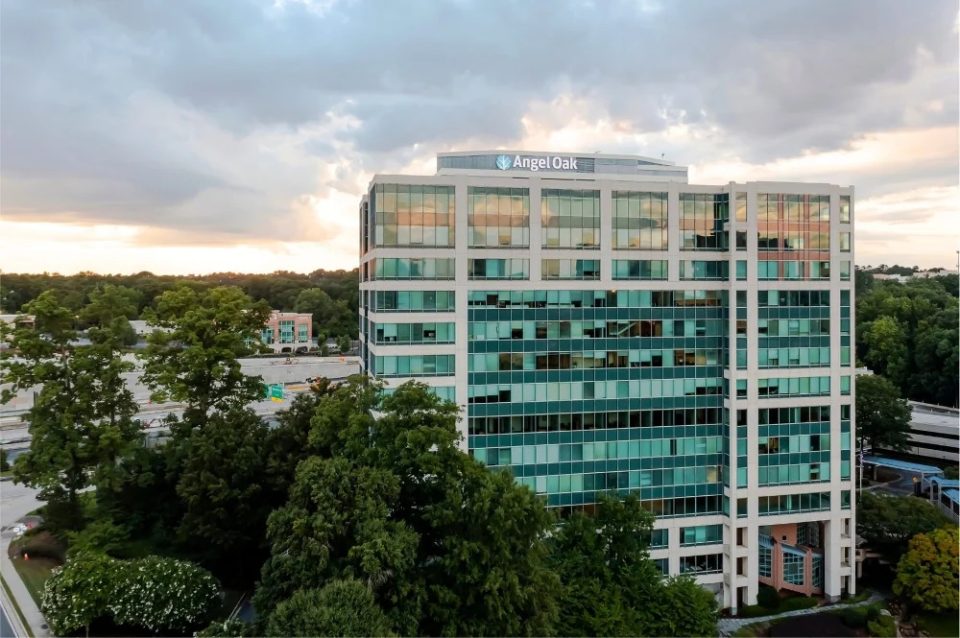
Angel Oak Mortgage REIT, Inc. (NYSE: AOMR) is one of the public companies built around this market. Based in Atlanta, it buys first-lien and second-lien non-QM loans and other mortgage assets, then bundles many of those loans into securitizations, which are bonds backed by pools of mortgages. It earns the difference between what borrowers pay and what its own financing costs. As a real estate investment trust, it must pay out most of its taxable income to shareholders.
That payout is the main reason investors own the stock. The quarterly dividend of $0.32 adds up to $1.28 a year, and with shares closing at $7.38 on October 26th, the yield works out to roughly 17%.
The trade-off is sensitivity to interest rates. Angel Oak carries many of its loans at fair value, updating them each quarter to reflect what the market would pay. When rates climb, older loans with lower rates become less attractive to buyers, even if every borrower keeps paying. Those markdowns are accounting changes rather than cash leaving the company, but they still shrink the value of each share on paper.
That is what happened in the third quarter. The company reported a GAAP net loss of $16.7 million, or $0.72 per share, mostly from those markdowns. The recurring side of the business held up better, with net interest income for the first nine months of the year rising 9.5% to $33.1 million. Book value fell 11.5% from the prior quarter to $8.97 per share, while economic book value, a company measure that also reflects the market value of its securitization debt, slipped 6.5% to $11.45.
The dividend is where things get tighter. Angel Oak declared its usual $0.32, payable November 30th to shareholders of record on November 23rd. Distributable earnings, the company’s measure of operating income before paper gains and losses, came to $0.28 per share. Put simply, the dividend wasn’t fully covered this quarter.
Chief Executive Officer Sreeni Prabhu said the company finished two securitizations early in the quarter, before most of the rise in rates. He called the pressure on portfolio values and new investment returns a near-term issue and said the company remains confident in how its loans are performing, adding that it will keep investing selectively rather than chase extra returns.
The quarter shows both sides of owning a mortgage REIT. The lending business underneath keeps producing interest income, and management says credit quality is holding up. Yet a jump in rates can erase a chunk of book value in a few months, and a dividend that runs ahead of earnings can’t do so forever. Whether distributable earnings climb back toward $0.32 will likely matter more to shareholders than this quarter’s paper loss.
