
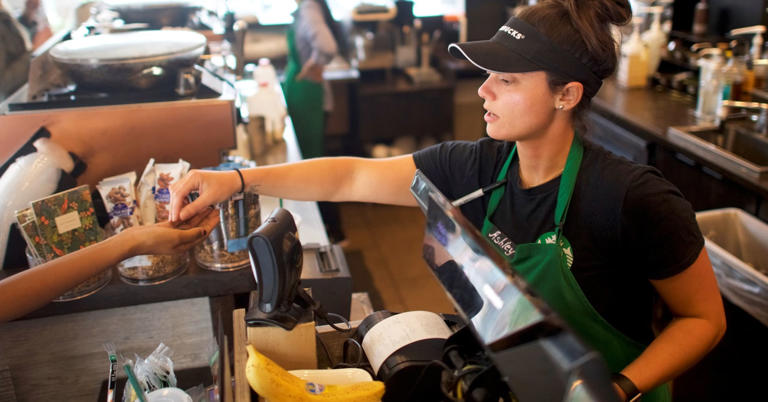
Starbucks Corporation (NASDAQ: SBUX) recently introduced quarterly bonuses for baristas and shift supervisors as a key step in its efforts to rebuild business. These bonuses reach up to $300 per quarter when stores hit specific targets, such as high “shot scores” that measure drink quality and speed. This move aims to motivate frontline workers, who play a central role in daily operations, and could add up to $1,200 a year for those in qualifying locations. Non-union stores qualify right away, while unionized ones wait for collective bargaining agreements.
This incentive program fits into a larger turnaround under CEO Brian Niccol, launched with the “Back to Starbucks” plan earlier this year. The company faced slowing sales and customer complaints about long waits and inconsistent service over the past few years. Foot traffic dropped as rivals gained ground, and U.S. same-store sales fell in recent quarters before signs of stabilization. Niccol’s approach targets both employee satisfaction and customer loyalty to reverse these trends.
On the employee side, Starbucks added weekly paychecks alongside the bonuses to help staff manage cash flow better. Shift supervisors and baristas now see faster access to earnings, which helps with everyday expenses. The company also invests in training through the Green Apron Service standards, a set of behaviors that emphasize friendly greetings, quick service, and personalized touches like remembering customer names. These steps address past issues where workers felt overworked during peak hours, leading to burnout and turnover rates above 100% in some periods. By focusing here first, Starbucks hopes to create stable teams that deliver better results.
Customer experience improvements run parallel to these employee efforts. Store upgrades include rearranging layouts for smoother flow, adding more baristas during busy times, and installing dual drive-thru lanes in select spots. These changes cut wait times, a major gripe from surveys showing average service over four minutes. Menu tweaks simplify choices, like promoting core drinks such as lattes and cold brews while testing smaller batch specialty items to avoid overwhelming staff. The goal is to recapture the “third place” feel, where people linger comfortably between home and work.
Challenges persist in this strategy. Union negotiations, ongoing since 2022, complicate rollout at about 500 U.S. stores, representing 3% of locations but drawing media attention. Talks restarted in March 2026 with revised proposals, yet no agreements yet mean uneven bonus access. Financially, global sales grew 2% in the latest quarter, with U.S. comparable sales up 1.5% after months of declines, but margins remain pressured by higher wages and remodel costs. Investors watch for sustained traffic gains, as shares traded around $95 amid volatility.
Overall, the plan balances quick wins like bonuses and pay changes with longer-term fixes such as store refreshes and service training. Early data shows “shot scores” rising 5% company-wide, hinting at operational gains. Employee retention improved slightly in pilot stores, and app orders increased as customers noticed faster pickups. These elements together aim to build momentum without overhauling the brand entirely.
Financial recovery signs emerged in Q1 2026 earnings, with adjusted operating margin expanding to 14.5% from 13.2% a year prior. International markets, especially China, contributed with 5% growth despite economic headwinds there. The company plans 1,000 new stores annually, focusing on drive-thrus and upscale formats to drive revenue. Analysts project 4-6% annual sales growth if execution holds.
Employee input shapes the path forward. Feedback sessions revealed needs for clearer goals and recognition, leading to the bonus metrics tied directly to controllable factors like drink accuracy. Customer surveys post-upgrades report 10% higher satisfaction scores. Yet scaling nationwide takes time, with full rollout targeted by end of fiscal 2026. Starbucks tracks progress via weekly metrics dashboards shared across leadership.
This comprehensive push reflects lessons from years of rapid expansion that strained basics. By prioritizing people on both sides of the counter, Starbucks seeks steady recovery. Results so far suggest the formula works, though consistency across 40,000 stores remains the test.
