
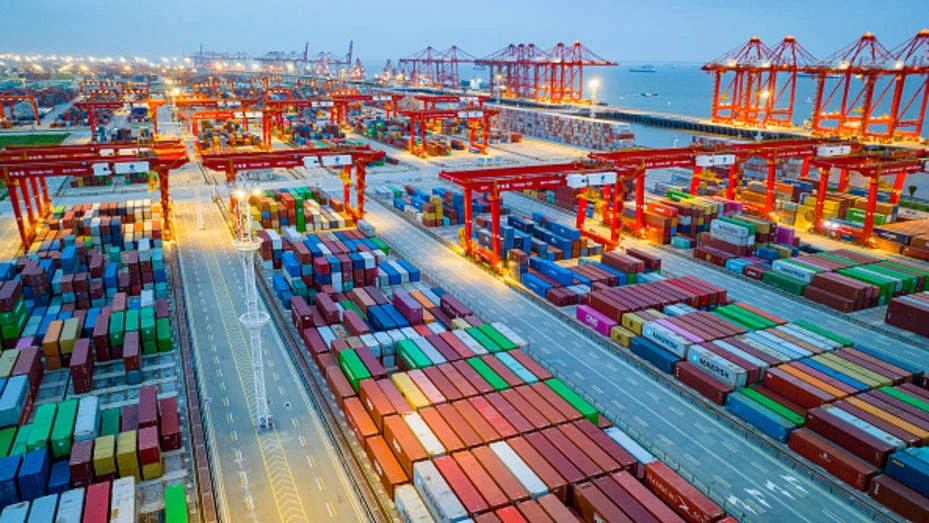
China’s exports grew 5.9% in November 2025, pushing its cumulative trade surplus for the year past $1 trillion, a striking contrast to the U.S., where shipments dropped nearly 29% amid continued trade tensions. This divergence highlights how global trade flows are evolving as both countries contend with tariffs, shifting alliances, and changing demand patterns.
For China, the rebound in export activity reversed a slight contraction in October and exceeded economists’ expectations. This growth did not come from the traditional U.S. market, where exports fell for the eighth straight month. Instead, China expanded sales to the European Union, Southeast Asia, Africa, and Latin America. Exports to the EU, for example, soared 15% year-on-year in November, reflecting a diversification strategy as U.S. tariffs remain high at around 47.5% for Chinese goods. Economists suggest this rerouting of exports helped China’s overall shipments increase by 5.9%, offsetting the 29% drop to the U.S. market.
The cumulative trade surplus exceeding $1 trillion this year by China far outstripped the previous record of nearly $1 trillion set under calmer trade conditions in 2024. Senior economists describe this surplus as an indication of China’s deeply integrated global manufacturing base and its ability to adapt quickly to obstacles imposed by tariffs. Xu Tianchen, senior economist at the Economist Intelligence Unit, said the diminished access to the U.S. market cut China’s export growth by roughly 2 percentage points, about 0.3% of GDP. He emphasized that “there’s no improvement in China’s direct exports to the U.S. Exports to the European Union, Africa and Latin America outperformed instead.”
Meanwhile, the U.S. trade picture shows a sharp decline. Exports to China plunged nearly 29% in November alone, marking an eighth consecutive month of significant contraction. Overall, U.S. exports have fallen approximately 19% from the previous year. This decline occurred despite a trade agreement reached in late October aiming to reduce tariffs and ease export controls between the U.S. and China. Washington maintains tariffs near 47.5% on Chinese goods, and Beijing’s tariffs remain about 32% on U.S. imports. Economists like Zhiwei Zhang, chief economist at Pinpoint Asset Management, argue that “while trade tensions persist, China’s export growth suggests resilience, but the U.S. export decline demonstrates challenges of sustained tariff impacts.”
Global trade shifts beyond just these two giants also provide context. The European Union has emerged as a key beneficiary of China’s redirected exports, with a 15% increase in shipments from China in November. Regions like Southeast Asia, Africa, and Latin America have also seen notable gains in Chinese imports, with increases of 14%, 26%, and 7.1% respectively. This emerging pattern underscores changes in global supply chains as countries diversify to mitigate geopolitical risks.
Looking ahead, economists remain cautiously optimistic about China’s growth prospects, predicting that its export recovery will help offset domestic demand softness and support the 5% growth target set by Beijing for 2025. Goldman Sachs forecasts that China may need to relax fiscal policies and monetary rates to sustain growth in 2026 after a weak fourth quarter in 2025. Analysts suggest that a stronger yuan could enhance consumption by lowering import prices and boosting household purchasing power. The U.S. meanwhile faces the challenge of revitalizing export markets and addressing ongoing trade imbalances that leave its shipments to China contracting significantly.
The trade landscape between China and the U.S. remains complex, shaped by tariffs, geopolitical competition, and evolving trade alliances. While China’s exports gain momentum through diversification and resilience in key global markets, the U.S. faces the difficult task of recalibrating its trade approach under continuing tensions, making next year a critical juncture for bilateral trade relations.
