
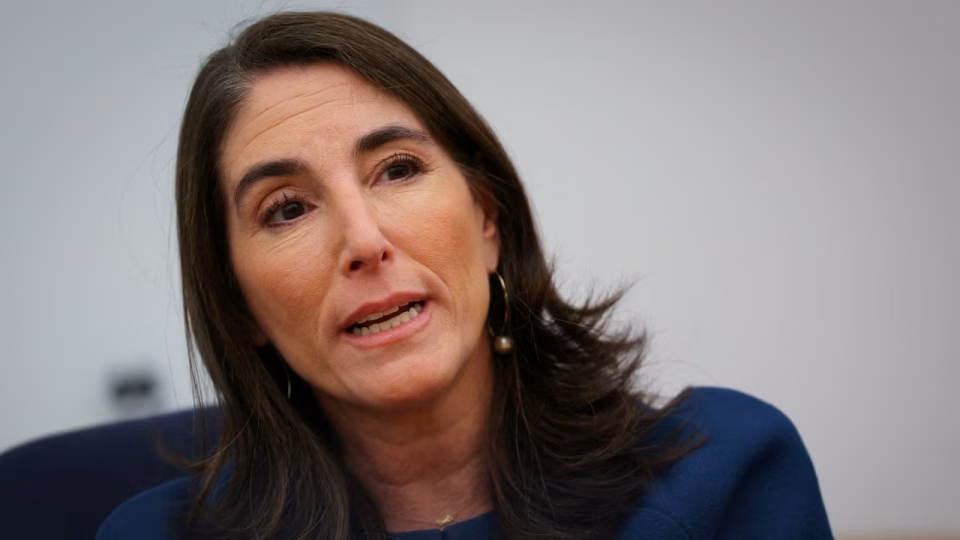
Beth M. Hammack, president of the Federal Reserve Bank of Cleveland, spoke recently about the balance between patience and vigilance as the U.S. economy faces new uncertainties from the ongoing conflict in Iran. Her message was simple but deliberate: it is too early to gauge the full economic impact of the war, and policymakers should resist the urge to act before the data clearly shows how global events might influence prices and growth.
Coming from a seasoned market participant and now a regional Fed leader, Hammack’s words reflect a cooling of expectations that interest rates will fall soon. She emphasized that holding rates steady for “quite some time” may be the most prudent course given that inflation, though lower than last year, still runs above the Federal Reserve’s 2% target. The approach underlines how global conflict can quickly alter inflation dynamics, especially when energy prices are involved.
The war in Iran has added a layer of complexity to an already delicate economic picture. So far, oil markets have shown bursts of volatility but have not yet pushed crude prices to extreme levels. Traders remain alert to any escalation that could disrupt supply routes in the Persian Gulf, which would directly raise energy costs in the U.S. economy. Rising fuel costs often feed through to transportation, logistics, and consumer goods, making the Fed’s inflation fight more complicated. If that kind of sustained price pressure materializes, monetary policymakers could be forced to delay rate cuts that were previously expected later in the year.
For now, Hammack’s call for steadiness mirrors the wider tone across the Federal Reserve’s leadership. Officials are looking for consistency in economic signals before committing to any shift in direction. Growth in the U.S. has moderated but not stalled, and the labor market, though cooling, remains healthy by long-term standards. Consumer spending has softened in recent months but continues to show resilience, especially in services. Those mixed signals explain why Hammack insists that patience is not mere hesitation but rather an intentional step toward clearer judgment.
Much of this caution also stems from the lessons of recent history. The Fed learned during the 2021 to 2023 inflation surge that acting on incomplete information can lead to policy whiplash. Cutting rates too early, only to face a renewed uptick in prices, could risk undermining the credibility that the central bank worked hard to restore. Hammack’s statement signals awareness of that risk, suggesting that policymakers prefer to err on the side of waiting rather than rushing.
Beyond the immediate policy implications, her remarks highlight how interconnected today’s global economy has become. A regional conflict thousands of miles away can ripple through supply chains and energy markets almost instantly. Even if the U.S. economy proves relatively insulated, a significant rise in oil prices or shipping costs could slow progress toward lower inflation. Hammack’s comments effectively acknowledge this interconnectedness, reminding investors and households that monetary policy cannot easily offset geopolitical turbulence.
Still, not everyone agrees with such caution. Some economists argue that keeping interest rates high for too long could dampen business investment and household borrowing just as inflation moderates. Mortgage rates remain elevated, and smaller companies report that credit conditions have tightened considerably. Hammack’s view, however, suggests the Fed is prepared to accept slower momentum if it means preventing a repeat of the inflationary persistence that haunted the economy only a few years ago.
Whether the conflict in Iran becomes a defining factor for global markets or simply a passing shock will likely dictate how long the current holding pattern lasts. For now, Hammack’s emphasis on patience serves as both a message of caution and reassurance. In moments of uncertainty, waiting can be the most difficult decision, but also the most responsible one for those steering the world’s largest economy.
