
A good share of Canada’s natural gas starts its journey in the Montney, a rock formation buried deep beneath northeastern British Columbia and northwestern Alberta. Large energy companies have drilled it for years. Smaller players are still working to prove what their own corners of it can do, and Coelacanth Energy Inc. (TSXV: CEI) is one of them. Its latest update, released today, describes a young company that has had a bumpy few months and is now heading into an important stretch.
Coelacanth’s land sits in an area it calls Two Rivers, a single connected block of roughly 150 sections in northeastern British Columbia. The company drills wells there and sells the oil and gas they produce. Location matters a great deal in this business, because gas is only worth something if it can reach a buyer. Coelacanth ships its gas on the Westcoast pipeline, which links to Coastal GasLink, the line that carries gas to the LNG Canada export terminal at Kitimat. On September 29th, the partners behind LNG Canada agreed to build a second phase that will double the plant’s size, with the expansion expected to start operating in the early 2030s. That is a long way off, but it means more of British Columbia’s gas should eventually find its way to overseas buyers.
The past few months were not smooth. Maintenance on the Westcoast pipeline and at a nearby processing plant forced Coelacanth to shut in all of its production from September 7th to October 21st. Nothing was wrong with its wells. The company simply had nowhere to send its product while the shared infrastructure was being worked on. Even with that interruption, third quarter output was up by nearly half compared with a year earlier, and production has since recovered to roughly 6,459 barrels of oil equivalent per day.
There is a catch in that growth. Most of the new production is natural gas, and gas in western Canada is very cheap. This past quarter, Coelacanth received only $0.91 (C$1.31) per thousand cubic feet. The company actually received better prices for its oil this year, but oil now makes up a smaller part of what it sells. The result is a company producing more while earning less for each unit it pulls out of the ground.
Even so, the business is much bigger than it was. Sales over the first nine months of the year reached $39.6 million (C$56.8 million), about three times the level of a year earlier, and the company turned a profit for the period. The shutdown did push the third quarter itself into a small loss.
The bigger change is in what Coelacanth owes. It started the year with net debt of about $53.0 million (C$76.0 million) and has cut that to roughly $10.1 million (C$14.5 million). Most of that came from selling new shares, not from cash produced by the wells. Earlier this year, the company raised $55.8 million (C$80.0 million) from investors, and it has since spent some of that money drilling new wells. The tradeoff is simple: the company carries far less debt, but each existing share now represents a smaller piece of it.
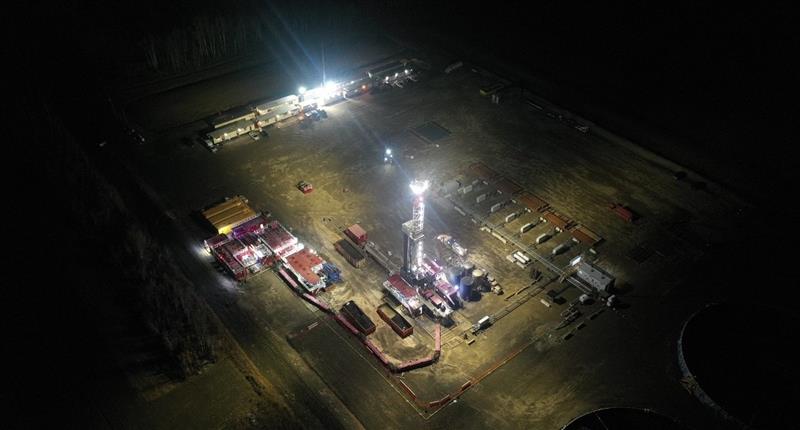
What happens next depends heavily on a set of four new wells, known as the 9-32 pad. Coelacanth has just started flowing back the water used to complete them and expects test results within weeks. Three of the wells sit in a zone the company already knows well. The fourth is a bolder bet, located about seven miles from an earlier successful well in an area where no future drilling locations have yet been counted as reserves. If it performs, it could open up a large new section of the company’s land.
Those results will go a long way toward showing whether Coelacanth’s land is as valuable as the company believes. With less debt, production back online and a pipeline route toward Canada’s growing LNG export industry, the company has given itself room to find out. The price of natural gas, which it cannot control, remains the biggest open question.
