
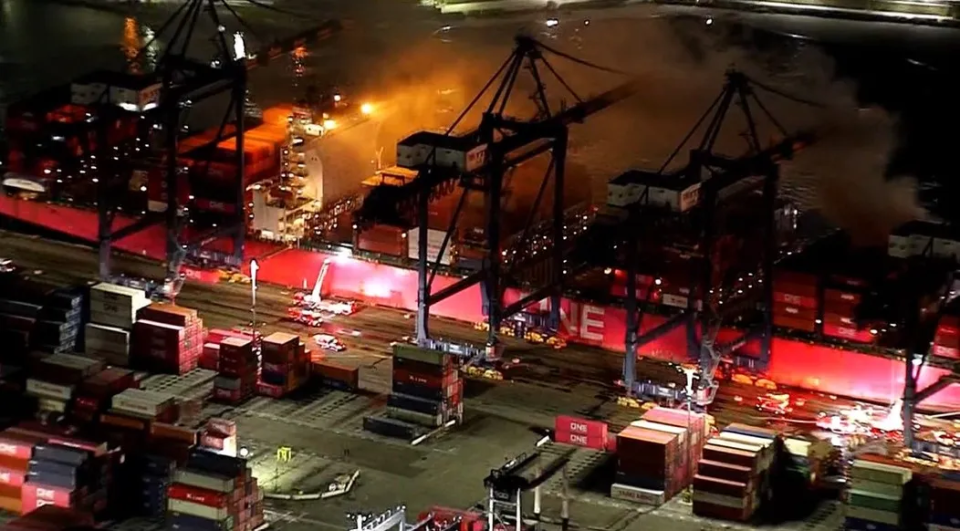
A fire that erupted on a container ship just off the Port of Los Angeles is creating more than smoke above the water. The blaze, which began late last week aboard the ONE Henry Hudson, has led to significant disruptions in the movement of goods at the busiest container port in the Western Hemisphere. While local firefighting crews continue their efforts to control the fire, the response from the federal government has been notably absent, raising concerns about how quickly cleanup and recovery will proceed.
Gene Seroka, the executive director of the Port of Los Angeles, has been vocal about the need for urgent federal involvement. “We need the Trump administration to help with assistance for cleanup,” Seroka said, underscoring the stakes as the impact extends beyond the immediate scene of the fire. Despite repeated efforts to engage federal officials, including attempts to secure meetings with cabinet members and the U.S. Trade Representative, Seroka has found little to no engagement from Washington. This lack of coordination threatens to slow the assessment of damage, the clearing of damaged cargo, and the resumption of normal port operations.
The vessel was moved about four miles offshore to prevent the fire from affecting the port infrastructure, allowing terminal work to partially resume but leaving a significant backlog and uncertainty for importers and exporters. The ship was about two-thirds full, carrying around 8,000 containers, of which approximately 117 have been physically compromised. Some containers include sensitive and potentially hazardous materials such as lithium-ion batteries, complicating firefighting and salvage efforts and requiring specialized handling.
The implications for the broader U.S. supply chain are substantial. The Port of Los Angeles handles a critical volume of imports, including machinery, automobile parts, and medical supplies such as personal protective equipment. Delays in cargo processing and damage assessment ripple through manufacturers, retailers, and ultimately consumers. Factories waiting for parts might reduce output and retailers could face shortages during the crucial holiday period. Seroka emphasizes the urgency: without federal support to accelerate cleanup, U.S. companies face prolonged uncertainty regarding their freight, putting millions of dollars of goods at risk.
History shows that federal coordination in times of crisis at key infrastructure sites has often made a difference. Past port disruptions, such as strikes, natural disasters, or major accidents, have seen federal agencies stepping in to coordinate cleanup, provide financial support, and fast-track recovery. Seroka contrasts the current situation with previous administrations, noting that when federal involvement occurs, progress speeds up markedly. The current silence from the Trump administration stands out as unusual, especially given the scale of the crisis and the port’s economic significance.
The U.S. Coast Guard is leading the salvage operation, with firefighting boats and specialized teams on site. Yet, the absence of a broader federal cleanup coordination leaves local authorities and port management strained. Seroka’s outreach to state leaders and other officials signals a scramble to build support networks in the absence of federal engagement.
This event highlights vulnerabilities in the U.S. supply chain and infrastructure management. Container ships catching fire are notoriously difficult to manage even under the best circumstances, due to the hazardous materials on board and the complexity of firefighting on water. The proximity to shore and port facilities heightens the stakes, as damage could extend beyond the vessel itself to the port’s cranes, terminals, and surrounding logistics networks.
For businesses relying on the timely arrival of products, this fire is a stark reminder of risks that can disrupt global trade flows, and how critical government involvement can be in managing those risks. The longer the cleanup and assessment take, the more economic uncertainty builds, and the harder it will be for companies to plan production, distribution, and sales.
