
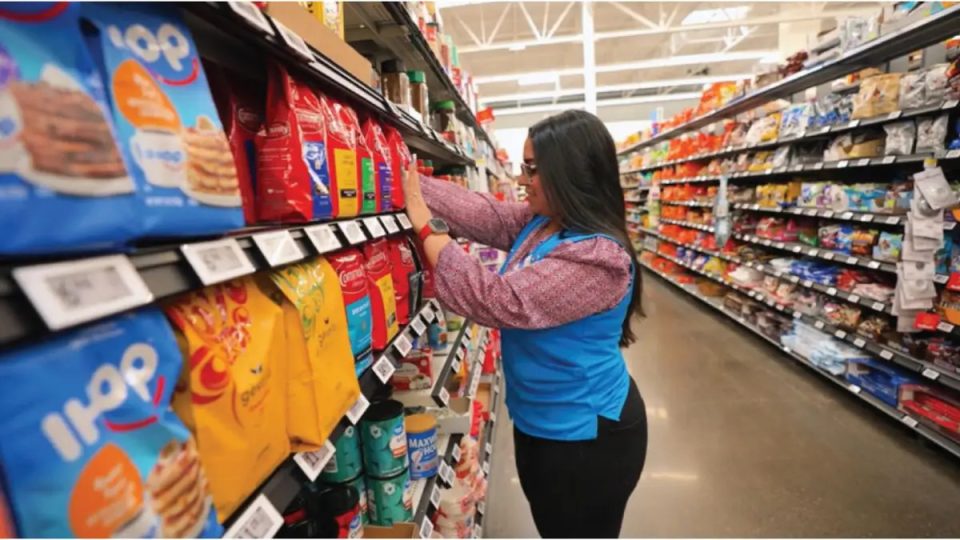
Walk down any supermarket aisle and you will pass thousands of small price tags. For decades they were paper, and every price change meant someone printing a new label, finding the right spot on the right shelf and swapping it by hand. In a large store, that adds up to many hours spent on a job customers never notice until it goes wrong.
Electronic shelf labels replace that paper with small, battery-powered displays clipped to the shelf edge. Most use e-paper, the low-power screen found in e-readers, so batteries last for years. Each label talks wirelessly to a base station in the store, linked to the retailer’s pricing system. When head office changes a price, every label in every store can update within minutes.
Saving labor was the original selling point, but the uses have grown. Labels can flash to guide staff picking online orders and signal which shelf needs restocking. Newer systems pair labels with shelf cameras and analytics software, and some retailers now sell advertising on in-store screens to the brands they carry. That turns a pricing tool into a data platform and lets suppliers earn recurring software revenue alongside one-time hardware sales.
Estimates vary, but Global Market Insights puts global sales at $2.8 billion in 2025, rising to $3.5 billion this year and potentially reaching $10.28 billion by 2035, or growth of about 13.9% a year.
The business has a few quirks. Contracts tend to be large and lumpy, because a single grocery chain converting hundreds of stores can swing a supplier’s revenue for a year, and the end of that rollout can hurt just as much. Suppliers also need scale to buy components cheaply and fund software development. Those pressures favor bigger players, which makes consolidation a natural next step.
That step arrived today. Shares of Pricer AB (publ) (STO: PRIC-B.ST), a Stockholm company founded in 1991 that sells shelf labels and in-store software across Europe, North America and Asia, rose more than 20% at the open after VusionGroup SA (EPA: VU.PA) announced a recommended cash offer for the whole company. [Investing.com]
Vusion is offering $0.59 (SEK 6.00) per share for both Class A and Class B shares, valuing Pricer at roughly $97.1 million (SEK 980.4 million). That is a 29.6% premium to yesterday’s closing price of $0.46 (SEK 4.63) and a 41.4% premium to the average price over the prior 90 trading days. Pricer’s board unanimously recommends the offer, Grant Thornton judged it fair from a financial perspective, and Sterling Strategic Value Fund, which holds about 14.15% of the shares, has irrevocably agreed to accept even if a higher bid appears.
The offer document is expected around December 7th, with acceptances running from December 8th to January 5, 2027, and settlement starting January 12, 2027. Vusion wants more than 90% of the shares, although it can waive that condition, and regulatory approvals are still required. The deal will be paid for with cash and debt, with no financing condition. If Vusion crosses 90%, it plans to buy out the remaining holders and delist Pricer from Nasdaq Stockholm.
Recent results help explain the board’s support. Third-quarter net sales fell to $49.9 million (SEK 504.2 million) from $59.3 million (SEK 598.4 million) a year earlier, partly on lower volumes with a major French grocer. Yet order intake rose 27.4% and gross margin reached 30.4%, so Vusion is buying a business whose profitability was improving.
For Vusion, the prize is more than extra labels. It plans to offer Pricer’s retailers its vision AI, retail media and analytics tools, turning every store running Pricer’s system into a ready-made audience for software Vusion has built. Buying that installed base is faster than winning those chains one contract at a time.
With shares trading below $0.59 (SEK 6.00), the gap to the offer is the reward traders want for waiting until January and for the risk that a condition trips the deal up. A rival bid is possible, but Sterling’s commitment, which holds even against a higher offer, makes one harder to pull off. A company that spent 35 years turning the paper price tag into software now looks set to join the rival it competed against.
