
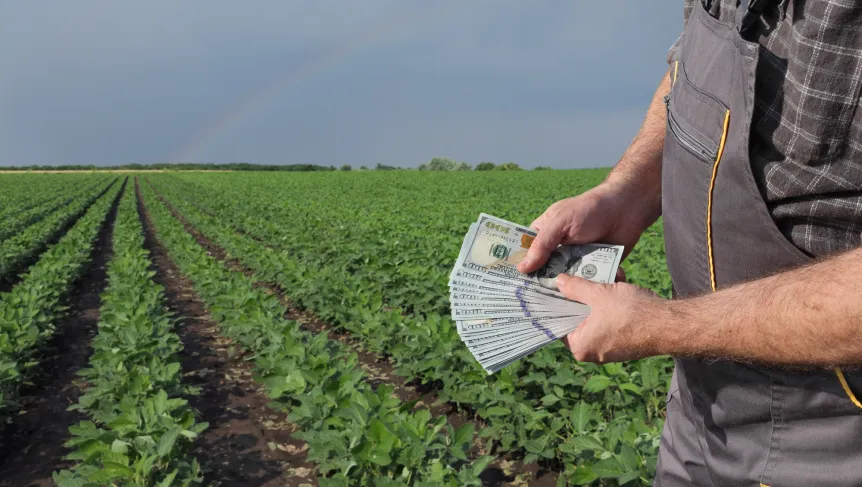
The U.S. Department of Agriculture has begun rolling out payments under the Farmer Bridge Assistance Program, marking a key step in the government’s effort to stabilize an agricultural sector still under pressure from low commodity prices and high production costs. The program, part of a $12 billion aid initiative announced by President Trump late last year, is designed as a one-time measure to help offset the financial strain brought on by a combination of shifting trade conditions and long-term market sluggishness.
Officials describe the program as a short-term measure designed to “bridge” farmers through a difficult financial cycle rather than serve as a permanent structural fix. Under the plan, each qualifying farmer will receive per-acre payments calculated from recent yield averages, regional input costs, and the market value of their crops. Preliminary USDA data indicate that payment differences across states reflect variations in farmland productivity and localized expenses such as fuel, fertilizer, transportation, and irrigation. Current rates set per acre include $44.36 for corn, $30.88 for soybeans, and $39.35 for wheat, with minor adjustments depending on specific regional cost burdens.
The payments are being distributed gradually, with the first round expected to reach most producers during the first quarter of 2026. In some states, particularly in the Midwest and Great Plains, local agencies have requested additional review time to align state registration systems with federal data. That means farmers in those regions could see their payments later in the spring. According to officials familiar with the rollout plan, the USDA’s goal is to ensure each farmer’s application is verified and processed properly to prevent overpayment or duplication from earlier subsidy programs.
Farm groups across several states have responded with cautious optimism. Many producers view the payments as modest support rather than a long-term solution to challenges facing U.S. agriculture. A soybean grower in Iowa, interviewed by national farm media earlier this week, described the program as “timely but incomplete,” noting that while input costs remain high, international buyers have yet to return to pre-tariff demand levels. His view reflects a broader sentiment among U.S. farm operators who have faced declining export margins since mid-2024.
From the policy side, department representatives have emphasized that the Farmer Bridge Assistance Program is not an open-ended subsidy but rather a targeted relief mechanism intended to mitigate the short-term consequences of market disruptions. They suggest that while macroeconomic pressures, including uncertainty in global grain demand, are beyond the department’s control, direct per-acre payments help “maintain operational continuity” for growers who continue to supply essential food commodities. Economists point out that the program’s design marks a shift away from previous blanket payments and toward a more data-driven method that aligns aid with verifiable cost indicators rather than generalized crop categories.
Variation among states also stems from differing administrative models and the diversity of crops under cultivation. States with strong corn, soy, and cotton output tend to see higher relative payment averages, primarily due to the larger capital investment those crops require. Meanwhile, specialty crop states, such as those growing fruits and vegetables, receive smaller but still significant per-acre supports meant to stabilize smaller operators.
The program’s timing comes at a delicate moment for U.S. agriculture. Inflationary pressure on fertilizer and diesel prices has eased compared to peaks in 2022 and 2023, but most operational costs remain well above pre-pandemic levels. At the same time, global demand for certain commodities, especially corn and soy, continues to fluctuate because of economic conditions in major import markets such as China and the European Union.
For many farmers, the payments represent breathing room rather than relief. They help cover immediate expenses that often determine whether a farm can secure next-season operating credit or retain full labor crews during planting season. Agricultural analysts say that while this one-time support may not transform long-term profitability, it could help reduce short-term liquidity strain across rural communities. By easing some of that financial stress, policymakers hope to buy time for a broader adjustment in trade and input markets before the 2027 farm season begins.
