
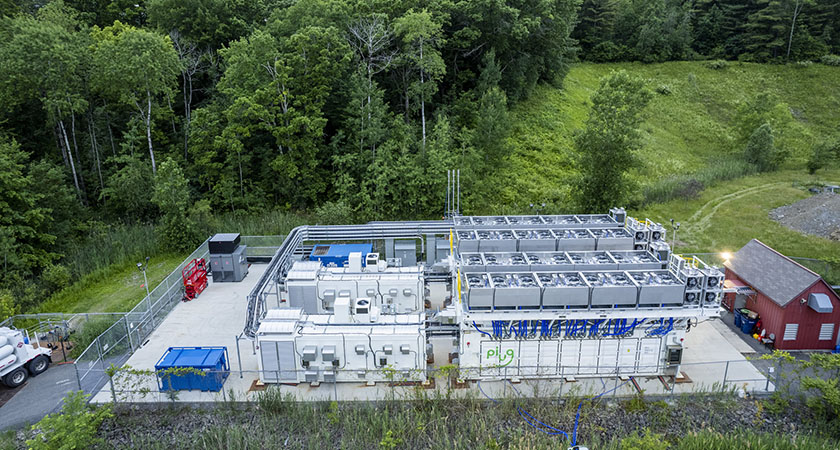
Fuel cells occupy a less familiar corner of the clean-energy world than solar panels, wind turbines, or electric-vehicle batteries. Yet they address one of the most persistent problems in the energy transition: producing dependable electricity without relying entirely on weather-dependent generation. A fuel cell converts chemical energy from a fuel, often hydrogen or natural gas, directly into electricity through an electrochemical reaction. Because it does not burn fuel in the conventional sense, it can produce power with lower local emissions and less noise than many traditional generation technologies.
The basic idea is straightforward. A fuel cell has two electrodes separated by an electrolyte. Fuel enters at one side, oxygen from the air enters at the other, and a chemical reaction moves electrons through an external circuit. That movement of electrons is electricity. Unlike a battery, which stores energy internally and must be recharged, a fuel cell continues producing electricity as long as it receives fuel and oxygen. That makes it useful for facilities that need steady power for long periods, including hospitals, factories, wastewater plants, utilities, and increasingly data centres.
Fuel cells also differ from solar and wind in an important way. Solar arrays generate electricity when sunlight is available, and wind turbines depend on wind conditions. Fuel cells can run continuously, which places them closer to conventional power plants in terms of reliability. They are modular, meaning operators can install several smaller units rather than one enormous facility. That flexibility is part of why fuel cells are often described as distributed power: electricity is generated close to where it will be used rather than transmitted across long distances.
Within the broader clean-energy industry, fuel cells sit alongside renewable generation, battery storage, grid upgrades, hydrogen production, and low-carbon fuels. They are not a replacement for every energy technology. Instead, they can complement renewables by supplying power when intermittent sources are unavailable. They can also serve locations where expanding the grid is expensive, slow, or impractical. As electricity demand rises from electrification, industrial activity, and data centres, the appeal of on-site generation that can operate around the clock has grown.
FuelCell Energy, Inc. (NASDAQ: FCEL) is one of the companies working in this field. The Connecticut-based clean-energy technology company designs, builds, operates, and services high-temperature fuel cells for electric power generation. Its systems are intended to provide continuous, scalable power at the point of use for utilities, industrial customers, data centres, and other distributed-generation users. The company also works with solid oxide electrolysis technology for distributed hydrogen production.
FuelCell Energy has announced that it completed the second tranche of a $49 million financing package supported by the Export-Import Bank of the United States, known as EXIM. The final tranche was approximately $24.7 million before closing and transaction fees. EXIM approved the full financing package in June, and the completed arrangement supports the delivery of five 2.8 MW FuelCell Energy Blocks to Gyeonggi Green Energy in South Korea. Together, those units represent 14 MW of generating capacity.
The South Korean project is not a small demonstration. Gyeonggi Green Energy has nearly 60 MW of installed capacity and has operated continuously for 13 years, making it one of the largest fuel-cell installations in the world. The site illustrates how fuel cells can move beyond experimental projects and become part of long-running power infrastructure. It also gives FuelCell Energy a reference point for selling its technology to utilities and industrial operators in other markets.
The financing arrangement was structured under EXIM’s loan guarantee program and arranged with Private Export Funding Corporation, with support from AF Capital. FuelCell Energy manufactures its fuel-cell platforms in Torrington, Connecticut, and says more than 90% of its supply chain is sourced in the United States. In practical terms, the deal connects American manufacturing with foreign demand for power equipment, while providing financing that can help make an international sale commercially workable.
For a company in the clean-energy sector, financing matters as much as technology. Building and delivering power systems requires capital, and projects often involve long development timelines. Export financing can help a manufacturer compete when buyers need structured payment terms or when a project requires substantial upfront investment. FuelCell Energy has completed EXIM-supported financing in 2024 and 2025 as well, suggesting that this approach has become part of how it funds international growth.
The announcement does not resolve every question surrounding FuelCell Energy’s business, including future project timing, profitability, or the pace of broader demand. But it underscores a more important point: fuel cells are no longer merely a promising clean-energy concept. With long-running installations, export-backed financing, and growing pressure on power grids from data centres and electrification, the technology is beginning to prove it can deliver the one thing renewable generation alone cannot always provide, dependable, around-the-clock electricity. For FuelCell Energy, the task now is to convert that proof point into consistent commercial momentum.
