
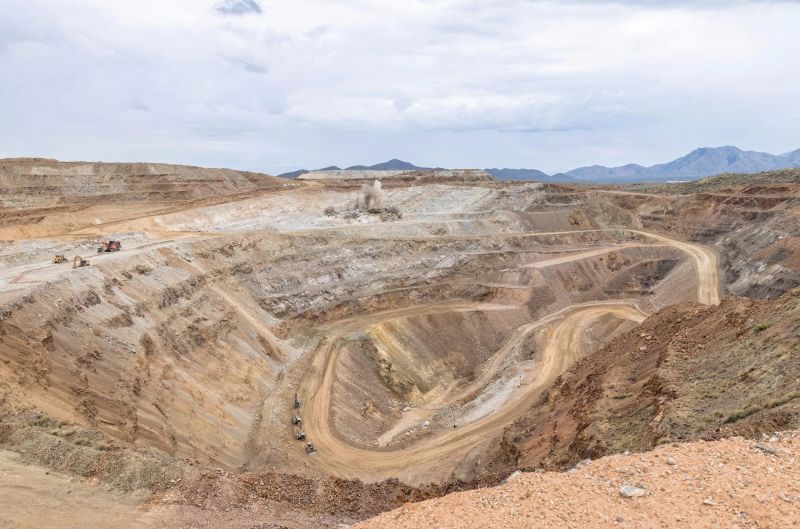
A Phoenix-based copper company is preparing to give U.S. investors a more direct way to own a piece of its Arizona mining business. Gunnison Copper Corp. (OTCQB: GCUMF, TSX: GCU) says its American Depositary Receipts, or ADRs, are expected to begin trading on NYSE American under the ticker symbol GUNN on or about October 26th. The move is subject to the effectiveness of the company’s registration statement with the U.S. Securities and Exchange Commission and final exchange approvals.
For readers unfamiliar with ADRs, they are U.S.-traded securities that represent shares in a company based outside the United States. In Gunnison’s case, each ADR will represent 30 common shares. The company already trades in Canada on the Toronto Stock Exchange under GCU and in Germany on the Frankfurt Stock Exchange under 3XS0. The new U.S. listing is meant to complement those markets, not replace them.
The listing also comes with an important distinction: Gunnison is not selling new shares or raising money through the ADR program. Instead, it is creating another way for existing shares to be held and traded in U.S. dollars. U.S. shareholders who want ADRs can begin converting common shares through The Bank of New York Mellon, the depositary bank for the program, beginning October 23rd. Conversion is optional, and current shareholders do not need to act.
Gunnison operates in southern Arizona, a region with a long mining history and growing importance in conversations about domestic mineral supply. The company describes itself as a pure-play copper developer and producer, controlling the Cochise Mining District, which contains 12 known deposits within an eight-kilometre economic radius.
The company’s Johnson Camp Mine is already producing finished copper cathode. Copper cathode is a refined form of copper used in electrical wiring, construction, electronics, and industrial equipment. Gunnison says the mine and its on-site solvent extraction and electrowinning, or SX/EW, facility allow copper to be mined, processed, and refined at the same location. That avoids sending concentrate overseas for smelting or refining.
That production detail matters because copper is central to modern infrastructure. It is used in power grids, electric vehicles, data centres, defense equipment, and advanced manufacturing. Gunnison says it is supplying copper to the U.S. defense sector and Amazon Web Services, the cloud-computing arm of Amazon (NASDAQ: AMZN).
The U.S. listing arrives as policymakers and companies pay closer attention to where critical minerals come from. Copper is not always grouped with rare earths or lithium in public discussion, but it is essential to electrification, military systems, and digital infrastructure. A domestic producer that can deliver finished cathode has a different supply-chain profile from a company that must rely on foreign processing.
Gunnison’s Johnson Camp operation is funded by Nuton LLC, a Rio Tinto venture. The company says the mine has production capacity of up to 25 million pounds of finished copper cathode annually. It also says Johnson Camp moved from a construction decision to production in less than 18 months, a pace it presents as evidence that its Arizona permitting experience and existing infrastructure can support future development.
Johnson Camp is only part of Gunnison’s story. The company’s flagship Gunnison Copper Project sits roughly 1.5 miles from Johnson Camp and is intended to become a much larger source of production. According to the company, the project’s main pit contains measured and indicated mineral resources of more than 846 million tons at a total copper grade of 0.33%, containing 5.19 billion pounds of copper.
A preliminary economic assessment completed in March estimates an after-tax net present value of $2 billion at an 8% discount rate, an internal rate of return of 23%, and a payback period of 3.9 years. The project is designed as an open-pit mining operation using heap leaching and SX/EW processing to make finished copper cathode on site, with a direct rail link.
Those figures are encouraging on paper, but they come with an important caution. A preliminary economic assessment is an early-stage study, not a final decision to build a mine. Gunnison’s own disclosure notes that the assessment includes inferred mineral resources, which are considered too speculative to be treated as mineral reserves. Mineral resources that are not reserves do not have demonstrated economic viability.
For Gunnison, the immediate milestone is the expected NYSE American debut under GUNN. For investors, the more meaningful question is whether the company can turn its operating mine, Arizona infrastructure, and large resource base into a durable expansion of U.S. copper production. The listing may widen the audience, but the company’s progress at Johnson Camp and the eventual development path for the Gunnison Copper Project will determine whether that attention translates into long-term value.
