
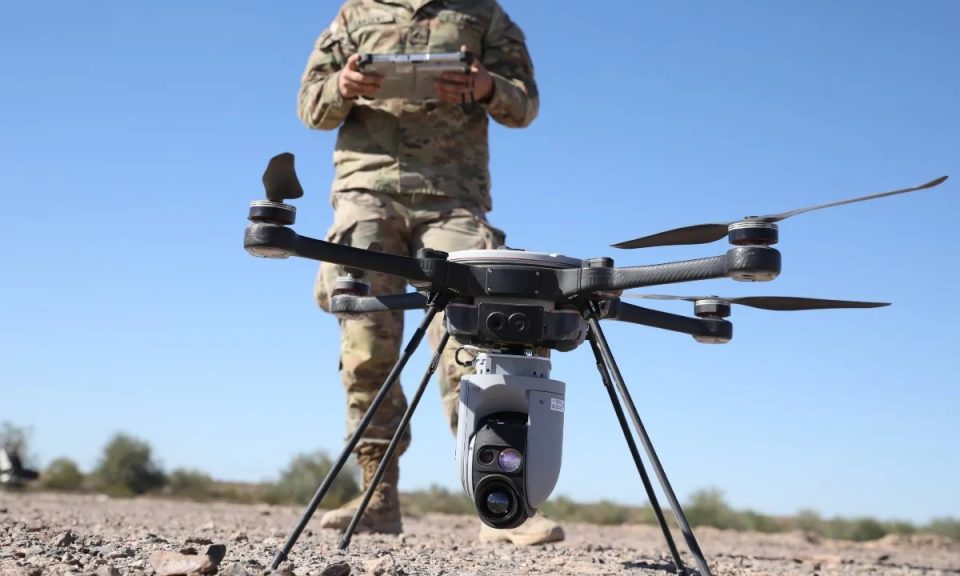
For most of the last century, military aircraft were expensive, flown by crews, and built in small numbers over many years. Unmanned aircraft systems are the formal name for military drones plus the ground equipment and people needed to operate them, and they have broken that pattern. Some are large surveillance planes that circle for hours. Others fit in a backpack and cost little enough to be lost on purpose. The war in Ukraine showed how far this can go. Reuters reported that Ukraine was expected to produce between 6 million and 7 million small attack drones in 2026 alone.
The U.S. military has been working to catch up. A memo from the Defense Secretary last summer called for every squad to be outfitted with small, one-way attack drones by the end of fiscal 2026. By June, the Pentagon had ordered 20,000 small drones from 10 vendors under the first phase of that push. The broader Drone Dominance Program will spend about $1 billion over two years and aims to buy more than 200,000 drones by 2027.
Estimates of the overall market vary a lot, depending on what researchers count. Global Market Insights puts worldwide military drone spending at about $20.9 billion in 2026, rising to roughly $62.3 billion by 2035. Volume is only part of the story. Buyers increasingly want aircraft that fly with more autonomy, keep working when GPS signals are jammed, and accept new sensors without a full redesign.
Much of this buying runs through a contract type called an indefinite delivery, indefinite quantity award, usually shortened to IDIQ. It works a bit like a preapproved shopping account. The government sets the terms and a maximum dollar value, known as the ceiling, and then places individual task orders as needs come up. Only those funded task orders become revenue. A company can win an IDIQ with a large ceiling and end up collecting far less, which is worth remembering whenever a contract headline crosses the wire.
That distinction frames today’s announcement from AEVEX Corp. (NYSE: AVEX), a defense technology company based in Solana Beach, California. AEVEX said it won a multi-year IDIQ with a ceiling of nearly $400 million from a U.S. customer it did not name. The award covers unmanned aircraft systems and related support services. The company was careful to note that the figure is a maximum potential value rather than guaranteed revenue. Chief Executive Officer Roger Wells said the award helps customers field aircraft “that can be manufactured at scale and adapted as mission needs evolve.”
AEVEX builds autonomous drones, loitering munitions (aircraft that wait over an area before striking), and airborne surveillance systems. It also modifies aircraft and offers counter-drone tools. In drone circles, it is best known for the Phoenix Ghost one-way attack aircraft, first announced in 2022 as part of U.S. aid to Ukraine. The company went public on April 17th at $20 per share. On September 8th, it closed its purchase of BlackSea Technologies, a Baltimore company, in a deal worth up to $650 million. BlackSea builds unmanned surface and underwater vessels.
The timing of the award stands out. AEVEX reports third quarter results after the market closes on Wednesday, followed by a conference call at 5:00 p.m. Eastern Time. Expectations are low. Analysts expect revenue of about $150.8 million, down roughly 25% from the $201.8 million reported in the second quarter, largely because the company’s biggest program, known as Deep Strike, is winding down. The shares have roughly halved as investors priced in that slowdown. In August, management guided to full year revenue between $700 million and $720 million, a figure that excluded any contribution from BlackSea.
A contract ceiling is an invitation to compete for work, not a sale. The more useful signals will come over the next several quarters. Watch how quickly the customer issues task orders under this award, whether management reaffirms or trims its outlook, and how much the new maritime business can help fill the gap Deep Strike leaves behind. Tomorrow’s report should begin to answer at least some of those questions.
