
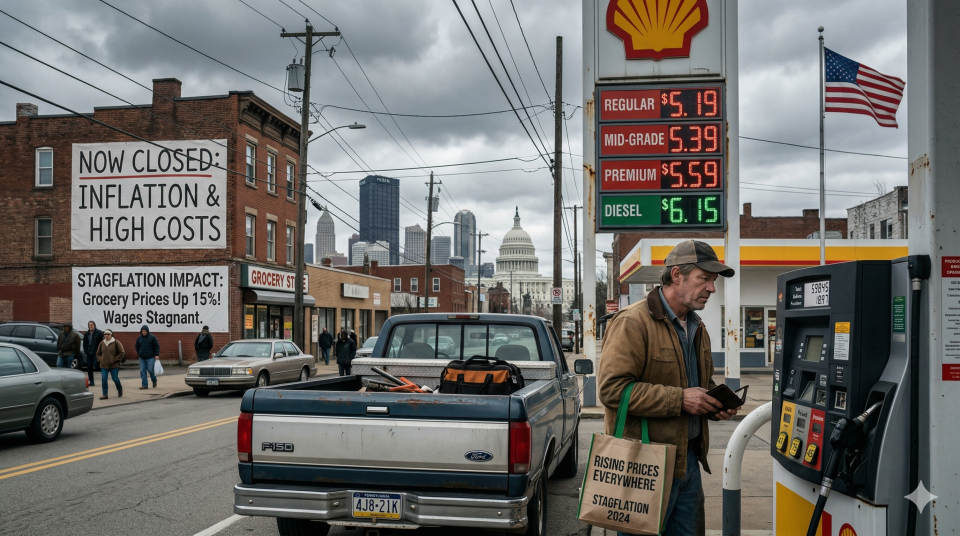
Stagflation used to sound like a relic of the 1970s, a term tied to oil shocks, long gas lines, and lost jobs. Today it has crept back into financial conversations, but it looks different. As noted in a recent analysis in VBNGtv’s article Why Stagflation Talks Are Heating Up, renewed stagflation concerns are gaining traction among economists and market analysts, reflecting the uneasy mix of stubborn inflation and uneven growth shaping 2026. In the U.S. economy, what many economists now call “stagflation lite” is taking hold: growth that is just strong enough to keep jobs from collapsing while inflation remains stubbornly above target. For business leaders and managers, this setup is less about a sudden crash and more about a slow, grinding squeeze on margins, spending, and strategic planning.
At the heart of the issue is a mismatch between expectations and outcomes. The Federal Reserve still expects around 2% GDP growth in 2026, with only one projected rate cut by year end, even as core inflation remains above 2.5%. That means companies are operating in an environment where demand is not falling off a cliff, but it is not expanding either. Revenue growth tends to be modest, yet costs stay elevated, especially in areas like logistics, energy, and higher-wage service roles. The result is tighter profit margins across many sectors, from retail and food services to light manufacturing and transportation.
Tariffs and trade policy are adding another layer to this squeeze. Studies from the Federal Reserve Bank of San Francisco show that higher U.S. tariffs reduce overall employment and real income, even as they provide some short-term support to certain manufacturing jobs. For businesses importing inputs or finished goods, the drag falls directly on the bottom line. Some companies pass those costs on to customers, but when households are already stretched by higher rents and utilities, that risks slowing sales further. The effect is especially noticeable in sectors that rely heavily on global supply chains, where companies must choose between swallowing higher input prices or risking customer resistance to higher selling prices.
Labor markets are also behaving in ways that feel more stagflationary than cyclical. Job growth has cooled, and unemployment has inched up, yet wage growth in many service sectors remains relatively high. This means that payroll costs are not collapsing as they would in a classic recession, even as sales growth slows. For mid-size businesses, that combination can be particularly awkward. They may be reluctant to lay off workers that took time and money to hire, but they also cannot count on double-digit revenue growth to cover the gap. The result is a cautious approach to expansion, with many companies focusing on efficiency, automation, and tighter inventory management instead of big hiring sprees.
The Federal Reserve’s stance reinforces this cautious tone. Officials have signaled that any rate cuts in 2026 will be gradual and conditional on inflation behaving, not on a sudden weakening of the economy. That leaves businesses with little hope of a quick return to cheap borrowing while still having to plan for higher financing costs on equipment, real estate, and working capital. At the same time, consumers face the same pressure. They are still spending, but they are trading down within categories, choosing value brands, and delaying big discretionary purchases. The effect is a subtle shift in demand patterns rather than a sharp drop, which makes it harder for companies to read the market and adjust quickly.
For investors, the stagflation-lite picture is reflected in a more fragmented market. Some sectors, like energy and certain industrials, benefit from sustained demand and pricing power, while others, especially consumer-discretionary and some tech-driven growth names, struggle to justify previous valuations. The broader effect is a focus on companies with pricing power, strong balance sheets, and the ability to manage costs more tightly than competitors. On Wall Street, this shows up as a rotation away from speculative growth bets and toward more defensively oriented businesses, even though the overall S&P is not in a bear market, at least not yet.
Looking ahead to the coming quarter, the risk is not a sudden collapse but a gradual worsening of the stagflation-lite pattern. If inflation proves stickier than the Fed projects, rate cuts could be delayed even further, extending the period of higher financing costs and tighter margins. At the same time, any new tariff rounds or geopolitical disruptions to energy and shipping could push core inflation back toward the mid-2% range, even if headline numbers look more benign. For businesses, that scenario points to a focus on operational discipline, stress-testing cost structures, and building some fat into contingency planning instead of counting on a smooth rebound.
In this environment, the biggest winners are likely to be companies that can adapt without overreacting. Those that understand that growth may be modest for several quarters, that input costs will remain elevated, and that consumers will remain price-sensitive are better positioned to navigate the quiet drag of stagflation lite. The U.S. economy is not heading into a repeat of the 1970s, but it is settling into a phase where slow growth and persistent inflation are the default backdrop, not a temporary blip.
