
Power plants have long relied on steam to turn heat into electricity. That familiar process heats water into steam, spins turbines, and generates power before condensing it back to water. Now a different approach uses supercritical carbon dioxide, or sCO₂, as the working fluid instead. This shift promises higher efficiency from the same heat sources, especially waste heat from industries like steelmaking. Let’s explore how this works and where it stands today.
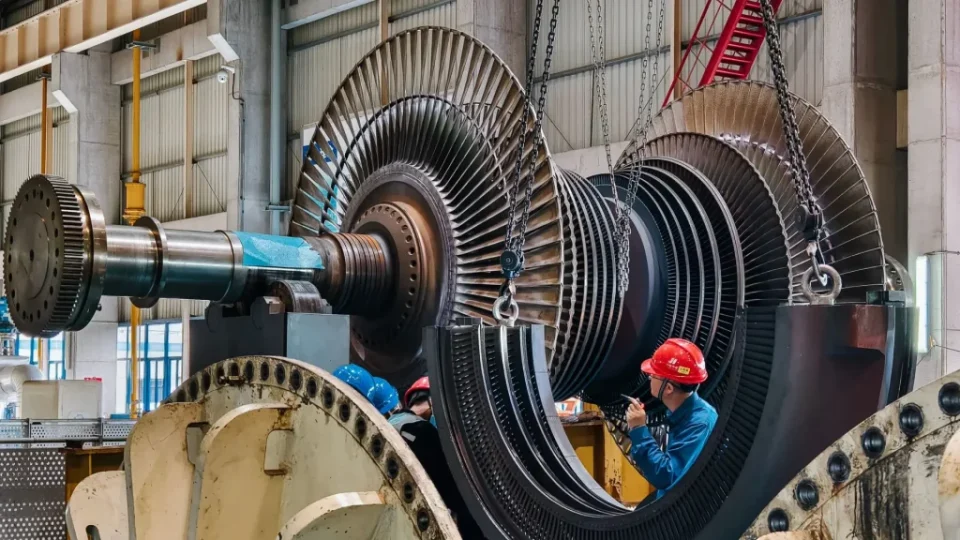
China National Nuclear Corporation (SSE:601985) unveiled the world’s first commercial sCO₂ power generator, called Chaotan One or Super Carbon No.1, at a steel plant in Liupanshui, Guizhou province. Two 15 MW units, totaling 30 MW, connected to the grid in December 2025. They capture medium to high temperature waste heat from the steel plant’s sinter line, where exhaust reaches 400 to 750 degrees Celsius. In a closed loop Brayton cycle, CO₂ stays above its critical point, acts like a dense gas, and recirculates without burning any fuel. The developer, Nuclear Power Institute of China under China National Nuclear Corporation, calls this a demonstration that solves bottlenecks in small to medium scale heat recovery.
This setup delivers clear gains over traditional steam cycles at the same site. Power generation efficiency runs about 85% higher, with net electricity output 50% greater from identical waste heat streams. The plant footprint shrinks to half that of a steam equivalent, and it guzzles far less water. Expect around 70 million kWh of extra electricity yearly, translating to $4.3 million (CNY 30 million) in revenue at local rates, all without added fuel costs. These results mark sCO₂’s jump from labs and pilots to revenue generating grid operation, though as a first of its kind, it remains a demonstration rather than a massive utility build.
In the U.S., the Supercritical Transformational Electric Power Demo, or STEP, represents the top pilot effort. Located in San Antonio, Texas, this 10 MW plant tests sCO₂ with heat from fossil boilers, nuclear, or concentrated solar. It validates components, studies system behavior, and cuts risks, without selling commercial power. Key achievements include reaching full turbine speed and exporting several megawatts to the grid, which points to the core cycle’s commercial potential. Brazil’s Petrobras joined as a partner in late 2025.
Both projects stack up well against steam Rankine cycles, which dominate globally. For 100 MW of thermal input in steel waste heat recovery, a steam unit might hit 30% efficiency and yield 30 MW electric. An sCO₂ setup like Chaotan aims for 55% to 60%, or 55 to 60 MW. Coal plants see typical steam at 33% to 40% efficiency, targeting 50% to 55% with advanced sCO₂, which cuts fuel use and CO₂ per MWh by 30% to 40%. Gas combined cycles run 40% to 50%, with sCO₂ eyeing similar uplifts to 50% to 55%. Emissions drop accordingly: coal steam at 800 to 1,000 kg CO₂/MWh falls to 500 to 600 kg with sCO₂; gas from 400 to 500 kg to 250 to 350 kg. Waste heat adds near zero new emissions but stretches output further with sCO₂.
I don’t like the way this paragraph reads. Make it smoother and expand the sentence Globally, adoption lags commercialization.
sCO₂ systems have a smaller footprint thanks to compact turbines and dense fluid throughout the cycle. Conventional steam setups demand huge boilers, condensers, cooling towers, and elaborate water treatment systems to keep everything running. Chaotan One shows easier upkeep too, with fewer moving parts overall.
Globally, adoption still trails true commercialization beyond the single Chinese plant. Japan runs turbine tests for nuclear and waste heat applications, but only at lab scale so far. South Korea pursues designs for nuclear reactors and solar thermal systems. In the European Union, projects across Germany, Italy, the UK, and Spain develop test loops aimed at concentrated solar power and fossil fuel plants, though no other grid connected commercial sCO₂ facilities operate outside China. Countries like Russia, India, and Australia stick to feasibility studies or small test rigs for now. China pushes further with molten salt energy storage combined with sCO₂ power, planning demonstration units around 2028.
Signs point to expansion, but hurdles persist. Chaotan’s economics look solid short term, yet long term durability and maintenance need years of data. Scalability poses risks: first units prove concepts, but utility scale demands standardized parts and supply chains. STEP aids de risking, and market forecasts see 15% to 20% yearly growth in components through the 2030s, led by North America, Europe, Asia Pacific, with Latin America and Middle East emerging. Policies could speed this via demos in dry regions and shared standards.
