
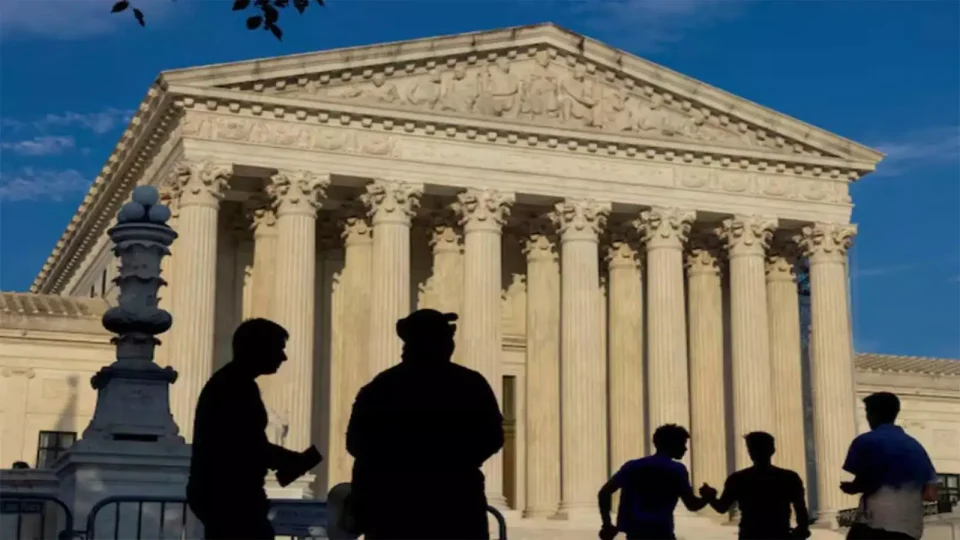
The Supreme Court will hear oral arguments on November 5, 2025, in a high-stakes case addressing the legality of President Trump’s tariff policy. Central to this case is the question of whether the president had the legal authority under the International Emergency Economic Powers Act (IEEPA) to impose sweeping tariffs on imports from nearly all countries without explicit congressional approval. This case challenges the scope of presidential power in regulating trade and the limits of unilateral executive action.
Trump initiated these tariffs starting in early 2025, dividing them into two categories. The first targeted countries like Canada, Mexico, and China for failing to curb fentanyl trafficking, while the second imposed a baseline 10% tariff on many countries, with higher rates up to 50% or more on several nations. The administration has defended the tariffs as vital for addressing trade deficits and national security threats, asserting that IEEPA grants the president broad emergency powers to regulate imports, including through tariffs. However, challengers argue that Congress exclusively holds the power to set tariffs and that allowing such executive latitude disrupts constitutional checks and balances.
The oral arguments scheduled for November 5th will feature three main advocates: one representing the Trump administration, Neal Katyal representing small businesses affected by the tariffs, and counsel for states opposing the tariffs. The Supreme Court agreed to extend the argument time reflecting the complexity and economic significance of the case.
The implications of the court’s decision are vast. A ruling against the administration could invalidate major portions of the tariffs, potentially forcing the government to repay billions collected from these duties. This would also curtail the president’s ability to exercise emergency powers in trade, reshaping future U.S. trade policy and limiting executive flexibility. Conversely, a decision supporting the administration could affirm expansive presidential authority, changing the relationship between Congress and the executive branch on economic and national security matters.
The stakes are particularly high for businesses disrupted by the tariffs. For instance, Learning Resources, a U.S. toy retailer relying on imported products, estimates a $14 million loss in 2025, several times higher than tariff costs in prior years. Such impacts underline the broader economic consequences for American companies and consumers adapting to rapidly changing trade regulations.
A Supreme Court ruling is expected by mid-2026, with some speculation that the justices may deliver their decision as early as January. Throughout this process, legal experts emphasize the case as a critical test of the balance between executive power and legislative oversight in the U.S. constitutional system.
