
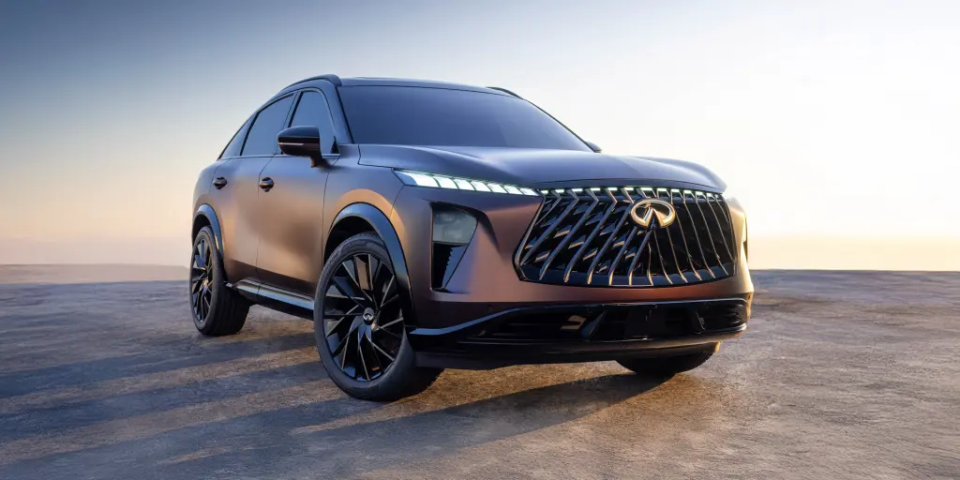
Infiniti has never had the same kind of gravitational pull in the U.S. luxury market as Lexus or Acura, but it once had a window of momentum. The brand peaked around 2017 with record sales in the U.S., a market that remains central to its ambitions. Since then, demand has slipped, and the once-broad lineup has contracted to a handful of vehicles. That decline is what makes the launch of the new QX65 midsize SUV notable, not just as a product refresh but as a quiet test of whether Infiniti can still find space in a crowded premium segment.
The QX65 itself is built around a familiar set of expectations for the U.S. midsize luxury SUV space. It uses a 268-horsepower VC-Turbo engine with about 286 foot-pounds of torque, anchoring a package aimed squarely at daily comfort and highway-driven family use. Inside, the cabin leans on dual 12.3-inch displays for instrument and infotainment functions, a layout that follows current mainstream trends more than it tries to redefine them. The starting price comes in the mid 50,000s, which positions it below the high 70,000s average for rival luxury midsize SUVs, giving Infiniti a modest value argument without moving into mass-market pricing territory.
Infiniti’s recent history in the U.S. has been defined by contraction rather than expansion. After that 2017 high, annual sales have fallen almost every year, and the brand now sits far below peak volume, down by roughly two-thirds from its best U.S. year. The company has acknowledged this slide in its own statements, noting that the number of “nameplates” on American dealer lots has thinned to just a couple of models. That shrinking shelf life has coincided with stronger performance from competitors such as Lexus and Acura, whose sales in the U.S. have either grown or held steady even as Infiniti’s has drifted downward.
Those declines are not entirely about the cars themselves. Analysts point to a broader “product lull” in which Infiniti, as a standalone brand, has moved more slowly than rivals in updating or expanding its lineup. The parent company’s broader restructuring and financial pressures have also constrained how much Infiniti can spend on marketing and new launches. Even where the intention to support the luxury brand has been clear, the execution has at times faltered, leaving Infiniti with fewer fresh models and less visibility in showrooms and advertising.
The QX65 launch is framed as an attempt to reset that narrative. Rather than unleashing a wave of new vehicles, Infiniti has signaled a more deliberate rhythm, planning one new model each year over the next five years. That cadence is modest compared with the aggressive rollout some competitors have used, but it also avoids overpromising. The brand is leaning on the SUV’s heritage, drawing stylistic and emotional cues from the older FX line of sport-oriented SUVs that earned a small but loyal following in the early 2000s. Those earlier FX models were praised for being unusually striking and sport-focused in a segment that often prioritizes comfort over driving dynamics, and Infiniti is trying to recapture some of that energy while updating it for current safety and efficiency expectations.
The choice of venue and presentation style also hints at how Infiniti wants to be perceived. The QX65 was unveiled at New York City’s Grand Central Terminal, a location that signals a desire to be seen as part of the mainstream American landscape rather than a niche import. The event also brought in high-profile figures such as NFL players Rob Gronkowski and Julian Edelman, reinforcing a feel-good, broadly accessible image rather than a fussy, high-end luxury aesthetic. For a brand that has struggled to maintain top-of-mind awareness, these touches are small but deliberate, aiming to anchor Infiniti in everyday American culture while still signaling a step above mainstream brands.
How all of this translates into sales will depend on several factors beyond the vehicle itself. The U.S. luxury SUV market is competitive, with strong offerings from German, Japanese, and domestic brands, and many buyers are already loyal to established names. Infiniti’s pricing wedge gives it some breathing room, but the brand must also rebuild trust in long-term reliability and dealer experience if it wants buyers to look past more familiar badges. The QX65’s assembly in Smyrna, Tennessee, helps with “American-made” optics, and the planned arrival at retailers in early summer means the vehicle will hit showrooms during a historically strong part of the buying cycle.
For now, Infiniti’s comeback story is more of a cautious experiment than a full-blown revival. The QX65 is not dramatically different in concept from what rivals already offer, but it is different in timing and context. After years of thinning inventory and declining volume, even a modestly successful new model can help stabilize the brand’s presence in the U.S. If Infiniti can sustain a steady stream of new vehicles over the next half-decade, the QX65 could become less of a one-off bet and more of a foundation for a slower, more deliberate rebuild.
