
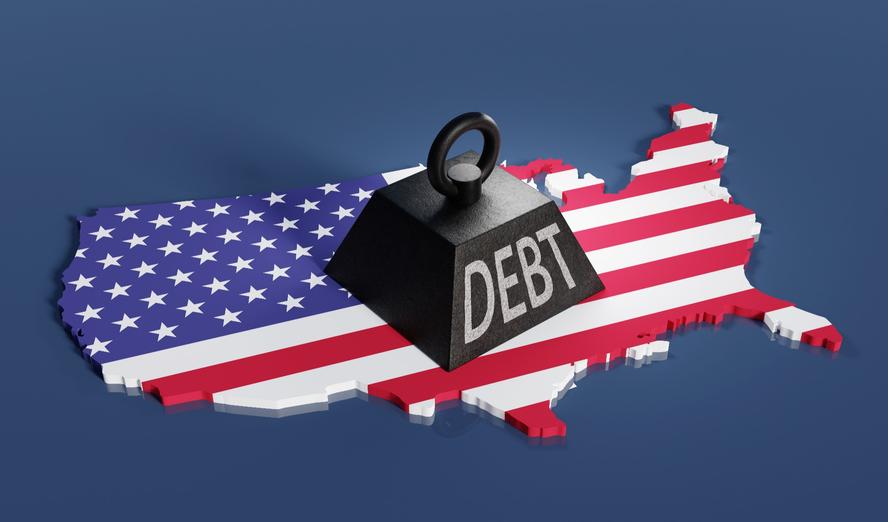
When you look at the U.S. federal budget today, one number stands out for its sheer size. The government now pays about $88 billion each month just to cover interest on its national debt. That amount equals what it spends on national defense and education put together over the same period. This development signals growing pressures on public finances that anyone watching markets or taxes needs to understand.
Governments borrow money by selling Treasury securities, like bonds and bills, to investors, banks, and foreign governments. The interest on these securities keeps the government running until taxes or new borrowing cover the principal. Right now, the total national debt exceeds $39 trillion, fueled by years of budget deficits where spending outpaces revenue. Higher interest rates, pushed up by the Federal Reserve to fight inflation, make each new borrowing more expensive. For the first half of fiscal year 2026, from October 2025 to March 2026, net interest costs totaled $529 billion, or roughly $88 billion per month.
This marks a sharp rise from prior years. In fiscal year 2025, annual interest hit $970 billion, already the second largest budget item after Social Security. Projections from the Congressional Budget Office show these costs climbing to $1.7 trillion by 2036, or 6.3% of gross domestic product, if trends hold. Businesses feel this indirectly through higher yields on Treasuries, which set benchmarks for corporate loans and mortgages.
To put $88 billion monthly in context, consider the comparison points. Department of Defense outlays for that six months came to $461 billion, covering military operations, personnel, and equipment. Education Department spending totaled $70 billion, funding schools, student aid, and research grants. Combined, these hit $531 billion, a near match to interest over the period. Unlike discretionary areas like defense or education, which Congress debates annually, interest payments carry a legal obligation and grow automatically with debt and rates.
This equivalence matters because it squeezes room for other priorities. Lawmakers face tough choices: cut programs, raise taxes, or borrow more, each risking economic ripples. For business leaders, it means watching how fiscal policy affects growth, inflation, and borrowing costs across sectors.
The administration has pursued aggressive tariffs on imports, especially from China, to boost domestic manufacturing and revenue. Officials argue these measures will generate funds to tackle deficits without broad tax hikes. Yet economists warn tariffs act like taxes on consumers and firms, potentially stoking inflation and prompting the Federal Reserve to keep rates elevated longer.
On spending, the administration eyes efficiencies in non-defense discretionary areas while protecting entitlements like Social Security and Medicare. Debt ceiling debates loom as Congress must act by mid-2026 to avoid default risks. Trump’s team emphasizes growth through deregulation and energy production to expand the tax base, countering interest growth. Still, without bipartisan deficit cuts, projections show debt hitting 122% of GDP by 2034.
For those in capital markets, these trends raise red flags. Higher Treasury yields compete with stocks for investor dollars, pressuring valuations in growth sectors like technology. Small-cap firms, sensitive to borrowing costs, face tighter credit as banks pass on elevated rates. Inflation tied to fiscal expansion could erode real returns on fixed income.
Currency markets watch closely too, as massive debt raises dollar sustainability questions amid trade policies. Investors might shift toward inflation hedges like commodities or real assets. Companies with strong balance sheets will navigate better, while high-debt entities face refinancing squeezes.
Interest costs have surged 30% year over year, outpacing most budget categories. CBO data for February 2026 showed cumulative fiscal 2026 interest at $262 billion already, on track for the monthly average. If rates stabilize around 4% for 10-year Treasuries, annual costs could exceed $1.2 trillion soon. Foreign holders, owning about 30% of debt, add geopolitical risks if they diversify away.
Policymakers have tools like spending caps or tax reforms, but political gridlock persists. Past efforts, such as the 1990s balanced budgets, relied on economic booms and restraint both parties rarely match today. Businesses preparing scenarios should model sustained high rates into planning.
The interplay of debt, rates, and policy shapes the economic backdrop for years. Savvy observers track Treasury auctions and CBO updates for early signals. As interest keeps pace with core spending, it underscores the need for fiscal discipline to sustain growth and stability.
