
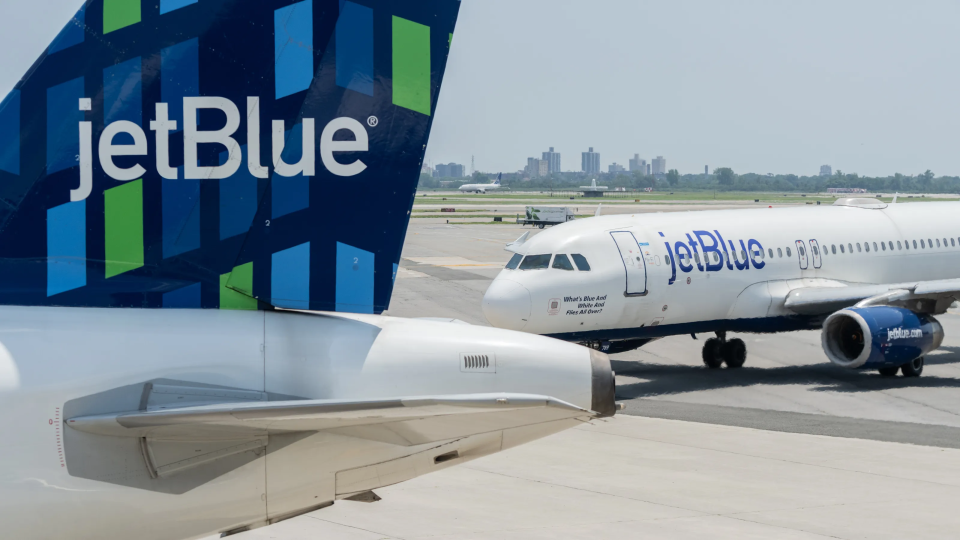
JetBlue Airways (NASDAQ: JBLU) has announced a groundbreaking partnership with Amazon’s Project Kuiper that will significantly upgrade the airline’s inflight Wi-Fi experience. Starting in 2027, a portion of JetBlue’s fleet will be equipped with next-generation satellite technology from Kuiper, promising passengers faster and more reliable internet connectivity during flights. This move positions JetBlue as the first airline worldwide to integrate Amazon’s low Earth orbit satellite broadband network into its inflight Wi-Fi service, known as Fly-Fi.
JetBlue’s Fly-Fi has enjoyed a reputation as an industry leader ever since its launch in 2013, being the only major U.S. airline to offer free, high-speed Wi-Fi on every aircraft. For nearly 12 years, this service has used geostationary satellites to deliver internet connectivity, enabling travelers to stream, browse, and connect at 35,000 feet. But satellite technology has evolved rapidly, and JetBlue’s latest decision reflects a shift towards new, more advanced networks with improved performance.
Project Kuiper is a $10 billion Amazon initiative deploying a constellation of more than 3,200 low Earth orbit (LEO) satellites intended to provide high-speed broadband globally. Unlike traditional satellites orbiting at much higher altitudes, LEO satellites operate closer to Earth, between around 367 to 391 miles high, offering lower latency and faster data speeds. This means inflight internet could become closer in quality to broadband at home or in an office.
The technology enabling Kuiper’s service involves electronically steerable antennas on JetBlue’s aircraft, which will interact with the LEO satellite constellation to provide internet speeds potentially surpassing one gigabit per second, at least for enterprise-grade hardware. While consumer-grade terminals are expected to offer download speeds of up to 400 megabits per second, this would still be a substantial improvement over existing inflight Wi-Fi speed and reliability.
JetBlue plans to start installing this upgraded technology on about one-quarter of its fleet beginning in 2027, with installations expected to finish by 2028. The enhanced Wi-Fi will be complimentary, continuing JetBlue’s strategy of providing free internet access to passengers. However, the airline does not plan to retrofit the entire fleet immediately, so connectivity performance will vary depending on the aircraft.
For travelers, this new partnership means more seamless and robust internet access at cruising altitude. They will be able to binge-watch shows, stay connected with family and friends, or finish work tasks without the frustration of slow or spotty service. The adoption of Kuiper’s LEO satellite technology could also extend reliable internet coverage to routes where older systems previously dropped off, such as over the Caribbean and remote areas.
On the industry side, JetBlue’s move signals how U.S. airlines are prioritizing inflight connectivity as a competitive differentiator. While JetBlue has relied on Viasat’s geostationary satellites for over a decade, this marks a first shift toward a multi-orbit approach, potentially blending the strengths of GEO and LEO satellite networks. Amazon’s Project Kuiper enters the arena to compete directly with SpaceX’s Starlink, which has already found alliances with other airlines like United and Hawaiian Airlines. JetBlue’s signing sharpens the competition for inflight broadband supremacy.
JetBlue’s president Marty St. George highlighted that the initiative is not only about speed but also about ensuring passengers experience the best possible connectivity. He expects Kuiper’s technology to offer greater reliability with less latency while maintaining affordable and free access onboard.
Project Kuiper aims to make broadband internet accessible worldwide, especially targeting underserved and remote regions. With over 100 satellites already launched since April 2025 and plans for dozens more, Amazon is rapidly building its satellite infrastructure. The initiative includes a network of ground stations and fiber connections to support a robust, global coverage footprint. Though commercial service is scheduled to begin for residential and commercial users around late 2025 or 2026, JetBlue’s inflight integration is set to be a notable early adopter of Kuiper’s technology in 2027.
JetBlue’s collaboration with Amazon’s Project Kuiper points to an exciting future for inflight connectivity. It promises passengers faster, more stable internet access at altitude while also nudging the airline industry toward embracing innovative satellite technologies beyond traditional offerings. For those who spend hours in the sky, this upgrade will likely mean staying truly connected, no matter where the flight path leads.
