

The thoughts and opinions expressed in this article are those of the author and do not represent the views or endorsements of VYRE Business News Global. The organization assumes no responsibility for any claims made in this content.
Gold and silver have pulled back. Mining equities have corrected. For many, this has created doubt. But if we step back and look at the actual forces driving the real economy, the thesis has not changed. In fact, it has only become clearer. Do not allow noise to distort economic realities happening in real time.
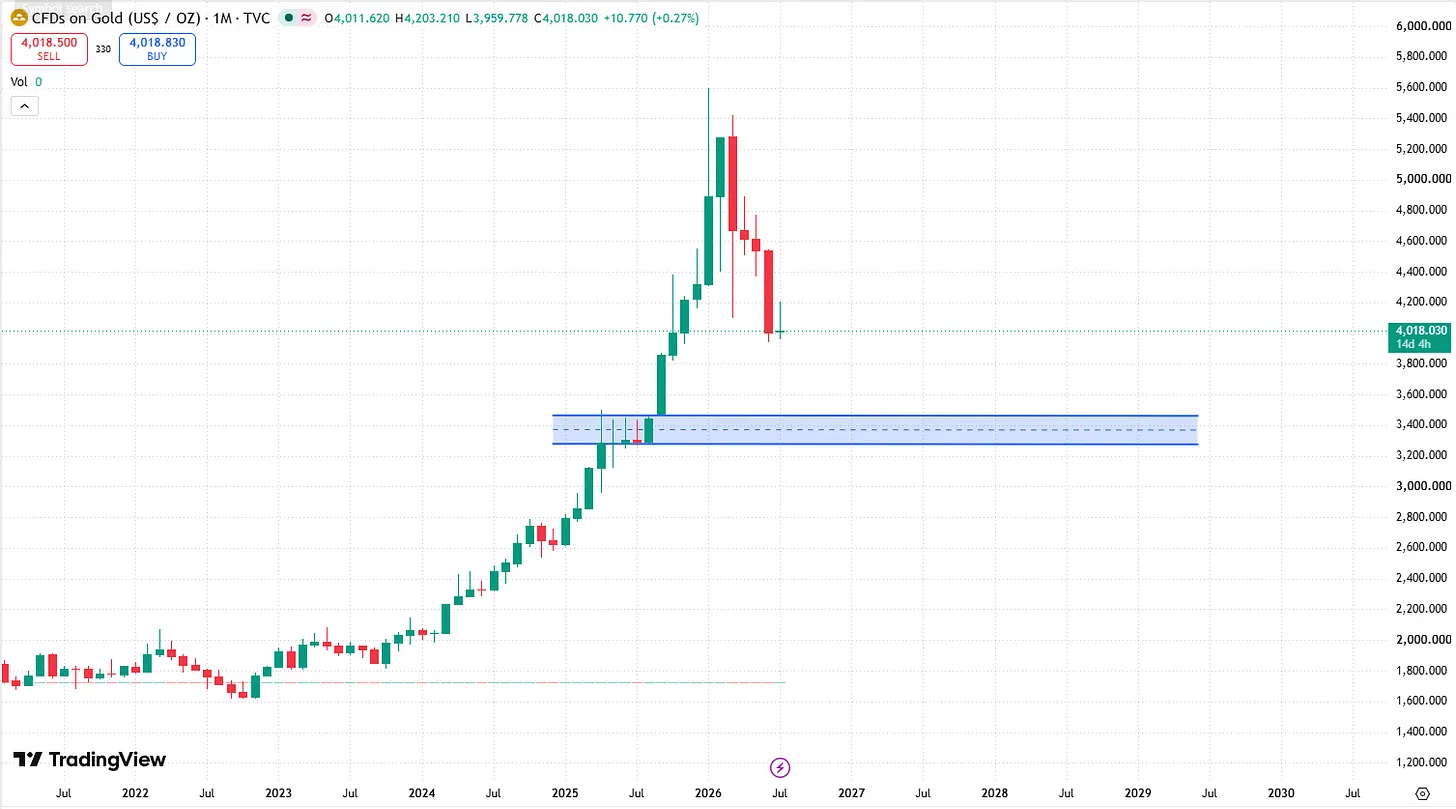
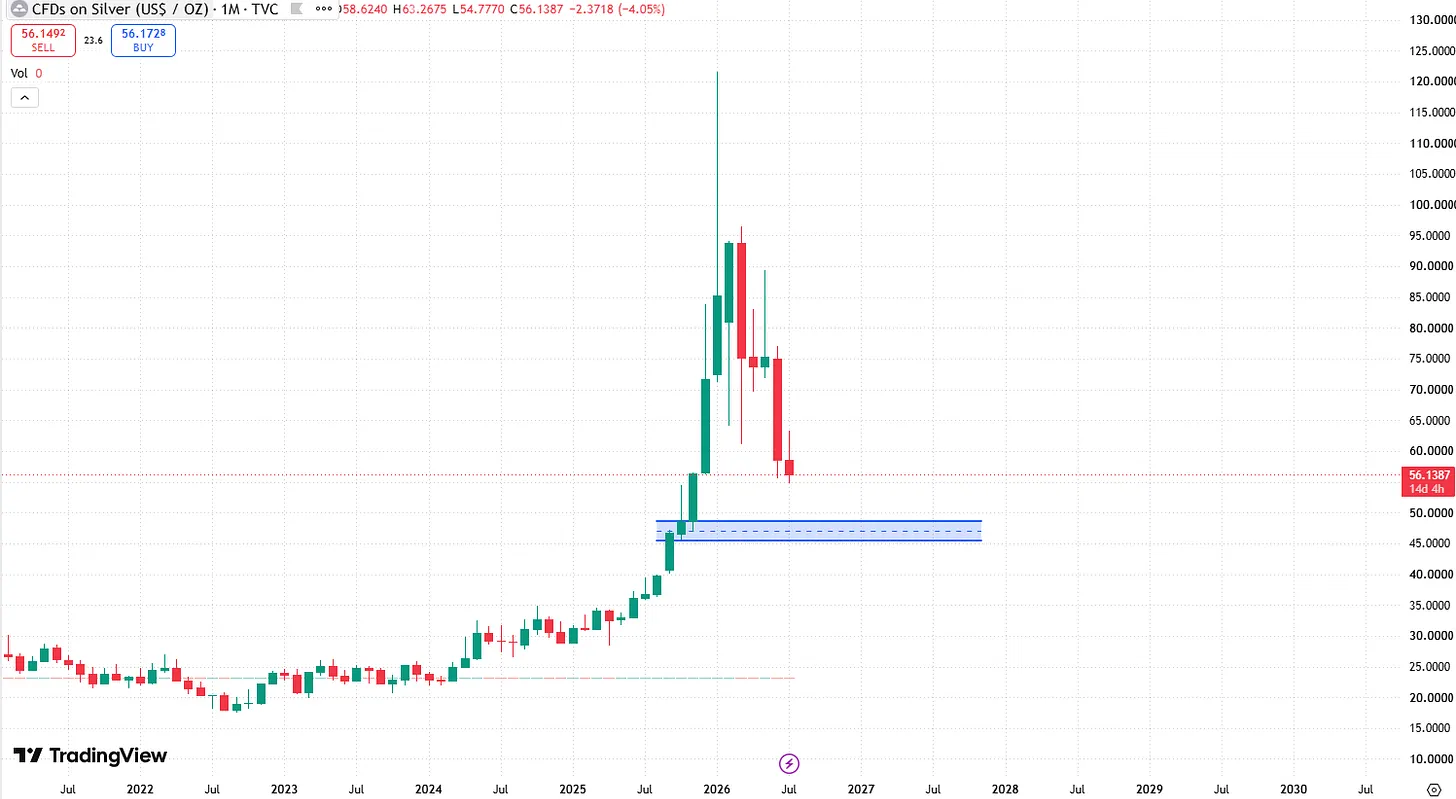
Below are a gold and silver chart. Within them I have placed a zone in blue which I believe to be the absolute bottom in gold and silver we are likely to witness over the next couple weeks.
Gold – $3300-3400 usd
Silver – $46-50 usd
First, let’s begin by stating the obvious that many still overlook:
Commodities are the building blocks of civilization.
Mining is the primary input of energy and materials required for modern life to function. We build, we innovate, and we electrify with the very things we dig out of the ground. This truth does not disappear because prices temporarily correct. Prices eventually catch up to reality, patience is merely what is required to endure the noise and market volatility.
The Real Drivers Have Not Slowed Down
While paper prices in gold and silver have cooled alongside mining equities, the structural demand for critical minerals and industrial metals continues to accelerate. We are watching governments and major economies treat these materials as matters of national and economic security. And rightfully so, after decades of neglect and dependence on the Eastern blocks to produce.
Key forces still fully in motion:
- Massive infrastructure and electrification programs across North America, Europe, Africa, South America and parts of Asia
- Accelerating AI and data-center power demand
- Rising defense spending across NATO and allied nations
- Explicit government strategies to reduce dependence on Chinese-controlled supply chains, with many critical minerals under tight supply control by China – like Tungsten as a perfect example.
These are not short-term narratives. They are multi-year, policy-backed commitments backed by real capital. Central banks will adjust to support these initiatives. Governments will further expand spending and deficits to push these initiatives forward. There is too much at risk now not to act and aggressively.
Governments Are Putting Capital Behind the Thesis
Canada has been particularly aggressive. Through its Critical Minerals Strategy and the new Canada Critical Minerals Accelerator, the federal government is deploying equity-style investments, infrastructure funding, and offtake support. One recent example is the commitment of up to $400 million into Teck’s Trail smelter to expand production of germanium, antimony, and potentially gallium — metals that have faced severe supply pressure due to Chinese export restrictions.
The United States continues to prioritize domestic processing and stockpiling. The European Union is advancing its Critical Raw Materials Act with clear targets for extraction, processing, and recycling. The Quad nations (U.S., Japan, Australia, and India) have outlined a $20 billion framework aimed at building supply chains outside of China. G7 coordination has followed a similar path on rare earths and permanent magnets.
This is not rhetoric. It is capital allocation and industrial policy.
China’s Export Controls Have Made the Vulnerability Impossible to Ignore
Since 2023, Beijing has layered export controls and licensing requirements on a growing list of critical materials: gallium, germanium, graphite, antimony, tungsten, and various rare earth elements. In several cases, prices outside China moved dramatically higher during periods of tight licensing. Even when some restrictions have been temporarily eased, the message remains clear — supply can be restricted for strategic reasons.
China still dominates refining and processing for many of these materials. The West has finally internalized this risk. The metals most affected — gallium and germanium for semiconductors and defense optics, antimony for munitions and flame retardants, tungsten for high-performance alloys, and graphite for batteries — illustrate how concentrated supply creates systemic vulnerability.
Pullbacks Do Not Invalidate Structural Reality
Market corrections in gold, silver, and mining equities often occur when short-term momentum fades or when risk appetite shifts. They do not reverse years of under-investment in new mines. They do not change the fact that new supply takes a decade to bring online. And they do not erase the policy urgency now visible across Western governments.
New mines are slow. Processing capacity outside China remains limited. Demand from electrification, infrastructure, AI, and defense continues to compound.
In this environment, the companies and jurisdictions that can deliver reliable, non-Chinese supply of critical minerals stand to benefit from both higher long-term prices and strategic government support. The same logic applies more broadly across the commodity complex: scarcity — whether physical or geopolitical — tends to reassert itself.
The Generational Point
As I have said before, the next generation will inherit a world that is increasingly defined by resource competition. The industry remains dominated by an older demographic, yet the wealth transfer is already underway. If younger investors and students do not understand why mining matters, they will miss one of the most important investment and civilizational themes of the coming decades.
Commodities are not a niche. They are the foundation. They are the starting point.
The recent softness in precious metals and mining stocks should be viewed in context. It does not signal that the world needs fewer materials. It signals that markets are temporarily discounting a multi-year structural story that governments, for their part, are still actively funding and legislating around.
That divergence remains one of the more compelling setups in the current macro landscape.
Imperium Mind

Nic Tartaglia’s MacroΩInsights
I am obsessed with the macro world, where I seek to dissect and understand the ever-changing dynamics of the world on a monthly basis through a Political, Cultural & Economic lens.
