
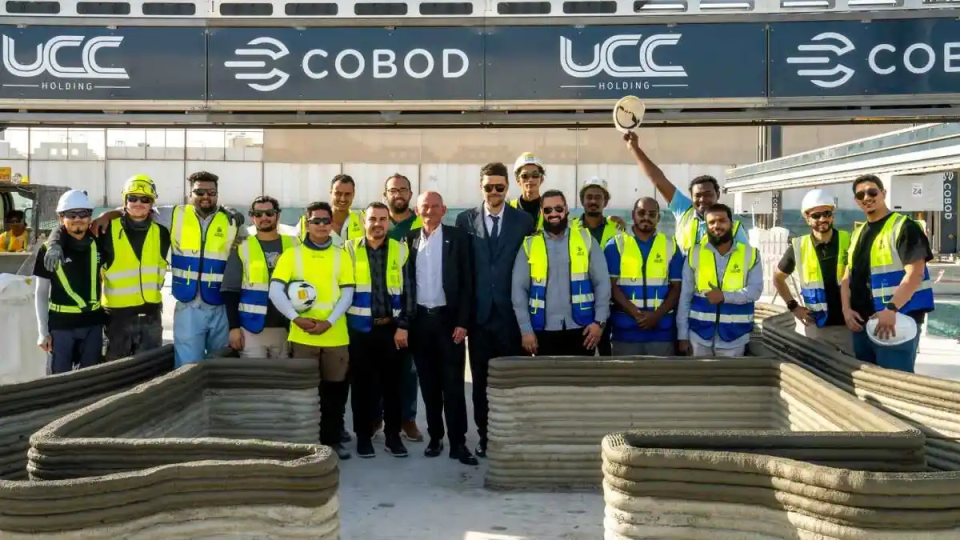
In the sun-drenched heart of Qatar, construction workers and robotic arms are collaborating on something that, just a decade ago, would have sounded like science fiction. Two massive new schools, taking shape in the desert outside Doha, are on track to become the largest 3D printed buildings ever created. This project is not about technological gimmicks but a radical shift in how the world thinks about building at scale, sustainability, and culture.
COBOD International, a private Denmark company in partnership with Quatar’s UCC Holding, is behind the ambitious undertaking. After installing two custom-made BODXL printers, each the size of a Boeing 737 hangar, the construction teams began “printing” walls and architectural features directly onto the desert sand. These printers are designed to extrude a unique concrete mix layer by layer, a bit like an inkjet printer on a supercharged scale.
Each school will cover about 215,000 square feet, and together, the pair total approximately 430,000 square feet. This is 40 times larger than the previous record-holder for 3D-printed buildings, making Qatar’s schools not just engineering marvels, but global milestones. For perspective, each structure is a two-story building set on a 100-by-100-meter site. The geometric freedom of 3D printing has allowed the design team to draw inspiration from the very desert that surrounds them. Curved, flowing walls evoke sand dunes, blending culture and technology in a way previously limited by conventional construction.
The scale of the equipment matches the ambition. Each BODXL printer is about 164 feet long, 98 feet wide, and just over 49 feet high. This enables a building footprint of 16,145 square feet in a single layer, and structures can rise up to five stories, though the schools themselves will be two stories tall.
For Qatar’s Public Works Authority (Ashghal), adopting this approach is as much a strategic move as a technical one. The country’s national vision includes a big push for sustainability, so these schools aren’t just experiments, they’re models for future public infrastructure. The construction process significantly cuts down on material waste, reduces the need for transportation as the concrete is mixed on site, and brings a dramatic drop in carbon emissions compared to traditional techniques. By embracing 3D printing, Qatar expects to build not just faster but smarter, supporting environmental, social, and economic sustainability all at once.
Perhaps just as important, the design and construction process would be nearly impossible with anything but digital fabrication. Traditional methods would require armies of skilled workers, vast amounts of scaffolding, and lengthy build times to achieve the same organic complexity found in these new schools. With 3D printing, even shapes that were once deemed too complex or costly can be produced with automated precision.
The team at UCC Holding spent months refining every detail, from the special nozzle on the printers that gives the concrete its shape, to field-testing concrete mixes that stand up to Qatar’s intense desert climate. The results are not only visually striking but designed to last, with efficiency acting as a core principle throughout the build process.
While it’s tempting to focus solely on technology, the motivation runs deeper: Qatar is responding to an urgent need for modern educational infrastructure and aiming to set a precedent for the region. These schools, slated for completion by the end of 2025, will serve thousands of students and stand as a proof point for large-scale digital construction worldwide.
The project’s combination of scale, culture, and sustainability is already turning heads across the construction sector and could pave the way for more complex, greener, and genuinely beautiful public buildings in the future. As 3D printed buildings rise from the desert sands, Qatar is giving the world a glimpse of what tomorrow’s cities might look like, built efficiently, thoughtfully, and fearlessly.
