
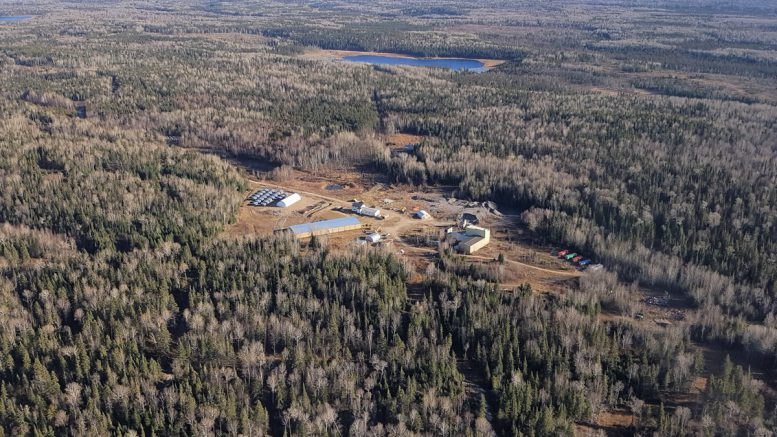
Mining exploration rarely follows a fixed script. A company sets a drilling budget, the core comes back from the ground, and the plan bends to fit what the rock reveals. That is what has played out this year at a gold deposit in northwestern Ontario, where results released today persuaded the owner to lengthen its drill program for the second time.
The company is NexGold Mining Corp. (OTCQX: NXGCF, TSXV: NEXG), a Canadian gold developer that went by the name Treasury Metals until 2024. Its Goliath Gold Complex holds three deposits called Goliath, Goldlund and Miller. Goldlund has been the focus of this year’s work, and today NexGold reported assays from 13 more holes covering 5,088 metres of drilling.
The widest result came from hole GL-26-042, which returned 1.35 grams of gold per tonne (g/t) over 38.9 metres, starting roughly 222 metres down the hole. Hole GL-26-052 cut 1.42 g/t over 27.2 metres from a deeper starting point near 372 metres. The highest grade came from hole GL-26-053, which hit 54.04 g/t over 1.3 metres, including a short section grading 91.7 g/t over 0.7 metres.
Those numbers need some context. A gram per tonne is simply how many grams of gold sit in each tonne of rock. Open pit mines move enormous volumes of material, so they can work with fairly low grades. Goldlund’s own 2023 prefeasibility study estimated probable reserves of 16.2 million tonnes at an average of 1.19 g/t, or about 621,000 ounces of gold. Measured against that average, long runs of grade above 1.3 g/t are encouraging, and they matter at least as much as the occasional spectacular hit. One caution applies. The lengths are measured along the drill core, not straight across the gold zone, and NexGold says true widths usually fall between 50% and 75% of the reported figures.
The program itself has grown in steps. Drilling began in January as a 25,000 metre campaign. By August 25th that work was finished, and the company raised the target to about 35,000 metres. Today it added another 2,000 metres, bringing the total to 37,000. That latest increase is modest, about 6%, and it has a specific job: testing the down-dip extension, meaning the part of the gold zone that continues deeper as it angles into the earth. NexGold expects to complete the program by year-end.
President and CEO Kevin Bullock said the latest assays show “continuity of gold mineralization and grade at depth.” He also noted that the results sit inside the limits of the mineralized zone as the company currently understands it. In other words, this round confirms the existing picture more than it redraws the map.
That distinction is worth understanding. Most of this work is infill drilling, which places holes between earlier ones so geologists can trust their models more. Greater confidence can move ounces into more reliable resource categories, and those categories carry weight with engineers and lenders deciding whether a mine gets built. Developers often see renewed market interest when an updated resource estimate arrives. NexGold has not announced a date for one, though it has said this drilling may inform future resource assessments.
It also helps to know where Goldlund sits in the company’s priorities. NexGold’s lead asset is the Goldboro Gold Project in Nova Scotia, where early construction work is underway. Bullock has described the Goliath complex as the pipeline project the company hopes to develop after Goldboro is built. Goldlund drilling, then, is groundwork for a second chapter rather than the main story today.
The next milestones are fairly clear. The remaining holes should be drilled by the end of the year, with assays following in the months after. The real question is whether this year’s 37,000 metres add up to a resource update that shows more gold, or more certain gold, than the 2023 study did. Until then, Goldlund remains a deposit where the drill keeps confirming what geologists expected to find, and where the company has chosen to keep looking a little deeper.
