
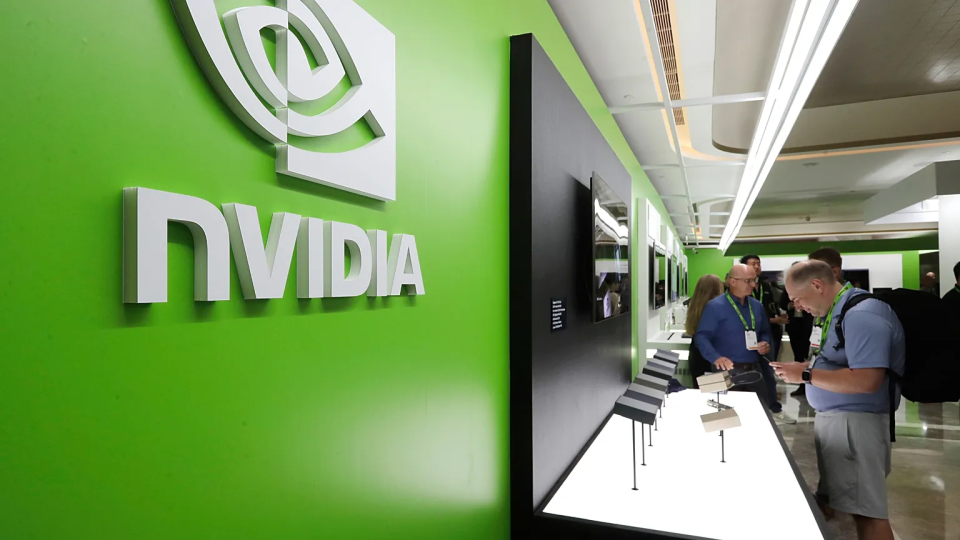
Nvidia Corporation (NASDAQ: NVDA), one of the world’s leading players in the semiconductor and artificial intelligence (AI) sectors, has recently seen a sharp rise in its stock price, opening above the historic $5 trillion market capitalization. Over the past five trading days, Nvidia’s shares have climbed over $30 per share, a nearly 18% increase, pushing the stock to new all-time highs and reflecting renewed investor enthusiasm.
Several interrelated factors are driving this impressive rally. First, Nvidia’s strategic role as the dominant chipmaker in the booming AI sector has captured the market’s attention. The company recently held its 2025 GPU Technology Conference (GTC), where CEO Jensen Huang highlighted Nvidia’s critical position in the ongoing AI race between the U.S. and China. Huang’s keynote presentations and announcements of new partnerships underline the company’s momentum. These developments typically influence market sentiment positively, as they underscore Nvidia’s expanding AI ecosystem and technological leadership.
Financially, Nvidia has delivered strong quarterly results that have reassured investors despite some challenges related to geopolitical issues such as U.S.-China trade restrictions. Its second-quarter revenue reached a record $46.7 billion, with $41.1 billion coming from its data center business, largely driven by demand for AI chips. This was a 56% increase from the previous year. Nvidia’s fiscal 2026 revenue is forecasted by the company to hit $170 billion, a 30% rise compared to 2025’s estimated $130.5 billion. This robust growth outlook reflects Nvidia’s ability to capitalize on the rapid global expansion of AI applications.
The company’s business is not limited to data centers. It is also broadening its automotive segment, which showed 103% year-over-year growth, thanks to collaborations with industry leaders like Toyota and Aurora Innovation in the autonomous vehicle space. This diversification helps mitigate risks associated with tariffs and supply chain uncertainties. Moreover, Nvidia’s aggressive capital expenditure, over $3 billion recently, has focused on expanding production capacity for its advanced AI chips, addressing the increasing demand from hyperscale customers.
Market analysts are optimistic but cautious. Wolfe Research recently set a price target of $230 per share for Nvidia, implying an upside potential of 14.4% from the current trading price, while many financial experts remain wary of ongoing geopolitical tensions and potential regulatory changes. The U.S. export restrictions on some Nvidia AI chips to China have led to a significant write-down, creating short-term headwinds. However, Nvidia’s decision to raise prices on key graphics processing units by 10% to 15% helps cushion the impact of tariffs and rising manufacturing costs.
Nvidia’s rise also ties closely to its strategic partnerships and large-scale deals. At the GTC event, Huang announced substantial contracts, including a deal to supply 18,000 of its most sophisticated GB300 Blackwell chips to Saudi Arabia’s Humain data center, which is planned to operate with a 500-megawatt capacity. These types of partnerships not only broaden Nvidia’s global reach but also demonstrate confidence in its technology’s essential role in building next-generation AI infrastructure.
On the market front, Nvidia’s stellar performance amid a broader tech rally has helped lift U.S. stock benchmarks as well. Recent market optimism is tied to expectations of the Federal Reserve signaling future interest rate cuts, accompanied by strong earnings reports from major technology firms. Nvidia’s role as an AI pioneer has made it a critical bellwether for investors looking to gain exposure to AI-driven growth, contributing notably to the strength of indices like the Nasdaq.
