
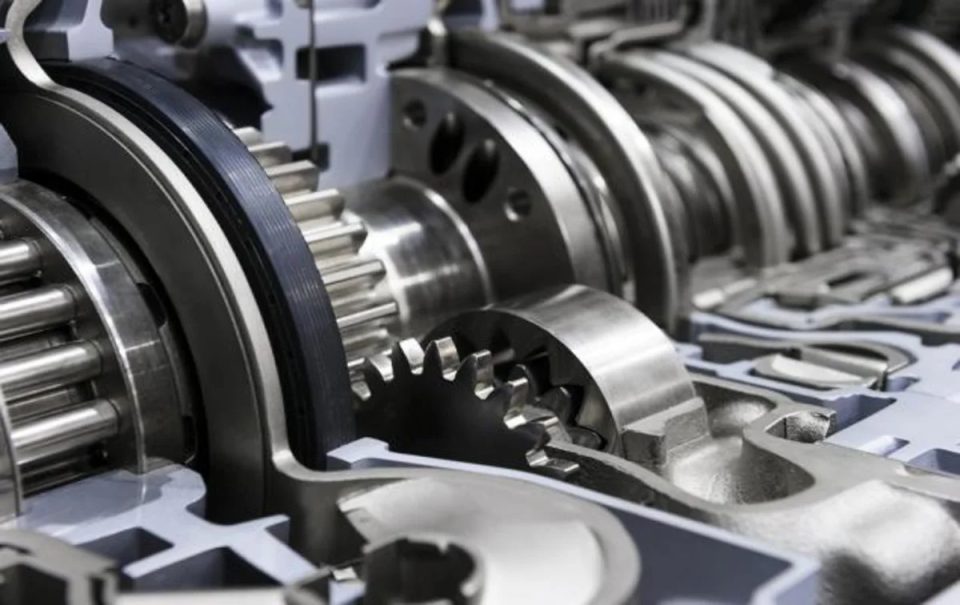
Behind every hospital operating room, power plant and Navy warship sits equipment most people never see. Large air handlers push filtered, temperature-controlled air through buildings. Heat exchange coils pass heat from one fluid to another so steam, water or air can be warmed or cooled. Centrifugal pumps keep cooling water, lubricating oil and fuel moving through engines and generators. Together, they make up the air and liquid processing industry. Much of it is built to order, designed around a single building or vessel, and expected to run for decades.
Two forces are lifting demand in this corner of industry. The first is electricity. The U.S. Energy Information Administration expects U.S. power use to grow 1% this year and 3% in 2027, which would be the strongest four-year stretch since 2000, driven mostly by data centers. More generation means more pumps and coils inside power plants. The second is naval shipbuilding. Back in July this year the Navy awarded General Dynamics and HII a combined $76.6 billion for 14 submarines, with roughly $5 billion aimed at the supplier base, giving component makers a clearer view of work through 2038.
One of the smaller companies supplying that equipment is Ampco-Pittsburgh Corporation (NYSE: AP), based in Carnegie, Pennsylvania. Its Air and Liquid Processing segment has three divisions. Aerofin makes custom finned tube heat exchange coils. Buffalo Air Handling builds large custom air handling systems for hospitals, universities and pharmaceutical plants. Buffalo Pumps makes centrifugal pumps for power generation, industrial refrigeration and the U.S. Navy.
Pumps and coils are the smaller half of the business. The larger segment, Forged and Cast Engineered Products, makes the heavy rolls that steel and aluminum mills use to press metal into sheet and plate, with plants in the U.S. and Europe. That side has been through a reset. Steel demand slowed in 2025, and the company closed its U.K. cast roll plant and moved work to its facility in Sweden.
The latest quarterly results show why the air and liquid side matters. Segment sales rose 17% to $42.8 million from $36.5 million a year earlier, on demand from power generation, Navy programs and air handling customers. Adjusted operating income in the unit climbed 9% to $4.8 million. On the earnings call, management said the segment’s adjusted EBITDA so far this year is the highest in its history.
That growth carried the company as a whole. Total sales came in at $111.7 million, up from $108.0 million, even though roll sales slipped to $68.9 million from $71.5 million, mostly because the U.K. plant is gone. The roll business still earned more, with adjusted operating income up 9% to $7.7 million as the Swedish plant reached its target capacity. Net income was $0.5 million, or $0.02 per share, compared with a $2.2 million loss a year ago.
Cash was the real story. Operating cash flow reached $21.8 million, compared with $6.3 million a year earlier, helped by collecting on receivables and taking in customer deposits. After capital spending, free cash flow was $19.7 million, and the company used it to cut net debt by $19.5 million in a single quarter, bringing it to $111.0 million. For a company this small carrying that much debt, steady cash generation matters more than a few cents of earnings per share.
Management also made a decision that looks ahead. During the quarter it extended a planned maintenance outage at its Burgettstown, Pennsylvania forge plant to lengthen the life of an existing forge press, saying it wanted the equipment ready for a larger 2027 order book. Some roll work the company had expected this year has also slipped into 2027. Total backlog has grown by $50.6 million this year to $379.5 million.
What emerges is a company with two engines running at different speeds. The pump and air handling business is drawing on long-term spending by utilities and shipyards, while the roll business is smaller than it was but more profitable. Whether the combination holds will depend on steel mill orders arriving on schedule next year and on continued debt reduction.
