
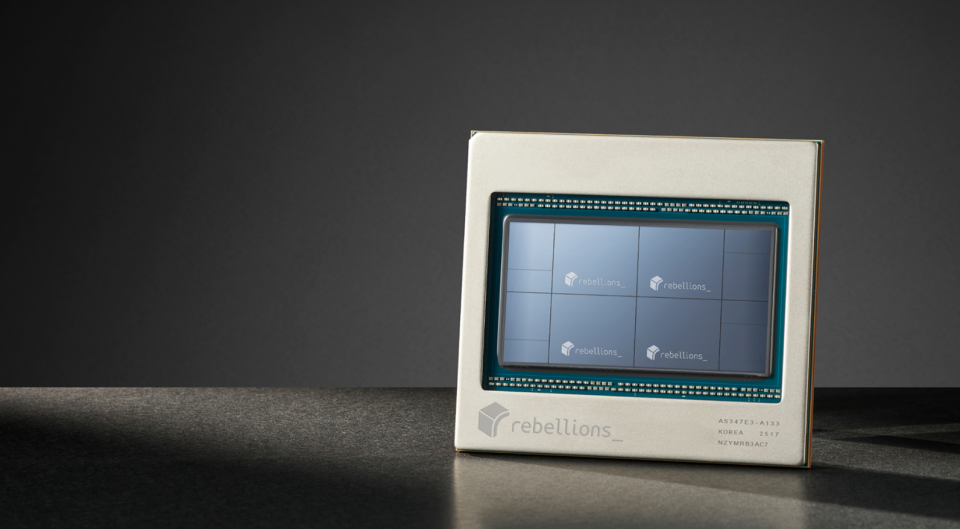
South Korean artificial intelligence chip developer Rebellions, Inc. has raised $400 million in new funding, valuing the company at about $2.34 billion according to company statements and media reports . The fresh capital marks an important phase for one of Asia’s most closely watched semiconductor startups, as Rebellions builds hardware aimed at speeding AI applications for industries from cloud computing to robotics.
Founded in 2020 by former Morgan Stanley trader Park Sung-hyun, Rebellions has focused its energy on chips designed specifically for AI inferencing, which is the stage where trained models perform tasks such as translation, image recognition, or recommendation filtering in real-time. The company’s early chips, like its Atom processor, were developed in partnership with Samsung Electronics (KRX: 005930) for use in data center environments. Its later designs have aimed to handle workloads efficiently using smaller power footprints, a key requirement for large-scale deployment in cost-sensitive data operations.
The latest funding round attracted participation from major Korean financial institutions, including KT Corp., as well as international investors that have shown growing interest in specialized AI hardware. According to reports, Rebellions will apply much of the funding toward U.S. expansion, establishing new partnerships with cloud service providers and possibly setting up a base in Silicon Valley to access engineering talent and potential customers.
Machine learning engineers distinguish between two major phases in AI computing: training and inference. Training involves building large models using high-powered graphics processing units, a field long dominated by Nvidia (NASDAQ: NVDA). Inference, however, is the process of applying those models efficiently in everyday use, such as running chatbots or sorting images on phones. Rebellions’ bet is that specialized chips for inference can capture a growing slice of the market as companies increasingly separate the computational needs of each phase.
The company’s lineup competes in a field that also includes U.S. startups such as Groq and Cerebras Systems, Inc., as well as established semiconductor leaders like AMD (NASDAQ: AMD) and Intel (NASDAQ: INTC) that are developing their own AI-dedicated architectures. This competition has intensified since the advent of generative AI, which has sent global demand for computation soaring. While Nvidia still controls more than 80% of the market for training chips, the inference market is far less consolidated, providing room for challengers like Rebellions to test new designs and pricing models.
South Korea’s government has identified semiconductor technology as a national priority, investing heavily in advanced manufacturing and research. Rebellions benefits from this strategy, drawing support from local venture funds and partnerships with domestic chip fabrication facilities. The backing also reflects a shift in South Korea’s tech ambitions, moving from memory chips, a space long dominated by Samsung and SK Hynix, to high-value AI computing components.
Rebellions represents a case study in how smaller, design-focused companies are finding niches within an industry dominated by giants. By building chips tailored for specific workloads rather than general-purpose processing, such startups can lower costs and optimize performance for given applications. It’s a strategy that mirrors how early smartphone components evolved into specialized segments, eventually reshaping the supply chain.
The company has stated that it intends to prepare for an initial public offering as global demand for AI hardware grows. Although details of timing or location have not been disclosed, the move signals a longer-term plan to scale manufacturing and secure wider market visibility. For now, Rebellions’ success will depend on converting its technical ambitions into sustainable commercial traction in a market that continues to expand at extraordinary speed.
