
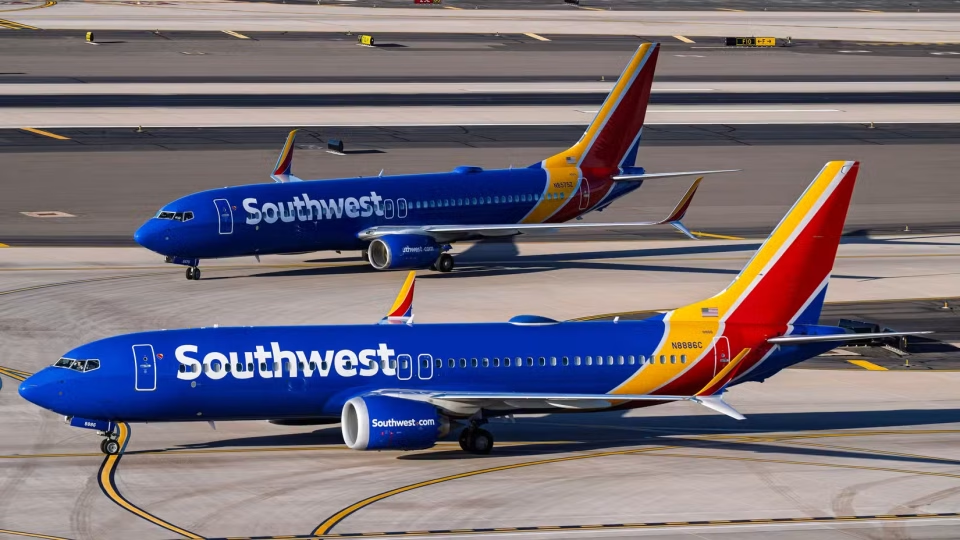
Imagine planning your finances months ahead, only to see everything shift because of events beyond your control. That is exactly what happened to Southwest Airlines Co. (NYSE: LUV), a major U.S. carrier known for its point-to-point routes and no-frills service. The company recently adjusted its 2025 earnings outlook downward to around $500 million before interest and taxes, a notable pullback from its earlier range of $600 million to $800 million. This change stems directly from softer demand tied to a U.S. government shutdown that wrapped up in mid-November.
Businesses in travel often walk a tightrope between fuel costs, labor expenses, and passenger numbers. For Southwest, the shutdown created ripples that lasted longer than the event itself. Federal workers, a steady source of bookings, cut back on non-essential trips during the pause, and some of that caution lingered even after operations resumed. Executives noted during recent updates that while the immediate halt ended, recovery took time as budgets adjusted and confidence returned slowly. This kind of external shock highlights how interconnected government functions are with everyday commerce, especially in sectors like aviation that rely on consistent flow.
Southwest operates differently from many peers. It sticks to a single aircraft type, the Boeing 737, which simplifies maintenance and training. That model helped it thrive in the past, but recent pressures test its resilience. The revised forecast reflects caution across the board, not just from the shutdown. Capacity growth plans for next year now face scrutiny, with potential tweaks to match actual bookings. Analysts watching the space point out that while $500 million keeps Southwest profitable, it signals a tougher environment where every seat counts more.
Look broader, and you see airlines navigating a mix of challenges. Fuel prices fluctuate with global events, and labor negotiations add uncertainty. Southwest already dealt with pilot contracts that boosted pay, eating into margins. Add in the shutdown’s demand hit, and the math gets tougher. The company maintains a strong balance sheet, with billions in liquidity to weather storms. Still, this outlook trim serves as a reminder that forecasts are educated guesses, prone to real-world curveballs.
Competitors felt similar effects. Delta Air Lines (NYSE: DAL) and United Airlines Holdings, Inc. (NASDAQ: UAL) reported softer bookings linked to the same disruption. Industry-wide, load factors dipped as leisure and business travel hesitated. Southwest’s move aligns with that pattern, showing solidarity in facing headwinds. For investors, it underscores the need to track macroeconomic signals alongside company specifics.
What does this mean for travelers? Fares might stabilize if demand stays muted, but expect vigilance on routes popular with government employees. Southwest continues its focus on low costs and high frequency, core to its identity since its founding in 1967. The earnings adjustment buys time to adapt without panic.
Passengers book flights with apps these days, often last-minute, which amplifies short-term swings. Southwest’s rapid rebooking policy shines here, helping retain loyalty even amid disruptions. Management emphasized in communications that core operations remain solid, with no major cuts planned yet.
Forward-looking, 2025 holds promise if economic conditions hold. Rising consumer spending could lift demand, and Southwest eyes international expansion cautiously. For now, the shutdown’s shadow prompts realism in planning.
Airlines like Southwest teach a key lesson in business: flexibility matters as much as efficiency. External forces shape paths, but steady execution builds endurance. Watch how this plays out through earnings season.
