
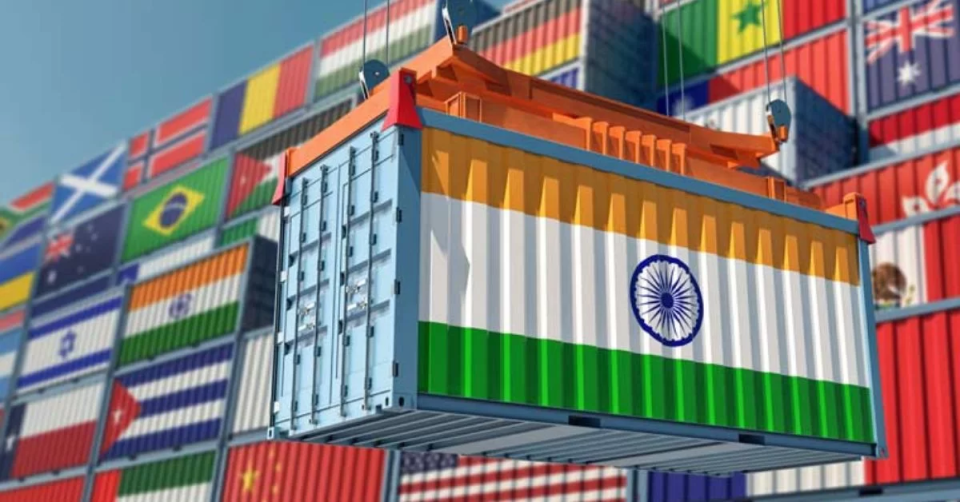
India’s export sector has shown a quiet resilience that has caught many trade watchers off guard. Despite increased tariff pressures from the U.S. and uneven demand recovery across major markets, India’s goods exports have continued to gain ground. This trend reflects more than just short-term policy maneuvering. It signals a broader reconfiguration of global trade patterns, where India is playing a more assertive role.
According to preliminary data from India’s Ministry of Commerce, merchandise exports in November were up about 4% from a year earlier, bringing total goods exports for the year to roughly $443 billion (INR 36.8 trillion). That figure marks one of the highest year-to-date totals India has seen, helped by strong performance in key sectors such as pharmaceuticals, electronics, and refined petroleum products.
What makes this growth stand out is that it is happening during a period when tariffs and trade barriers are still shaping global supply chains. The U.S., which remains one of India’s largest export destinations, has maintained import duties on items ranging from steel to certain electronics components. However, Indian exporters appear to have adapted faster than expected, finding ways to sidestep tariff exposure by diversifying export markets and altering production lines to meet evolving regional rules of origin.
Several structural advantages are fueling this adaptability. First, India’s relatively stable rupee has made its export pricing more predictable at a time when currency volatility has complicated trade for many emerging economies. A second factor is the continuing relocation of manufacturing from China, particularly by multinational firms seeking to spread geopolitical risk. Companies in sectors like consumer electronics and textiles have expanded production in India, thereby lifting the country’s export base.
India’s trade relationship with the U.S. remains important, but its recent growth owes as much to its regional outreach. Exports to the United Arab Emirates, the Netherlands, and Bangladesh have risen sharply, offsetting weaker shipments to China. The India–Middle East–Europe Economic Corridor, still in its early stages, has given exporters renewed optimism that logistics and port infrastructure will eventually support more consistent trade flows across these markets.
Policy also plays a crucial role. Indian authorities have emphasized export incentives for high-value manufacturing, from semiconductors to electric vehicles, to move the country up the value chain. The government’s Production Linked Incentive program has encouraged domestic capacity building, and the results are starting to show in export numbers.
At the same time, India’s services trade continues to anchor its global presence. Earnings from IT and business process services have surpassed $350 billion (INR 29.1 trillion) for the current fiscal year, helping offset any softness in goods exports caused by tariff volatility. Together, these sectors show how India’s export momentum is increasingly drawn from multiple engines rather than a single driver.
Observers note that India’s exporters have also benefited from improving logistics efficiency. The rollout of digital customs clearance and port automation has reduced shipment delays, helping small and medium-sized exporters meet tight delivery schedules. These changes might sound procedural, but in a world where supply chains hinge on minute timing, they make a measurable difference.
It would be premature to declare India immune to trade headwinds. Global shipping costs remain unpredictable, commodity prices continue to fluctuate, and protectionist sentiment still shapes cross-border trade policies. Yet what stands out in India’s performance is how exporters have managed to grow not by escaping global disruptions, but by learning to navigate through them.
If these trends continue, India could consolidate its role as a reliable exporter in a scattered global marketplace. Tariffs may alter the routes through which its products reach consumers, but they have not stopped the movement itself. That steady motion, rooted in adaptability, geographic diversification, and persistent policy support, may be what defines India’s trade story for years to come.
