
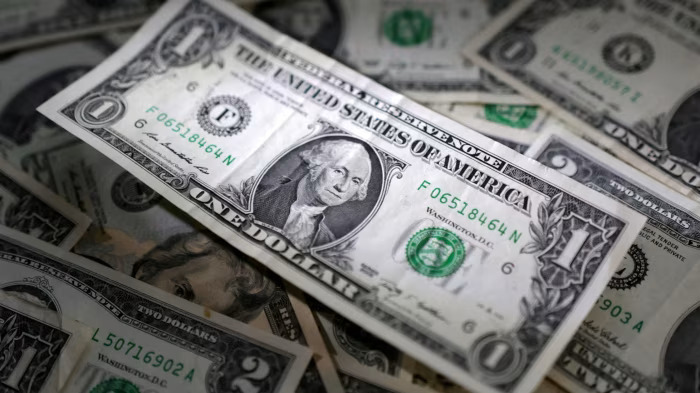
The U.S. dollar has been losing ground this year in a shift that goes beyond economic fundamentals or trade policy. According to Thierry Wizman, global currencies and rates strategist at Macquarie Group (ASX: MQG), the decline reflects a broader loss of confidence in U.S. leadership among global investors. The dollar’s fall, down more than 9% so far in 2025, signals deeper political and economic concerns that could have lasting implications for international financial markets.
The weakening of the dollar started to gain momentum in early 2025 amid an environment of uncertainty and unexpected policy moves coming from Washington. Initially, many investors viewed the U.S. economic outlook with optimism, expecting that tax cuts and measures would keep interest rates elevated and underpin a strong dollar. However, this sentiment shifted when the administration implemented aggressive tariffs on a wide range of countries and products, tariffs as high as 50% on Brazil and India, and up to 100% on semiconductors, causing alarm in global capitals. Rather than being seen as a strategic move, these tariffs appeared to many as erratic and lacking coherent political and economic objectives.
Wizman notes that this approach has caused serious diplomatic fractures, pushing countries like Brazil and India closer to China and potentially strengthening the BRICS alliance in a way that could reduce the dollar’s role as the global reserve currency. Switzerland, a historically neutral and allied country, also found itself subject to a steep 39% tariff on exports to the United States, jeopardizing industries from pharmaceuticals to watches and even gold exports. Such moves have not only disrupted trade relationships but also harmed perceptions of U.S. reliability and leadership on the global stage.
The economic backdrop has compounded these political concerns. Market participants are increasingly worried about the sustainability of U.S. fiscal policy. Moody’s recent downgrade of the U.S. government’s credit rating underscored fears about the ballooning federal debt and the lack of a credible plan to reduce deficits. This downgrade sent the dollar lower on markets already jittery about fiscal risks. Economists and investors alike are now questioning the traditional view of U.S. Treasury securities as the safest assets in the world, which could push interest rates higher as lenders demand greater returns to compensate for risk.
Despite these challenges, currency strategists and financial experts generally agree that the U.S. dollar will maintain its crucial role in the global financial system for the time being. According to Samuel Zief, head of global FX strategy at JPMorgan Private Bank, there is no practical alternative that can match the dollar’s dominance in global trade settlement, financial infrastructure, and reserve holdings. While the dollar’s value may continue to decline gradually, this shift is seen more as a recalibration of investor confidence rather than a complete loss of faith or a rapid capital flight from dollar assets.
Looking ahead, experts expect the dollar’s gradual depreciation to be driven by an economic growth rate in the U.S. that aligns more closely with the rest of the world, rather than the rapid expansion seen in prior years. In addition to geopolitical uncertainty, the evolving strategies of global asset managers are playing a role. These investors are reassessing their exposure to U.S. assets in light of slower growth prospects and fiscal instability, which could lead to a more prolonged adjustment in dollar value.
Wizman remarks that the global loss of confidence is unlikely to be reversed quickly, even if tariffs are rolled back or modified. The dollar remains strong compared with historical standards, but it will likely face continued downward pressure amid these uncertainties. This recalibration in value and trust reshapes how the global financial community views the United States, not just as a market but as a leader in economic policy.
The dollar’s decline reflects more than trade tensions or economic data, it’s emblematic of a broader reassessment of U.S. leadership in a changing multipolar world. While the greenback’s role as a global reserve currency remains intact for now, the political and fiscal challenges facing the United States have cast a long shadow on its economic influence. Navigating this landscape will require renewed clarity and stability in policy to restore confidence both on Wall Street and in governments around the world.
