
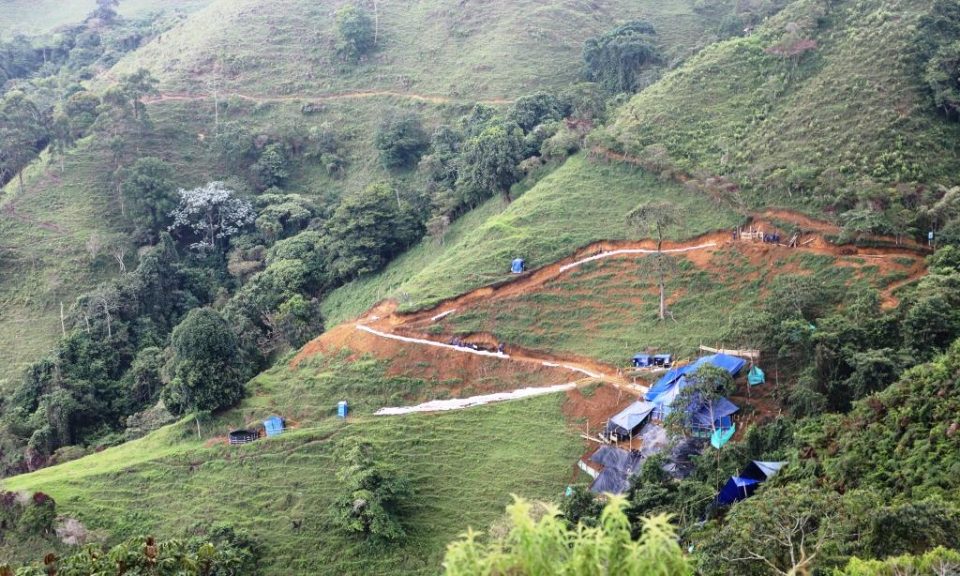
Gold explorers live and die by the drill. A company can spend years mapping a hillside, but what investors ultimately want is a core sample proving the gold is there in quantity. A Colombian project produced exactly that kind of sample today, and the details suggest the deposit may be richer than its owner’s own estimate assumed.
Collective Mining Ltd. (NASDAQ: CNL, TSX: CNL) said a hole at its Apollo deposit, in the Caldas region of Colombia, cut through 154.30 meters of rock averaging 12.66 grams of gold equivalent per tonne. Gold equivalent folds small amounts of silver and other metals into a single gold figure. Many underground mines operate profitably on just a few grams per tonne. Inside that stretch sat 30.45 meters grading 39.01 grams, including a band under five meters thick that topped 184 grams.
The intercept begins about 1,200 meters below surface, in a part of Apollo called the Ramp Zone, and it is the widest high-grade result the company has recorded there. What stands out is how it compared with the company’s own math. On September 8th, Collective published its first Mineral Resource for Apollo, a formal estimate of the metal the deposit holds. Along this hole’s path, results came in locally more than 75% richer than predicted, and the high-grade section ran about 20 meters higher and 30 meters deeper than expected. The richest 30 meters sat in rock the model had pegged at roughly one gram per tonne. The company stresses this is a local comparison, not an updated estimate.
Then there is how the hole ended. Drilling stopped because the rig had reached the limit of its drill rods, not because the gold ran out. The final 12 meters were still mineralized at a modest grade, and geologists believe the hole may have been entering a new channel of mineralized rock. Executive Chairman Ari Sussman summed it up by saying the hole “ran out of rods.” New track-mounted rigs built for deeper work are arriving to follow it down.
Geography adds to the company’s confidence. About 1.75 kilometers away sits the Marmato mine, owned by Aris Mining Corporation (NYSE: ARIS, TSX: ARIS). Collective says the two systems start at similar elevations and contain very similar gold and silver bearing minerals. It credits Apollo’s higher grades to the host rock, a broken, porous material called crackle breccia that gives gold-carrying fluids more room to move and settle. Collective also cautions that Marmato’s results guarantee nothing about its own ground.
Much of the target remains untested. The rock body hosting Ramp measures about 1.5 kilometers around at depth, and only about 590 meters of that circumference has been drilled for this style of gold. Just 21% had enough drilling to make the September estimate. Several holes to the north show visible gold in the core, though the company notes that what geologists see by eye is no substitute for lab results. Assays for 71 holes across the project, 17 of them at Ramp, are still pending.
This month, work begins on a tunnel roughly three kilometers long, designed to reach the heart of Ramp so future holes can be drilled from underground and be far shorter. The company plans to drill Ramp down to sea level in 2027 and expects an updated resource between late 2027 and early 2028, followed by a Preliminary Economic Assessment, an early study of whether a mine could make money. This year’s drilling program of up to 90,000 meters is fully funded.
The team has walked this path before. Its founders built Continental Gold and sold it to Zijin Mining Group Co., Ltd. (HKEX: 2899.HK) for about $1.4 billion in enterprise value, and insiders and close associates own 45.2% of Collective. That does not remove the risk attached to exploration, and one spectacular hole is not a mine. Still, when results start beating a company’s own model, the next round of deeper drilling becomes the part of the story that could be worth watching.
