
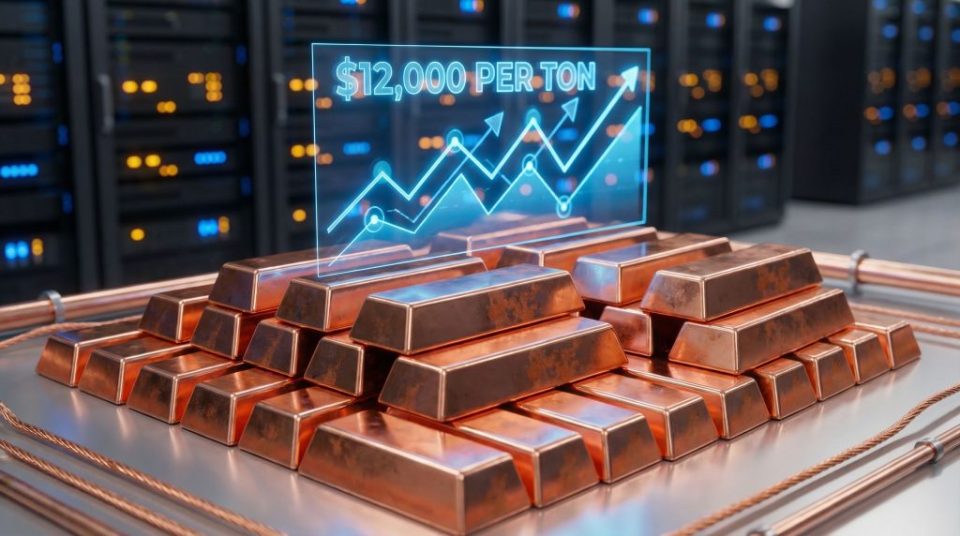
Every economic era seems to have its signature material, a resource that captures the industrial mood of its time. For the mid-2020s, that material may well be copper. Once seen as a barometer for global manufacturing health, copper has now taken on a deeper significance. It sits at the intersection of electrification, digital infrastructure, and geopolitics.
Industry watchers say that 2026 could mark a pivotal moment for copper markets, as demand from energy transition projects and artificial intelligence infrastructure shows little sign of slowing. The same copper wiring that once powered factories now forms the veins of data centers and electric grids. From high-voltage lines running across rural landscapes to the tangled cables cooling racks of servers, copper has quietly become the connective tissue of modern ambitions.
Citi analysts have projected that prices of the red metal could surge sharply in 2026, partly due to this sustained technological and industrial appetite. The bank’s view rests on two converging factors: heavy consumption from renewables and AI, and a constrained mining pipeline. The connection is straightforward. Each new data center requires tens of thousands of pounds of copper for wiring, cooling systems, and transformers. Meanwhile, renewable power installations and grid upgrades depend on copper at nearly every stage. As nations commit to larger renewable capacity and a more resilient grid, the pressure on supply intensifies.
The recent rally in copper prices has also been influenced by something less visible: tariff worries. Industry experts believe that, beyond raw demand, market sentiment has been fueled by concerns over U.S. trade policy and shifting import costs. These anxieties have pushed traders and governments alike to shore up inventories. According to analysts, this behavior has effectively “turbocharged” the latest upswing, as participants seek to secure supply before new trade restrictions or cost fluctuations appear.
On the supply side, the picture is far from stable. Several major copper producers have faced setbacks due to environmental disputes, labor issues, and investment delays. Exploration and production require long lead times, and any disruptions ripple through the market for years. This limited pipeline creates what some economists call a structural deficit: too few new mines coming online relative to the explosion in global copper use. Even modest shortfalls can send prices climbing quickly, especially when demand is rising from multiple sectors simultaneously.
Citi expects that the U.S. may play an unusual role in tightening global balances through what it calls “hoarding behavior.” The firm suggests that, as arbitrage opportunities widen between domestic and overseas markets, American buyers might absorb large shares of global inventory, drawing on already depleted non-U.S. stocks. If this bullish scenario unfolds, it could deepen shortages in key manufacturing regions such as Europe and East Asia.
This dynamic hints at a broader challenge: copper’s future has become intertwined with both policy and innovation. For governments, securing copper supply now carries strategic implications, much like oil in the mid-20th century. For industries from automotive to cloud computing, it poses logistical and cost hurdles that could reshape investment timetables. Unlike past commodity cycles that hinged largely on macroeconomic growth, this one is grounded in technological transformation itself.
Spot prices have tracked these developments closely, reflecting not just physical scarcity but anticipation of longer-term shifts. Traders view copper as a proxy for the pace of electrification worldwide, often treating it as a forward-looking indicator of infrastructure confidence. Even modest policy news or project announcements can now sway sentiment quickly.
Looking toward 2026, very few expect equilibrium. Demand from data expansion and decarbonization remains hard to quantify yet persistently upward. Supply growth, on the other hand, may take years to adjust. The result could be a volatile but consequential period for copper markets, where the world’s wiring metal becomes as politically and economically charged as the systems it powers.
