
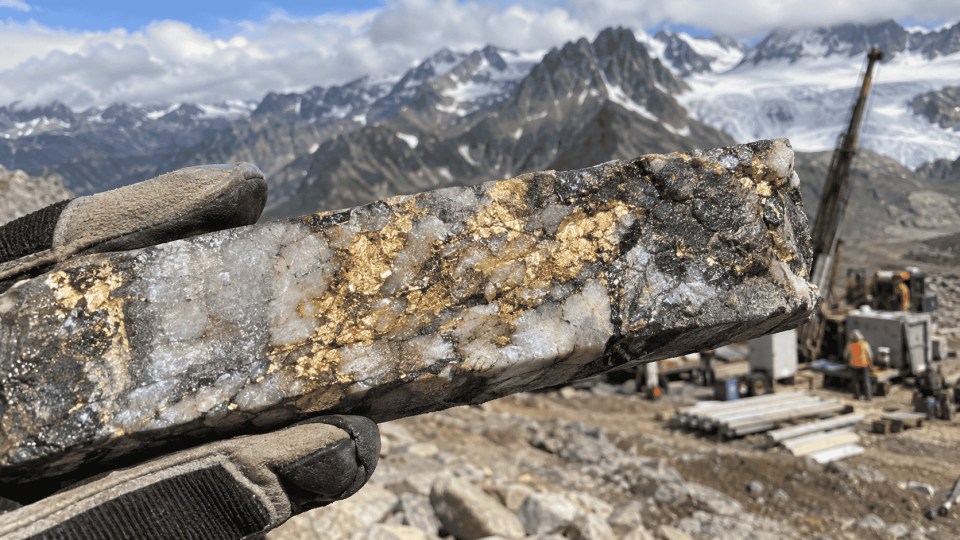
Just east of the Alaska Panhandle in northwestern British Columbia lies a stretch of rugged, glacier-carved mountains that ranks among the richest gold, silver and copper belts in the world. It is known as the Golden Triangle. The region runs about 500 kilometers from the port town of Stewart north to the Stikine River, and people have been pulling metal out of these mountains for more than a century.
The numbers behind the name are hard to ignore. One industry estimate puts the region’s endowment at more than 220 million ounces of gold and 87 billion pounds of copper as of 2024. Historic mines such as Snip and Eskay Creek earned the area its reputation, and the story is still being written. Brucejack, an underground mine known for unusually high grades, and Red Chris, a large copper and gold operation, are producing today. Eskay Creek is being rebuilt, with construction ongoing.
For most of its history, the region’s biggest problem was access. Steep terrain, heavy snow and a lack of power made it expensive to build anything. That has changed. The Stewart-Cassiar Highway has been paved, the port at Stewart ships concentrate overseas, and a $502 million (CAD $700 million) high-voltage transmission line brought grid power into the area.
Governments are still investing. In July, Ottawa committed about $358 million (CAD $500 million) to an underground expansion at Red Chris. The project is expected to lift Canada’s copper production by 15% and extend the mine’s life by roughly 14 years. Plans are also moving ahead for the North Coast Transmission Line, an extension of the line that already supplies hydropower to Brucejack and Red Chris. Meanwhile, a provincial report estimates that only 0.0006% of the Golden Triangle has been mined, which helps explain why explorers keep coming.
One of those explorers is Goliath Resources Limited (OTCQB: GOTRF, TSXV: GOT), a Canadian company that owns 100% of the Golddigger Property. Today it released a new set of drill results from the Surebet Zone, the center of a gold discovery it has been drilling for several years.
The standout hole, GD-26-498, returned 14.61 grams of gold equivalent per tonne of rock across 6 meters. Gold equivalent folds the value of silver, lead, zinc and copper into a single gold figure, though in this case gold did most of the work. Inside that interval, a 2-meter section returned 42.31 grams per tonne. A second hole, GD-26-490, came back with 11.88 grams per tonne over 4 meters, including 43.93 grams per tonne over about a meter. Many underground gold mines operate on average grades well below 10 grams per tonne, so results like these get noticed.
The more important point is not any single hole. These were largely infill holes, drilled between earlier holes to check whether the high-grade core holds together. According to Goliath, the results confirm that it does, and they will feed into a first mineral resource estimate and a preliminary economic assessment. Those are the early studies that tell investors how much metal a deposit holds and whether mining it might make financial sense.
The broader picture is about scale. More than 200,000 meters have been drilled at Surebet, and visible gold has appeared in 412 of 483 holes, or 85%. Drilling now covers about 2.01 square kilometers, and two neighboring zones, Bonanza and Golden Gate, have both grown in size. Goliath is also considering spinning out some claims into David Resources Limited, a private subsidiary it fully owns.
None of this means a mine is around the corner. A discovery still needs a resource estimate, economic studies, permits and financing before construction begins, and that process usually takes years. Still, a deposit that keeps returning consistent high grades, in a region with paved roads, grid power and a working port, is the kind of story the Golden Triangle has told before. The coming resource estimate will be the next real test of how this one ends.
