
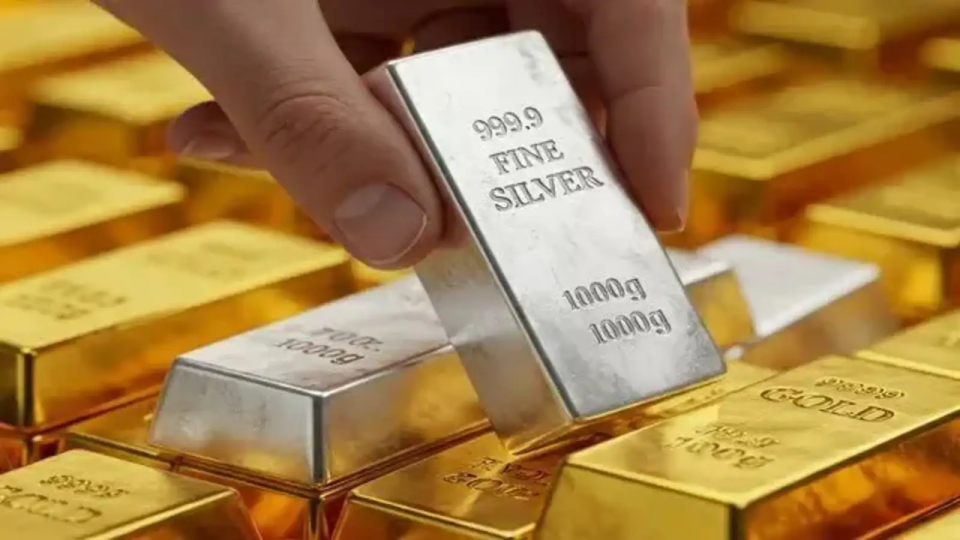
Gold and silver prices took a dramatic turn on January 30, 2026. These metals, often seen as safe stores of value during uncertain times, saw sharp declines after hitting recent highs. Gold dropped to an intraday low of $4,962.70 before settling around $5,112.70 per ounce, down 4.5% for the day. Silver fell even more steeply, reaching a low of $95.12 and trading near $100.63 per ounce, a 12% drop.perplexity+1
Over the past two days, the path looked very different. Gold climbed as high as $5,480.20 today after peaking near $5,598 yesterday, while silver touched $118.45 today following a high of $121.64. This rollercoaster movement caught many in the market off guard. Investors who bought in during the rally now face quick paper losses, and those on the sidelines wonder if this marks a lasting shift or just a brief pause.
Several factors came together to push prices lower. A stronger U.S. dollar played a big role, as it makes dollarpriced commodities like gold and silver costlier for buyers using other currencies. The dollar index rose about 1.2% in the session, adding pressure on metals. Profit taking also kicked in after the meteoric gains; gold had risen roughly 19% year to date before today, and silver surged 45%, leaving some traders eager to cash out near record levels.
President Trump’s recent nomination of Kevin Warsh as the next Federal Reserve chair added another layer. Warsh, a former Fed governor known for favoring tighter monetary policy, sparked concerns that interest rates might rise sooner or stay higher than expected. Higher rates tend to hurt nonyielding assets like gold and silver, since they increase the opportunity cost of holding them over interest bearing options like bonds. Markets reacted swiftly to the news, with futures pointing to a hawkish turn at the central bank.
This drop stands out in historical context. Gold first broke above $5,000 per ounce late last year amid geopolitical tensions and central bank buying, mostly from emerging markets. Silver, with its dual role as both a precious and industrial metal, rode the wave higher thanks to demand from solar panels, electronics, and AI related tech. The gold to silver ratio, which tracks how many ounces of silver buy one ounce of gold, had compressed to around 50:1 recently, hinting silver was catching up. Todays selloff pushed it back toward 51:1, a level seen often in corrections.
Think of gold and silver as barometers for broader economic moods. When inflation fears or stock market wobbles dominate, demand rises and prices climb. But when growth signals strengthen or policy tightens, they often retreat. Central banks hold over 36,000 tonnes of gold globally, about 20% of all mined, which steadies the market but amplifies swings during sentiment shifts. Silver differs with 50% of demand tied to industry, making it more sensitive to manufacturing cycles.
Traders now watch upcoming data like producer price index reports and Fed speeches for clues. If Warsh’s nomination moves forward and signals fewer rate cuts, metals could test lower supports around $4,900 for gold and $95 for silver. On the flip side, any stumble in U.S. economic data or renewed global risks might spark a rebound. Volume spiked today, with gold futures seeing 259,000 contracts and silver 128,000, showing heavy repositioning.
Longer term patterns suggest resilience. Gold sat at a 50 day moving average of $4,540 before this run, and silver at $73, meaning even after the drop they remain well above those benchmarks. Investors often view such pullbacks as healthy after parabolic moves, clearing out weak hands before the next advance. For those eyeing entry points, physical bars, exchange traded funds, or futures offer ways to participate, each with its own risks around storage, leverage, or liquidity.
Markets move on expectations, and today’s action reflects bets on a U.S. economy gaining steam under current policies. Precious metals remind us that no asset rises forever without tests. As traders digest the Fed chair news and dollar moves, gold and silver hover at levels that still dwarf last years prices, setting the stage for whatever comes next.
