
Uber Air is a new project by Uber Technologies (NYSE: UBER) that aims to turn city-to-city air travel into a routine extension of its ride-hailing service, rather than a one-off luxury experience. At its core, Uber Air is not a separate app or a standalone airline, but an integrated “air taxi” option embedded inside the Uber app, designed to move people quickly over short to medium distances using small electric aircraft. The idea is to give users a multimodal trip that feels familiar: order a car, then a flight, then another car, all within a single interface and with one upfront price.
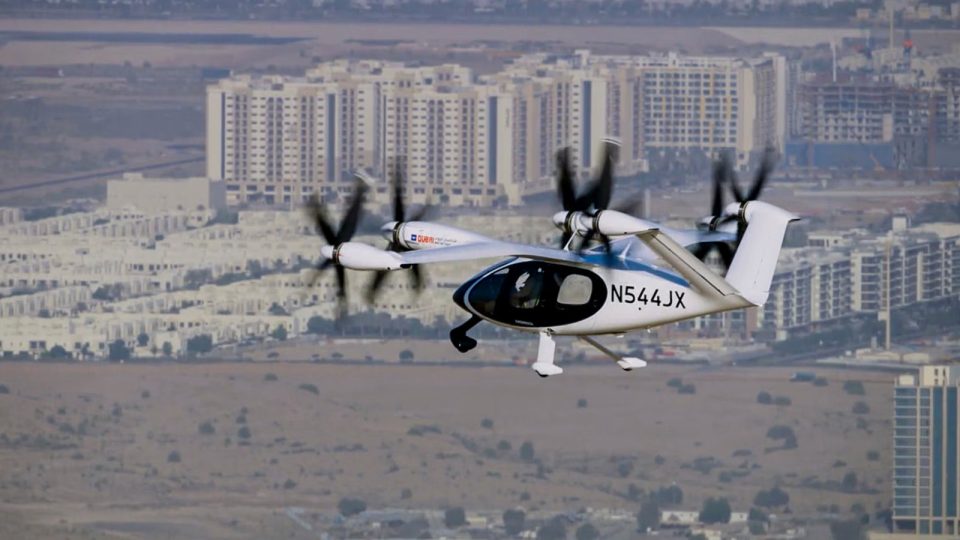
Uber Air is not building its own planes; instead, it is effectively acting as the booking layer and customer-facing platform for a network of electric vertical takeoff and landing (eVTOL) aircraft operated by partners such as Joby Aviation (NYSE: JOBY). Joby’s aircraft are pilot-flown, four-passenger vehicles that can take off and land vertically, so they do not need full-scale airports but can operate from small rooftop pads or dedicated “vertiports.” Each vehicle is all-electric, has six tilting propellers, and is engineered to be relatively quiet, with large windows intended to keep the ride feeling more like a premium car service than a traditional commuter flight.
From the rider’s perspective, Uber Air is meant to feel like an extension of the existing Uber app logic. A user enters a destination as usual, and, if available, the option “Uber Air powered by Joby” appears alongside ground-based services such as Uber Black or UberX. Selecting this option triggers a multimodal sequence: an Uber Black car moves the rider from their starting point to the nearest vertiport, the Joby aircraft flies the middle segment, and another Uber vehicle picks them up at the destination. The app shows an all-inclusive, per-passenger price before booking, rather than itemizing each leg separately, so riders can compare the aerial option directly against staying on the road.
Joby’s eVTOL aircraft are designed for speeds of up to about 200 miles per hour, with a range of roughly 100 miles per charge, which makes them suitable for intracity or short suburban routes rather than long-haul travel. The company and Uber have highlighted that the aircraft rely on multiple redundant systems, including four independent battery packs and a triple-redundant flight computer, which are intended to help meet or exceed Federal Aviation Administration (FAA) safety and reliability standards. Both companies note that Joby has already recorded more than 50,000 miles of flight testing across its fleet and is in the final stages of FAA type certification, a critical hurdle before regular commercial service can begin.
Dubai is slated to be the first city where Uber Air powered by Joby goes live later this year, under an exclusive six-year operating agreement between Joby and local stakeholders. Initial routes are expected to connect Dubai International Airport (DXB), Dubai Mall, Atlantis The Royal, and the American University in Dubai, giving riders a high-profile test bed in a city accustomed to rapid infrastructure experimentation. Beyond Dubai, Uber and Joby have publicly outlined plans to expand into Los Angeles, New York City, parts of the U.K., and Japan, but each of those markets depends on completing local regulatory approvals and building the necessary vertiport infrastructure.
Uber has stated that the aerial portion of an Uber Air trip should feel broadly comparable in price to an Uber Black fare, at least in the initial phase, which positions it as a premium but not extravagant option rather than a niche luxury service. Exact fare structures will not be finalized until closer to launch, allowing the company to adjust based on operating costs, demand, and local regulations. The broader goal is to normalize short-distance air travel within everyday mobility, so that, for some trips, flying above congestion becomes a routine alternative rather than a special occasion.
Uber Air represents a bet that urban air mobility can evolve from demonstration flights and test programs into a real, scalable service layer that sits alongside existing ride-hailing, rail, and bus networks. If Joby and Uber succeed in making the aircraft, vertiport footprint, certification, and pricing all work in concert, the project could reshape how people think about travel in dense metropolitan areas. It is not guaranteed that Uber Air will become a dominant mode of transport, but it does offer a concrete example of how existing platforms are trying to stitch together air travel into the broader fabric of daily commuting rather than treating it as a separate, isolated experience.
