
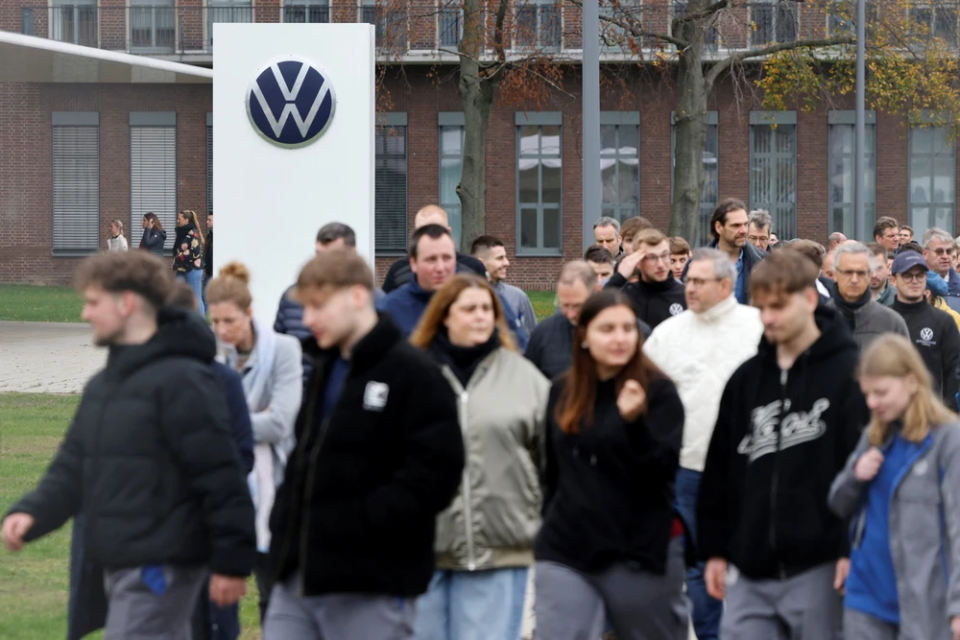
Germany’s largest automaker Volkswagen (XETRA: VOW3) finds itself amid a sweeping workforce reduction as it grapples with weak global demand and stiff competition, particularly from Chinese electric vehicle manufacturers. The company has committed to a significant restructuring plan involving the elimination of approximately 35,000 jobs by 2030, which amounts to roughly one quarter of its workforce. This move follows a period of intense negotiations and considerable unrest among workers, culminating in an agreement last December that averted immediate plant closures but committed to major employment cuts and capacity reductions.
The backdrop to Volkswagen’s workforce overhaul is a challenging economic environment for Germany’s automotive sector as a whole. Over the past year, the auto industry in Germany has shed nearly 51,500 jobs, a decline of 6.7% of its workforce, reflecting one of the steepest employment contractions in the country’s industrial landscape. The sector has endured falling revenues, with a 1.6% drop in the second quarter of 2025 compared to the previous year. This decline is magnified by a chronic overcapacity issue and weakening exports to crucial markets such as China and the United States, where new tariffs and heightened trade barriers have dampened sales.
Volkswagen’s situation epitomizes the sector-wide stress in Germany. In the late 2024 period, the company faced the prospect of closing plants for the first time in decades due to declining profits and high operational costs in Germany. The proposed plan aimed to cut wages sharply and reduce around 40,000 jobs. Worker pushback was fierce, highlighted by extended strikes involving 100,000 employees. Ultimately, an accord with the powerful IG Metall union resulted in postponing plant closures but sealed the commitment to a far-reaching job reduction and a goal of annual savings totalling approx. $16.4 billion (€15 billion).
Production adjustments are integral to the plan. Volkswagen will halt car manufacturing at its Dresden site this year and at Osnabrück by 2027. In Wolfsburg, the company is consolidating production lines, effectively halving its operational footprint there. These moves reflect an attempt to rightsize output in the face of market realities and reduce roughly 700,000 units in capacity. It’s a recognition that continuing with previous production volumes would be unsustainable given current and expected demand levels.
The impact of tariffs and global competition is not limited to Volkswagen alone. Other heavyweights such as BMW and Mercedes-Benz have also reported steep profit declines amid similar pressure points. U.S. tariffs on European autos have introduced billions of euros in additional costs annually, complicating an already difficult transition toward electrification. As German automakers invest heavily in electric vehicle technology, the cost burden weighs heavily on their financials, further squeezing margins and prompting cost-cutting measures across the sector.
Supplier companies in the automotive ecosystem are also feeling the pinch. Robert Bosch GmbH, a leading auto parts supplier, announced plans to cut 13,000 jobs globally by 2030 amid slumping demand and fierce competition. Bosch’s leadership cited a pressing need to cut material, operating, and investment costs while streamlining logistics and supply chains. They anticipate revenue growth of about 2% this year compared to 2024, but warned of a persistent shortfall in their Mobility division amounting to roughly approx. $2.95 billion (€2.5 billion).
Broader economic trends compound these sector-specific challenges. Germany’s overall industrial employment is down by about 2.1% year-on-year, signaling widespread effects of weakening demand and global economic uncertainty. Moreover, the rise of artificial intelligence in industrial processes introduces a new set of pressures, with forecasts suggesting that more than a quarter of German companies expect job losses linked to AI-driven automation over the next five years. This technological transformation is likely to contribute further to workforce restructuring in manufacturing and related fields.
The structural adjustments underway highlight a fundamental reshaping of Germany’s automobile industry. While the sector attempts to navigate costly shifts toward electric vehicles and comply with new trade realities, the labor market consequences are stark and politically sensitive. The negotiated compromises between companies and unions seek to soften the impact but cannot eliminate the harsh reality of shrinking employment.
What this means going forward is a sector that must adapt not only through innovation but also significant operational changes. For Volkswagen and its competitors, balancing investment in future technologies with managing immediate costs will be critical as global competition intensifies and market conditions remain challenging. The road ahead includes leaner workforces and leaner production footprints as they aim to remain competitive in a rapidly changing global marketplace.
